Table of Contents
Introduction
And if you’re reading this, it’s likely that you already suspect that a career change is in order. Perhaps it’s the Sunday night dread that starts coming over you at 5 p.m. Or the fact that you’ve been looking at job boards on your lunch break for the last six months.
Here’s the reality: 67% of American workers feel trapped in their current role, but it takes, on average, 2-3 years for most to make a move. That’s like two to three years of your life in the wrong place. If you need to make a change in your career, knowing the signs of it early can save you from burnout, regrets, and wasted time at a job. In this guide, I’ll break down the 7 most common signs you need a career change — and more importantly, what to do about it.
Why Recognizing You Need a Career Change Matters More Than Ever
The typical American will have 5-7 different careers during his/her working life. Not jobs—careers. That’s a full pivot in direction, industry , or role. But too many of us were raised with this antiquated idea that you choose one path and stay on it forever. But that’s not how the modern workforce functions anymore.
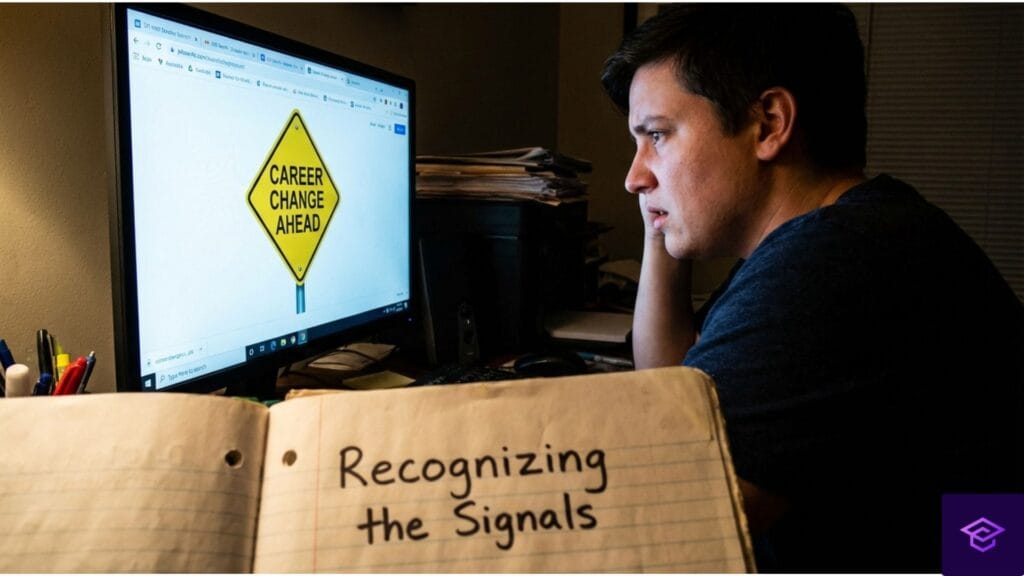
When you’re ready for a career change but ignore the writing on the wall, it will cost you far more than just happiness. Studies have found that being in the wrong career causes chronic stress, heightened risk for physical illness, damaged relationships, and even depression. But on the other hand, far from it. Because on the flip side, those who acknowledge they’re in need of a career change and actually do something about it report being much happier with their life, improved mental health, and increased earnings two to three years later.
It’s not that something is wrong with you and your career — it’s that you don’t know how to pick up on the signals or what to do next. Let’s fix that right now.
Sign #1: You Dread Monday Morning (And Tuesday, Wednesday, Thursday…)
Everyone has rough Mondays. But if you experience dread that starts on Sunday night and doesn’t let up until 5 pm Friday, that’s not just dealing with discomfort—that’s a surefire sign that you need to make a career change. This is not having a bad week or working on a hard project. This is about a lingering, low-grade anxiety that stalks you through your entire workweek.
What This Sign Means If You Need a Career Change
It’s not that people have become lazy or lost motivation and are spiraling into a state of chronic Sunday scaries. Those are your brain’s way of telling you that something is simply fundamentally out of whack. When you’ve got the wrong career, your subconscious realizes it much sooner than your conscious mind is ready to acknowledge. You may tell yourself that it’s “just a phase” or “everyone feels this way,” but you know deep inside that this cannot last.

What to Do If This Is You
Begin monitoring your energy during the week. Each day for two weeks, rate how you feel in terms of mood and energy on a scale from 1 (low) to 10 (high). If you consistently rate yourself between 3 and 5 on Monday through Thursday and above a 7 on the weekends, you are due for a career change. Do not neglect this data — it’s your body giving you plain feedback that something here is out of whack.
Sign #2: You’re Jealous of Other People’s Careers
Browsing LinkedIn and experiencing a twinge of envy at the latest from someone’s work life? That’s not FOMO — that’s yet another indication that you need a career change. Notice which kinds of roles make you feel jealous. If you hear yourself thinking “I wish I could do that” more than “I’m happy doing what I’m doing,” it’s time for a career change.
The Jealousy Test for People Who Need a Career Change
Healthy career envy is specific. You aren’t envious of everyone — you envy people in certain positions or fields. This specificity is actually helpful. It informs you about what’s lacking in your current job. When you need a career change, jealousy is typically one of the ways that your values and interests attempt to wave their arms to get noticed.

Action Step: Map Your Envy
Write down the last 5-10 times you felt career envy. What were those people doing? What industry? What skills were they using? This exercise will help you to see the patterns that tell you precisely what kind of career change to make.
Sign #3: You’ve Stopped Learning and Growing
Do you recall just how different everything seemed at the very start of your job? If it feels like those days are long gone and now you’re sort of just clocking in and out, that is a huge indicator you may need a career change. Humans are wired for growth. When we stop learning, we stop growing — and the lack of growth breeds discontent.
If you can do your job in your sleep, if there’s no challenge left, if you haven’t learned something new in more than a year — it’s time for a career change. Growth isn’t a choice when it comes to lasting career fulfillment. It’s essential.
The Growth Gap: Why You Need a Career Change When Learning Stops
When you need a career change because your career path isn’t offering the growth you want, it’s not always about an individual company, but that prospect of growth can be one factor influencing whether or not you stay with a particular employer. You’ve hit the ceiling, and there’s only one way up and out. This is particularly among people in their 30s and 40s who have a good grasp of their current role but see no way forward.

Quick Growth Assessment
Ask yourself: What new skill have I mastered in the past 12 months? If it’s “oh, nothing really,” or if you learned it on the outside because work doesn’t offer any growth opportunities, you need a career change.
Stuck in the growth gap and what to do about it? You’re not alone — and you don’t have to try to do it alone. The 6 Dimensions in CareerMIND measure your Background, Skills/Abilities, Interests, Personality, Values, and Preferences to reveal precisely the careers that give you the growth you want. AI-powered career matching that goes way beyond “take this quiz, get a job title” — for just $19/month (so less than lunch for two). Start your assessment today.
Sign #4: You’re Only There for the Paycheck
I mean, let’s be honest — we all work for money. But if money is the only thing keeping you there, that’s an issue. If someone asks what you like about your job and the first thing you think of is “the paycheck” or “the benefits,” it’s time for a new career. Yes, money matters — but it can’t be the only thing that holds you there.
Here’s why that matters: Studies have shown that beyond about $75,000-$95,000 (depending on where you live), more money doesn’t buy significantly more happiness. If you are earning good money and miserable, then what you need may be a new career more than an extra income.
The Golden Handcuffs: When You Need a Career Change But Fear Leaving
And many of those looking for a career change feel pinned down by their existing salary. They are doing well money-wise in a job they despise, and they fear they will not be able to command the same pay again. This is what’s known as the “golden handcuffs,” and it’s how millions of Americans find themselves in jobs that suck them dry.

But what most people don’t know is that if you need a career change and make a strategic shift (not a frantic leap), 40% of career changers report earning the same or more within two years. The operative is strategic quitting, not panic quitting.
Take Sarah, for example. She had a $120K corporate law job she hated. She was chasing paychecks, she felt trapped in her salary — until she realized that her misery was costing her more than any recently issued paycheck could make up for. Six months after transitioning from the law to legal consulting using CareerMIND, she is now making $115K for 30 hours a week — and surprisingly enough, loves Mondays.
Sign #5: Your Values Don’t Align with Your Work
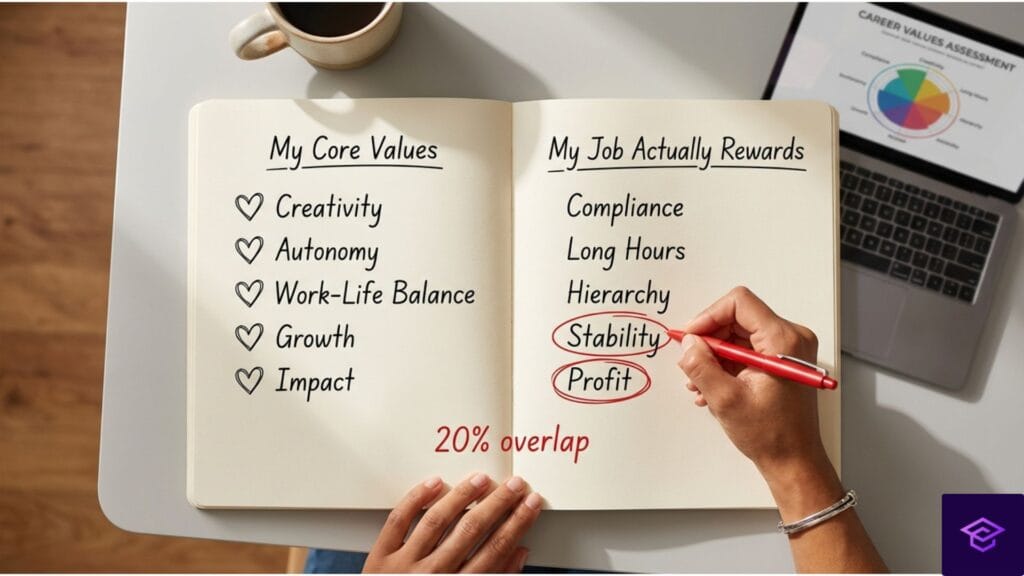
Values misalignment is one of the most painful aspects that can inspire a career change. Perhaps you believe in the importance of creativity, but work in a structure-driven, process-oriented environment. You might prioritize work-life balance, but work in a culture that worships 60-hour weeks. Perhaps you care about having an influence, but your job feels pointless.
No amount of money or status fills that gap when your core values conflict with your daily work. If you find yourself constantly feeling like you’re giving up a part of yourself to get through the workday, it’s probably time for a career change.
How to Know If Values Misalignment Means You Need a Career Change
Identify your top 5 personal values (for example: autonomy, creativity, security, impact, flexibility, and collaboration). Now, compile a list of the 5 strongest values your current occupation demands or rewards. If it’s less than 50% overlap, you should change your career. It’s that simple.
Not sure what you really value in a career? CareerMIND’s analysis digs deeper than simple personality tests to tell you what truly motivates your career satisfaction. Find out which careers match your interests for only $19/mo — less than your Netflix subscription.
Sign #6: You’re Experiencing Physical Symptoms of Job Stress
Headaches. Insomnia. Stomach issues. Chronic fatigue. If your body is deteriorating and the biggest form of stress in your life comes from work, you have to need a career change. Your health is not negotiable. So rather than the disease affecting one’s career, it suggests “what happens to a lot of people is when they need to make a change, and their body tells them that, but they don’t listen,” he explains, adding they can be left with lifelong health problems.

Stress-related health problems are reported to be costing the American worker some $300 billion a year for healthcare and missed work due to stress. If your job is making you physically ill, that does not mean you need to “toughen up” – it means you require a new career path before the damage becomes irreversible.
When Health Issues Signal You Need a Career Change
Monitor your symptoms for a month. Track when they show up (normally Sunday night through Friday), when they go away (usually Friday evening and weekends), and if there is a level of severity involved. If there’s an obvious pattern correlating to work, and your doctor has systematically ruled out other causes, you need a career change.
Sign #7: You Can’t See a Future You’re Excited About
You know when you’re asked, ‘Where do you see yourself in 5 years?’ and the honest answers are “I have no idea” or “absolutely not here”? You need a career change. It’s not a lack of ambition if you can’t imagine a future in your chosen direction; that’s just your gut warning you away from the wrong course.
If you’re not going to switch careers, most people can identify some version of growth or progress within the one they have. They may not have every fact worked out, but they can see a way ahead. If you can’t, it’s because there isn’t one — at least, not to which you adhere that bears any resemblance to who you are and who you want to be.
What to Do When You Realize You Need a Career Change
So, step one is knowing you need a career change. But what comes next? Here’s the real deal: Most people who are seeking need a career change hit a hard stop because they have no clue how to strategize taking first steps forward. Either they act on impulse and regret it, or they sit still indefinitely and forever.
One of the best ways to approach need a career change is to make it into a project with defined steps: assess your current reality, figure out what you actually want (not just don’t want), research and consider options, create a plan on how you’d get there, and finally execute while ensuring that you have some sort of safety net in place.

The Data-Driven Approach When You Need a Career Change
CareerMIND leans on a 6-Dimension model to help professionals who feel stuck in their careers to understand where exactly they should go next. Rather than taking a chance or following vague suggestions, you evaluate your background, interests, skills, values, and Preferences to discover what types of careers match who you are. It’s kind of like Netflix for your career — custom-tailored recommendations around you, not one-size-fits-all career tests.
And for just 19 bucks a month (that’s even cheaper than Netflix), you can get AI career matching that takes into account all six dimensions. Then compare that to costly career coaches who cost more than $300 per session, and still might mislead you since they’re operating on incomplete information.
Key Takeaways: What to Do If You Need a Career Change
If you saw yourself in several of the signs above, it’s time for a need a career change. Here’s your road map: First, recognize the signs instead of denying them — you’re not exaggerating, you’re being truthful with yourself. Second, decide which category is most misaligned (values, growth, health, future vision). Third, do your homework — and we don’t mean gut feeling. Fourth, draw up a timeline of transitions with milestones. Fifth, take an initial small step this week — research, networking call, skills assessment, whatever will help keep you on track.
The ones who successfully navigate career changes? Remember: they don’t wait for the perfect moment. They know they want to change careers, make a plan, and begin to act. The typical person who wants a career change takes 2-3 years to do so. Don’t be average.
Frequently Asked Questions About Needing a Career Change
How do I know if I need a career change or just a new job?
If your boss, or specific colleagues, or company culture at large is the problem, perhaps you should just find a different job in the same field! But if you are unenthused by the work itself, don’t see a future that excites you, or your values conflict dramatically with the entire industry, then you need a career change — not just a new boss to work for.
Is it too late to make a career change at 40?
Absolutely not. The typical professional changes careers between 5 and 7 times in a lifetime and makes their most successful career change at the age of 40. It’s not too late for a career change at 40, and you could be ahead of the curve since you know yourself (and what makes you happiest) better than you did when you were 25.
How long does a career change take?
For most career changers, the speed is 6-18 months from decision to new job. This consists of study (1-3 months), learning something new if necessary (3-6 months), and job hunting (3-6 months). How long it takes depends on how different your target career is from your current one.
How do I figure out what career is right for me if I need a career change?
Six fundamental dimensions to consider: Background, Interests, Personality, Skills, Values, and Preferences. CareerMIND uses AI to do this for $19/month — providing personalized career matches based on all six dimensions, not just a personality test.