Table of Contents
Introduction
If you have ever done a career personality test and thought to yourself, “Well, that was pointless,” then you are not alone. The overwhelming majority of career personality tests will tell you that you’d be a good teacher, engineer, or entrepreneur — along with about 47 other options. Really helpful, right?
Here’s the thing: Some career personality tests are grounded in 70 years of psychological research. Others were cranked out by a marketing intern over a long weekend. One gives you clarity. The other one says that you’d be a great astronaut-lawyer-chef. Can you guess which of the two you’ve been taking?
The difference? Here’s one that helps you achieve real career clarity. The others, 15 minutes of your life.
In this guide, you’ll learn what career personality tests are really all about, which ones might be worth your time, and how to actually use the results to make wise career decisions. This is your roadmap if you are a recent grad, think about a career change, or have ever asked yourself, “There has to be something better than this!”
What Is a Career Personality Test (And Why Everyone Gets It Wrong)
It is intended to pair your personality with careers that are right for you, based on your personal preferences and work style. Sounds simple, right?
And that, here, is what most people believe a career personality test is a magic crystal ball. You take the test, you get your answer, boom — problem solved.

That’s not how it works.
A good personality test doesn’t tell you what to do. It reveals patterns in how you operate, what energizes you, and what depletes you. It then recommends careers that fall under those patterns.
The Psychology Behind Career Personality Tests
The majority of respectful career personality tests follow one of the following psychological models: Big Five personality traits, Holland Codes (RIASEC), or Myers-Briggs Type Indicator (MBTI). They each do it uniquely, but they all attempt to answer one question: “What kind of work environment will make you happy?”
Here’s what a career personality test typically measures:
- How you process information and make decisions
- Whether you recharge alone or with others
- Your tolerance for structure vs. flexibility
- How you handle stress and conflict
- What motivates you intrinsically
The best career personality test won’t just label you. It’ll help you understand why certain jobs feel right, and others feel like torture.
The 5 Best Career Personality Tests (Ranked by Accuracy)
Career personality tests aren’t all created equal. Below are the ones that really work, ranked by scientific validity and usefulness.
1. CareerMIND 6-Dimension Assessment
Whereas many old-style career personality tests only measure personality, CareerMIND actually measures 6 dimensions of career fit: Background, Interests, Personality, Skills, Values, and Preferences. This holistic approach lets you see the full spectrum of your career fit, not just your personality type.
Why it works: “A lot of career personality tests don’t take into consideration what your actual skills are and the values you have. CareerMIND doesn’t. It connects you to careers based on who you are and what you can do.
Cost: $19/month (compared to $300+ for career coaching)
2. Myers-Briggs Type Indicator (MBTI)
The MBTI is likely the most well-known career personality test in existence. It types you into one of 16 personality archetypes based on four dichotomies: Introversion/Extraversion, Sensing/Intuition, Thinking/Feeling, Judging/Perceiving.
Why it works: It has been out since the 1940s and provides a baseline for your natural inclinations.
The catch: It isn’t as scientifically rigorous as some researchers would prefer, and it has a tendency to oversimplify. You’re more than four letters.
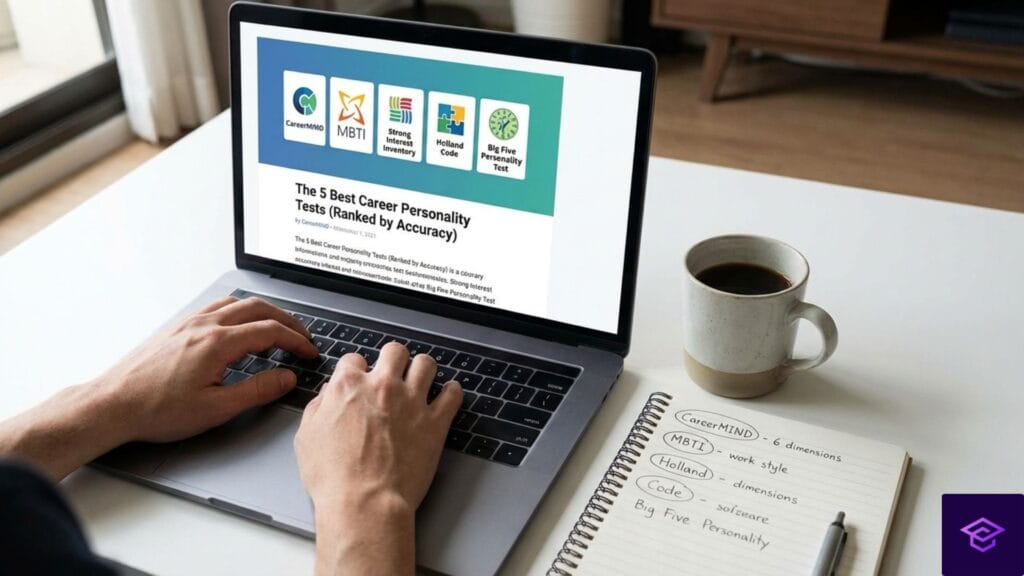
3. Strong Interest Inventory
This career test doesn’t just consider your personality traits, but also finds out what you are like using your likes and dislikes. It compares the things you’re interested in with the interests of satisfied people working in a career selected by your major.
Why it works: Shared interest in something is more important than compatible personality structures when it comes to job satisfaction.
4. Holland Code (RIASEC) Assessment
The Holland Code personality test will give you a real sense of satisfaction. Find out what type of person you are striving to become. The majority of the people are a mix of 2-3 types.
Why it works: It’s simple and research-based, and enables you to quickly eliminate very broad career categories.
5. Big Five Personality Test
The Big Five represents the dimensions of Openness, Conscientiousness, Extraversion, Agreeableness, and Neuroticism. Not exactly a career personality test, it is, however, one of the most scientifically tested and validated personality frameworks.
Why it works: This one lends you nuanced insight into your performance across various work settings.
Which Career Personality Test Should You Take?
- If you want comprehensive career matching: CareerMIND (evaluates more than just personality)
- If you want to understand your work style: MBTI or Big Five
- If you want interest-based suggestions: Strong Interest Inventory or Holland Code
Honestly? Take more than one career personality test. The patterns that show up across multiple assessments are the ones to pay attention to.
How to Actually Use Career Personality Test Results (Most People Get This Wrong)
You fill out a career personality test. You get your results. You read them, you nod along, and then… nothing much changes.
Sound familiar?
Here’s how to actually use career personality test results to make real decisions:
Step 1: Look for Patterns, Not Absolutes
Your results from a career personality test are not a prescription. They’re data points. If one test says you are introverted and another suggests that you’re extroverted, then more than likely, you’re an ambivert. Notice what is consistently showing up across the tests.
Step 2: Match Results to Real Job Descriptions
Marketing may be recommended by a personality test as “a good fit” for you. Cool. But marketing encompasses data analytics, event planning, and copywriting. Read real job descriptions and find the day-to-day responsibilities that you think line up with your personality traits.
Step 3: Test Your Results in the Real World
According to your career personality test, you would excel in creative positions. Great—now go do something creative. Freelance. Volunteer. Side project. Check reality against theory.
Real example: Marcus, 31, did the Big Five and came out high in Openness and Conscientiousness. Generic suggestion: “Try creative fields!” Not helpful. But when he cross-referenced those characteristics with his natural skills (project management) and values (stability + variety), he arrived at product management. Two years in, though, he’s going great guns — structured creative troubleshooting. That’s how you utilize the outcomes of a career personality test.
The 2-Year Test Results
Ask yourself before getting into a career personality test, induced job: “Can I see myself doing this for 2 years?”
Not 20 years. Not forever. Just 2 years.
If the answer is no, continue searching. If so, you have a promising direction.
Want to skip the guesswork? CareerMIND’s 6-Dimension assessment does the heavy lifting for you—personality, skills, values, and preferences in one place. Take the 10-minute assessment.
Common Career Personality Test Myths (Debunked)
Let’s clear up some misconceptions about career personality tests that keep people stuck.
Myth 1: “A Career Personality Test Will Tell Me Exactly What to Do”
Wrong. A career personality test reveals to you patterns and potential. You still have to actually decide. Think of it as a GPS device, he says; It helps show you the way, but in the end you’re still choosing which direction to head.
Myth 2: “Personality Tests Are Just for Young People”
Dead wrong. Career personality tests are relevant at any age. And in fact, they’re often most valuable midcareer, when you have been around long enough to know what you don’t want.

Myth 3: “If the Career Personality Test Says I’m Not a Good Fit, I Should Quit”
Hold up. Misalignment will likely show up on a career personality test, but it doesn’t mean you are messing things up. It means you’re gathering data. Use it to strategically adjust your behavior, not make wild emotional shifts.
Myth 4: “Free Career Personality Tests Are Just as Good as Paid Ones”
Sometimes yes, sometimes no. A lot of these free career personality tests are just shortened versions of the paid ones. They offer you a whiff, but not the whole picture. That said, a free Holland Code self-assessment is likely more helpful than a $500 test with no scientific basis.
The Real Value of Test
A career personality test is not a source of answers. It gives you language for what you already feel. That vocabulary will help you articulate your next job needs in a negotiation with your boss or in an interview for un autre boulot.
Career Personality Test vs. Career Assessment: What’s the Difference?
The terms “career personality test” and “career assessment” get tossed around interchangeably, but the two aren’t really identical.
It is all about you and your traits within the context of different careers. It’s one piece of the puzzle.
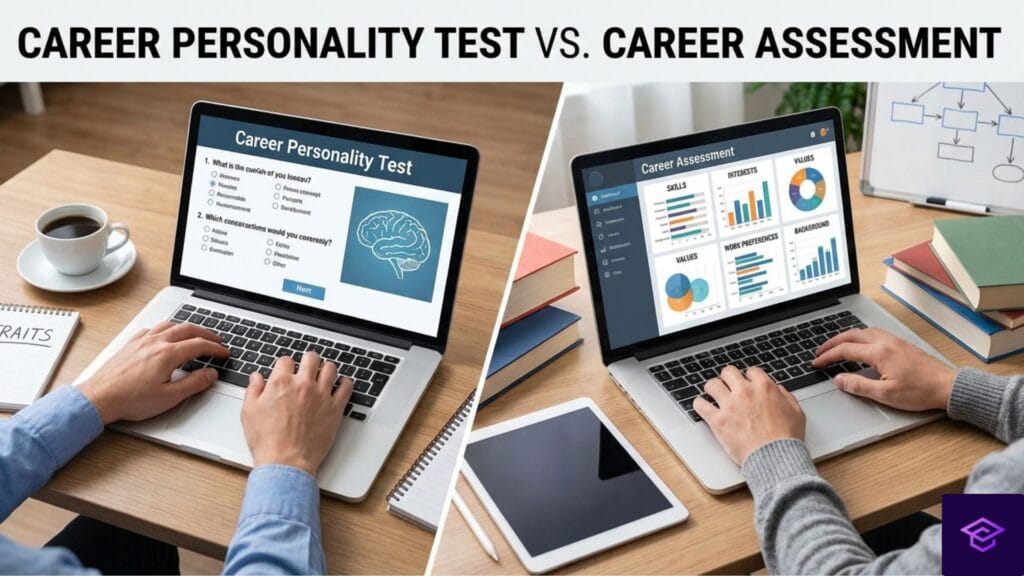
A career assessment is broader. Personality is one possibility, but so are skills, interests, values, work preferences, and background. The 6 Dimension process in CareerMIND is not just a career personality test; it is a career assessment.
Consider it this way: A career personality test explains to you how you work. A career evaluation will indicate how you operate, what you’re good at, what matters to you, and how and where you’ll be willing to work.
Which one should you take? Both. Begin with a career personality test in order to understand what you gravitate toward. Perform a comprehensive career assessment to clarify the whole picture.
How CareerMIND Goes Beyond Traditional Career Personality Tests
Most career personality tests stop at personality. CareerMIND starts there.
Here’s what makes it different: instead of just asking “What’s your personality type?”, CareerMIND evaluates six dimensions of career fit.
The 6 dimensions are:
- Background: Your education, experience, and history (data points, not limitations)
- Interests: What naturally draws you in
- Personality: How you process and interact
- Skills: What you can actually do (not just personality traits)
- Values: What matters most to you in work
- Preferences: How you want to work (remote, structured, fast-paced, etc.)

And on a typical career personality test, you might find out you’re introverted and analytical. Great. Half the world of software engineering is too, and half the accounting world. But, what do you value more: Creativity or stability? Do you want to work from home or at an office? Do you know how to code or write?
Those questions matter. CareerMIND answers them.
The result: Rather than receiving 50 nebulous career recommendations, you now receive 3-5 concrete matches that align with both who you are (or can become) and what you actually want to do — not just your personality.
When to Take a Career Personality Test (and When to Skip It)
It is valuable if you truly have an open mind about new information about yourself. It doesn’t serve you when you’re just seeking reassurance that a decision you’ve made is O.K.
Take a Career Personality Test If:
- You’re feeling stuck and don’t know why
- You’re considering a career change, but don’t know where to start
- You’re early in your career and exploring options
- You’re successful but unfulfilled and want to understand the disconnect
- You want data to back up your gut feeling about a career direction
Skip the Career Personality Test If:
- You’re just procrastinating on taking action
- You’ve already decided what you want and just need a push
- You’re looking for someone to tell you what to do
- You’re in crisis mode and need immediate income (get the job first, optimize later)
A career personality test is a tool, not a magic wand. Use it when you’re ready to act on what you learn.
What to Do After Taking a Career Personality Test (3-Step Action Plan)
You’ve taken the test. You’ve read the results. Now what?
Here’s your concrete next step:
Step 1: Document Your Top 3 Recurring Traits
Examine all of the career personality tests you have ever taken. And what is there every single time? List the 3 traits or preferences that come up most frequently. These are your non-negotiables.

Step 2: Research 5 Job Descriptions That Match Those Traits
Visit LinkedIn, Indeed , or any job board. Look for jobs that fit your persistent characteristics. Read the actual day-to-day responsibilities. Do they energize or deplete you? Pick 2-3 that genuinely excite you.
Step 3: Informational Interview with 1 Person in That Field
Track down someone in the role you’re interested in. You might ask them: “What does a typical Tuesday look like?” Here’s how to test your career test results in real life. Theory meets practice.
Don’t skip step 3. This is exactly where most people fail (and it’s also why career personality tests are so awful). The test gives you direction. You have to walk the path.
Key Takeaways: Career Personality Test Edition
Let’s wrap this up with the essentials:
- A career personality test measures how you operate, not what you should do
- The best career personality tests are research-backed (MBTI, Holland Code, Big Five, CareerMIND)
- Personality is important, but it’s not the only factor—skills, values, and preferences matter too
- Take multiple tests and look for patterns across results
- Use results as a starting point for exploration, not a final answer
- Test your career personality insights in the real world through projects, freelancing, or informational interviews
Career clarity doesn’t come from a single career personality test. It comes from combining self-awareness with real-world testing.
Ready to Find Your Career Match?
Career personality tests are useful. But they’re only the beginning.
If you’re looking to dig deeper than your personality and get matched with careers based on your full profile—your skills, values, background, interests, and work preferences—the CareerMIND’s 6-Dimension assessment is the whole enchilada.
Now, take the quiz. Get 3-5 perfect-fit career matches based on who you really are. All for $19/month — less than what you spend on Netflix and 94% cheaper than career coaching.
Frequently Asked Questions About Career Personality Tests
What is the best career personality test?
The best career personality test for you depends on why you are taking it. For a more comprehensive career match beyond personality, CareerMIND’s 6-Dimension is the most complete. People will privately and publicly (e.g., on social media, in a courtroom) try to tell you they are not, but for personality type inclusively, MBTI or Big Five have proven scientific validity. For interest-based matching, consider trying Strong Interest Inventory or Holland Code. Best way to do this: take a bunch of career personality tests and find the commonalities.
Are free career personality tests accurate?
Some are, some aren’t. Free Holland Code (RIASEC) or Big Five tests can be helpful. But most free career personality tests are poorly designed marketing tools. Seek out tests developed from sound psychological theories. It being free might also be too good to be true.
Can a career personality test tell me what job I should have?
No. A career personality test does highlight jobs that may be a good fit due to personality traits, but it cannot tell you what job you should have. Weigh your skills, values, financial needs, life circumstances, and market demand. Utilize a career personality test as an input, not the sole input.
How often should I take a career personality test?
Your basic personality doesn’t change much, so there’s no need to undergo a career-personality test every year. Retest every 3-5 years, and when confronted with a significant career decision. If the outcomes don’t sit well, it’s more sensible to test out a different assessment rather than rushing to go through the same one again.
What if my career personality test results don’t match my current job?
Don’t panic. It’s data, not the order to quit. Ask yourself: Do you feel sapped for energy or out of line with your job? If that is the case, then perhaps the career personality test isn’t telling you anything new. If you find yourself happy regardless of the mismatch, personality is only one piece. You may be making up for it through strong skills, great coworkers, or alignment in values and preferences.