Table of Contents
Introduction
Here’s a question most people never ask: What do you really need from a career? Not what would make you sound good at a dinner party. Not what your parents envisioned. What do you need? The answer lies within your career values and ignoring them is the number one reason smart, capable people end up stuck, burned out, or quietly miserable in jobs that look good on paper.
If you’ve ever got that job you thought would make you feel complete, only to find yourself back at feeling empty, your values got lost in the mix. This guide changes that. We’ll explain what career values even are, why they give you more insight into job satisfaction than salary or job title ever will, and most importantly, how to discover your career values so you can start making career decisions you’re less likely to regret.
What Are Career Values? (And Why Most People Can’t Define Them)
Career values are the core principles and needs that must be present in your work for you to feel fulfilled, motivated, and engaged. Think of them as your personal non-negotiables. They’re not skills. They’re not interested. They’re the deeper “why” behind what makes work feel meaningful — or miserable.

Examples include autonomy, creativity, financial security, making an impact, leadership, work-life balance, recognition, stability, collaboration, and continuous learning. Everyone has a unique set. And here’s the thing, your career values aren’t something you choose. They’re something you discover.
Most people have never sat down and actually defined what they need from work. They pick careers based on job availability, what they studied, or what pays well. That’s not wrong — but it’s incomplete. When these core needs aren’t met, no paycheck is big enough to make the work feel worthwhile long-term.
Career Values vs. Career Interests: What’s the Difference?
This is a distinction most career advice skips entirely. Career interests are what you enjoy doing — coding, writing, working with people, solving puzzles. Career values are why certain work environments or outcomes matter to you. You might be interested in marketing and value creativity and autonomy. Both matter. But when your values aren’t aligned, even a job you’re skilled at and genuinely interested in will start to feel hollow.
Think about it this way: a person who values independence but works in a highly structured corporate environment will eventually hit a wall — even if they’re talented and the pay is great. That friction is a values mismatch. It’s not personal failure. It’s a predictable outcome when values go unexamined.
Why Career Values Predict Job Satisfaction Better Than Salary
We’ve been sold a story: get a good salary, and you’ll be happy at work. Real talk — that’s not how it works. According to Gallup’s State of the Global Workplace report, only about 23% of workers worldwide feel engaged at their jobs. And engagement that sense of purpose and connection to your work is driven by values alignment, not compensation alone.

Once you’re earning above a baseline that covers your financial needs, additional salary has diminishing returns on happiness. But your core career values? They never stop mattering. A person whose values include impact and creativity who lands in a bureaucratic, output-only role will feel the mismatch every single day, regardless of the salary on their offer letter.
The right values are the foundation. Everything else, salary, job title, and company prestige, is the surface. Build on a cracked foundation and the whole structure wobbles eventually.
The Hidden Cost of Ignoring Your Career Values
Here’s what it really costs you to ignore your career values. It costs you years. An average person changes careers 5 to 7 times throughout their working life, and a good chunk of those transitions happen due to values mismatches that no one identified early enough.
It costs you energy. It is exhausting in a way that’s difficult to explain, but impossible to ignore, to be working against what you actually need. It manifests as Sunday dread, tuning out in meetings, and that low-level background static of “Is this really it?”
It also costs you money. Every career pivot that stems from “I just couldn’t do it anymore” rather than deliberate planning is a restart for salary negotiations, credibility rebuilding, and possibly retraining. It’s not a nice-to-have to understand your career values upfront. It’s a financial decision.
5 Warning Signs Your Career Values Are Being Violated
Not sure if this applies to you? Watch for these signals:
- You feel disengaged even when the work isn’t hard.
- You dread interactions that used to be fine, team meetings, client calls, and manager check-ins.
- You find yourself fantasizing about completely different careers, not just different companies.
- Your need for recognition, autonomy, or purpose feels consistently unmet, even though you’re performing well.
- You feel relieved — not sad — when things get canceled or delayed.
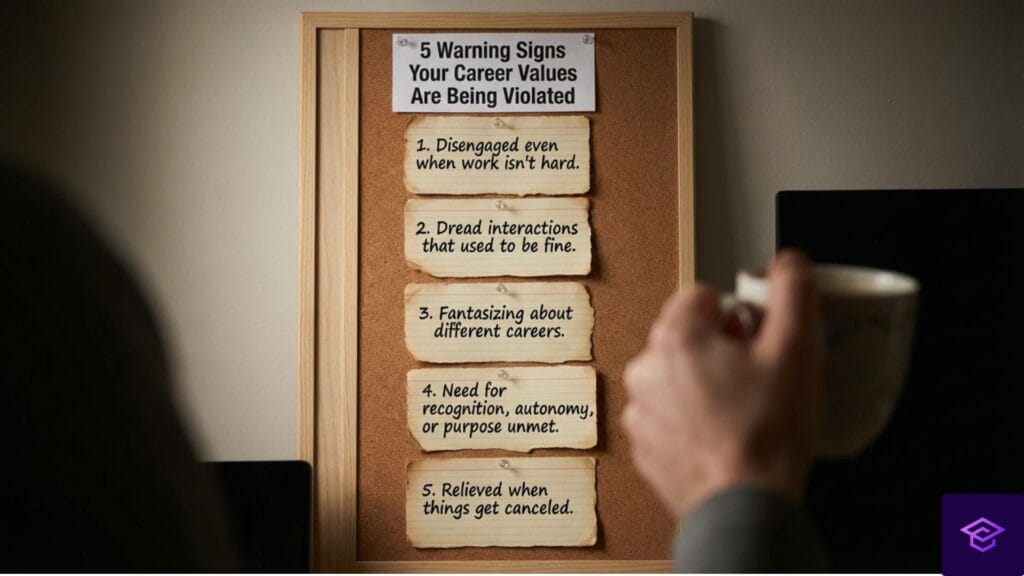
If two or more of those hit close to home, your values deserve serious attention. This isn’t about being ungrateful or dramatic. It’s data. What you need from work is telling you something. The smart move is to listen.
How to Identify Your Career Values in 3 Steps
Identifying your career values doesn’t require a therapist, a life coach, or a six-week retreat. It requires honest reflection and the right framework. Here’s a practical three-step process for getting clear fast.
Step 1 — Look at Peak Moments and Low Points
Think back across your work history and identify two or three moments when you felt genuinely energized and proud of what you were doing. Then identify two or three moments when you were most miserable or disengaged. Write them down. Now look for patterns. The energized moments reveal which career values were being met. The miserable moments show you which ones were being violated.

For example, if your best moments all involved leading a team, pitching ideas, or creative problem-solving, values like leadership, creativity, and influence are likely core to you. If your worst moments involved heavy bureaucracy, micromanagement, or repetitive tasks, autonomy and variety are probably non-negotiable for your satisfaction.
Step 2 — Use a Career Values List to Name What You Feel
Most people know something is wrong before they can articulate it. A values inventory allows you to articulate the feeling. Scan through a full list and check ones that really feel like an immediate fit. Typical categories are work environment (collaboration versus independence), impact (community, company, individuals), growth (learning, advancement, mastery), lifestyle (flexibility, stability, compensation), and purpose (meaning, mission, and legacy).
Don’t overthink it. For each of those items, your gut reaction tends to be more accurate than whatever analytical muscle you have working hard to derive what you “should” value. Circle what lights you up. Flag what makes you uncomfortable. Your career values are already in there, you’re just bringing them to the surface.
Step 3 — Prioritize Your Top Career Values
Here’s where most exercises fall apart: people end up with 20 values and no clarity. The goal isn’t to honor everyone equally. It’s to identify your top 5 to 7 career values, the ones that are truly non-negotiable for your well-being at work. These become your filter for every opportunity going forward.
Ask yourself: if I had to give this up entirely, could I still feel good about my work? If the answer is no, it’s core. If you could live without it under the right circumstances, it’s secondary. This prioritization is where your values become a decision-making tool, not just a list on paper.

Take Marcus, 34, a project manager who was great at his job but dreaded Mondays. When he mapped his peak work moments, the pattern was undeniable: every high-energy moment involved creative problem-solving with a small, scrappy team. His values around creativity and collaboration were being completely starved in a process-heavy corporate role. That one insight redirected his entire job search. He wasn’t looking for a new industry. He was looking for a different environment one that matched his career values.
Career Values and CareerMIND’s 6 Dimensions Framework
At CareerMIND, career values aren’t an afterthought. They’re one of the six core dimensions we use to match people with careers that actually fit. The 6 Dimensions framework covers Background, Interests, Personality, Skills, Values, and Preferences because fit isn’t one-dimensional. A job that aligns with your interests but violates your values will still make you miserable. A role that matches your skills but ignores what you truly need will still lead to burnout.
Our AI-powered assessment analyzes all six dimensions together, giving you a comprehensive picture of your career DNA, not just a personality type or a skills gap analysis. Career values are weighted heavily in that equation because the data backs it up: values alignment is one of the strongest predictors of long-term career satisfaction and retention.
How CareerMIND Surfaces Your Career Values
The CareerMIND assessment uses scenario-based questions and behavioral prompts designed to reveal what you need from work even when you’re not sure how to articulate it yourself. Instead of asking “what do you value?” Which most people answer aspirationally rather than honestly, our system observes patterns across your responses to surface your actual career values. The result is a match based on who you really are, not who you think you should be.
Not sure what your career values actually are? CareerMIND surfaces them for you using scenario-based questions that reveal what you actually need, not what you think you should say.
Key Takeaways: Career Values Summary
Career values are the non-negotiable needs that must be present in your work for you to feel fulfilled and engaged not skills, not interests, but the deeper “why” behind job satisfaction.
- They predict job fulfillment better than salary or title — once past a financial baseline, compensation has diminishing returns on happiness.
- Ignoring your career values costs you years, energy, and money usually all three at once.
- Your top 5 to 7 are your decision filter; use them before every job search, pivot, or negotiation.
- They evolve. Revisit your career values every few years, especially before major life or career transitions.
- CareerMIND’s 6 Dimensions framework builds values into every match because alignment is one of the strongest predictors of long-term career satisfaction.

Ready to Discover Your Career Values?
You’ve spent enough time guessing. Knowing your career values isn’t just self-reflection. It’s the foundation for every good career decision you’ll make from here on out. CareerMIND’s assessment maps your values alongside your Background, Interests, Personality, Skills, and Preferences to give you a match that actually fits. No fluff. No generic advice. Just clarity.
For $19/month, less than a single career coaching session, you get a comprehensive look at your career DNA, including a deep analysis of your career values and how they map to real career paths. Take the CareerMIND assessment today and finally know what you’re looking for before your next job search, your next pivot, or your next “is this really it?” moment.
Frequently Asked Questions About Career Values
What are career values and why do they matter?
Career values are the basic needs, such as autonomy, creativity, or impact, that must be satisfied in your work for you to feel fulfilled. They matter because they are better predictors of job satisfaction than salary or title. Work is meaningful when your role aligns with what you value in a career. Without them, even a lucrative job only feels hollow.
How do I find my career values?
Review your best and worst work experiences and look for patterns in what was present or missing. Then use a career values list to name what you feel and narrow it down to your top 5 to 7 non-negotiables. The CareerMIND assessment makes this faster using scenario-based questions that surface your true values without the guesswork.
Can career values change over time?
Yes and they will. In your 20s, values around growth and adventure tend to dominate. By your 30s and 40s, stability, impact, and work-life balance usually rise to the top. Revisit your career values before any major career transition to make sure your decisions reflect who you are now, not who you were five years ago.
What’s the difference between career values and work preferences?
Career values are what you need to feel fulfilled creativity, autonomy, and impact. Work preferences are more surface-level remote vs. in-office, big team vs. small. Both matter, which is why CareerMIND’s 6 Dimensions framework treats them as separate inputs. Confusing the two leads to poor career decisions.
How do career values relate to career change decisions?
They’re your best diagnostic tool. If your career values around creativity, autonomy, or impact are chronically unmet, that’s a signal to explore a change. If they could be met in a different role at your current company, a full career change may not be necessary. Know your career values first, then decide.