Table of Contents
Introduction
67% of professionals report feeling trapped in the wrong job. And they’re all sitting on a goldmine that they can’t see.
That’s the real problem. Not a lack of experience. Not the wrong degree. Not bad timing. The catch is that no one ever showed you how to spot transferable skills — the talents you’ve already developed that employers across dozens of industries desperately want, today.
This guide changes that. Seven proven steps. Zero fluff. By the end, you’ll know precisely how to recognize transferable skills, articulate them in a way that sticks, and construct an industry-change strategy around what you already possess.
Unsure what jobs match your abilities? In just 10 minutes, the CareerMIND assessment maps your 6 Dimensions and reveals your best-fit roles.
What Are Transferable Skills and Why Does Knowing How to Identify Them Matter?
Transferable skills are abilities you’ve built in one context that apply directly to another. They’re not tied to a specific job title or industry. They move with you. When you know how to identify transferable skills, you stop seeing yourself as “just a teacher” or “just a customer service rep” and start seeing yourself as someone with a powerful, portable skill set that employers across dozens of industries actively want.

According to the U.S. Bureau of Labor Statistics, the average person holds 12 or more jobs over their career — meaning the ability to identify transferable skills and articulate them clearly isn’t a nice-to-have. It’s a career survival skill. Especially in 2026, with industries evolving fast and AI reshaping entire fields, companies are actively recruiting people who bring fresh perspectives combined with solid foundational abilities. Knowing how to identify transferable skills is what makes you visible in that process — and what separates candidates who get callbacks from those who don’t.
The problem is that most people have no system for how to identify transferable skills. They either undersell themselves completely or they list vague buzzwords like “good communicator” without being able to back it up. This guide fixes that. By the end, you’ll know exactly how to identify transferable skills, name them, rank them, and turn them into a career change strategy that actually works.
Why Transferable Skills Are the Foundation of Every Career Change
Think of your transferable skills as your career DNA. They don’t disappear when your job title changes. They compound over time. And once you know how to identify transferable skills properly, you’ll realize they’re often worth more than formal credentials — because you can demonstrate them with real proof, not just a certificate on a wall. That’s the real power of learning how to identify transferable skills: it turns your past into your strongest asset.
How to Identify Transferable Skills: 7 Steps That Actually Work
Seven steps. That’s all it takes to go from “I don’t know what I’m good at” to a career-change-ready skills profile. Here’s the complete framework for how to identify transferable skills at any career stage — whether you’re 22 or 52, one job in or ten.
Step 1 — Audit Everything You’ve Done, Not Just Your Official Job
The first step in how to identify transferable skills is casting a wider net than most people do. When most people seek transferable skills, they only look to their formal work history. That’s too narrow. Your transferable skills exist everywhere — and if you only look at your official job description, most of them will slip by you.
Consider every job you’ve had, even the “irrelevant” ones. Consider volunteer jobs, side projects, freelance work, student organizations, sports teams, and caregiving. All of that counts. The point of this first step, when it comes to figuring out which transferable skills you have, is that everything needs to come up. You can filter later. At this moment, volume is the answer.

Get out a notebook, and respond to these prompts: What problems did I solve? What do people depend on me for? What did I take ownership of that wasn’t mine, technically? What was I teaching other people how to do? This is the starting point for everything that comes next, and the answers are where your transferable skills are hiding.
Step 2 — Sort Your Transferable Skills Into Categories
Once you’ve got your raw list, the next step in how to identify transferable skills is to organize what you’ve found. Transferable skills generally fall into these six buckets — and tagging each one helps you see the full picture of what you actually bring:
Communication — writing, presenting, active listening, negotiating, storytelling, explaining complex ideas simply.
Leadership — delegating, motivating teams, making decisions under pressure, managing conflict, and coaching others.
Analytical — research, data interpretation, spotting patterns, troubleshooting, strategic planning.
Organizational — project management, prioritization, time management, process improvement, meeting deadlines.
Technical — software, tools, platforms. Many are cross-industry: Excel, CRM systems, design tools, and basic coding.
Interpersonal — relationship building, collaboration, cultural sensitivity, customer service, empathy.
Go through your raw list and tag each transferable skill with a category. This is one of the most clarifying steps in how to identify transferable skills — because when you can see your transferable skills organized by type, you’ll realize you’re not starting from zero. You’re starting from somewhere genuinely solid.
Step 3 — Name Your Transferable Skills the Right Way
This is where the bulk of people lose points without realizing it. Or, you’ve begun to identify one or more transferable skills — but you’re calling them the wrong thing, and it’s costing you every single time you apply for a job.”
“I am a people person” is not a transferable skill. “Good communicator” is not a transferable skill. Those are vibes. Nobody hires a vibe. It’s a simple formula for how to identify transferable skills that translate onto a resume: what you did + who or what it impacted + the result.
This is what it looks like in practice:
“Good at communication” -> “Wrote weekly updates for 60-person department, decreasing meeting time by 30%.”
“Organized” -> “Managed a 12-week product launch across 4 departments with zero missed deadlines.
“Team player” — “Partnered with engineering and design to deliver a feature which reduced customer support tickets by 22%.”
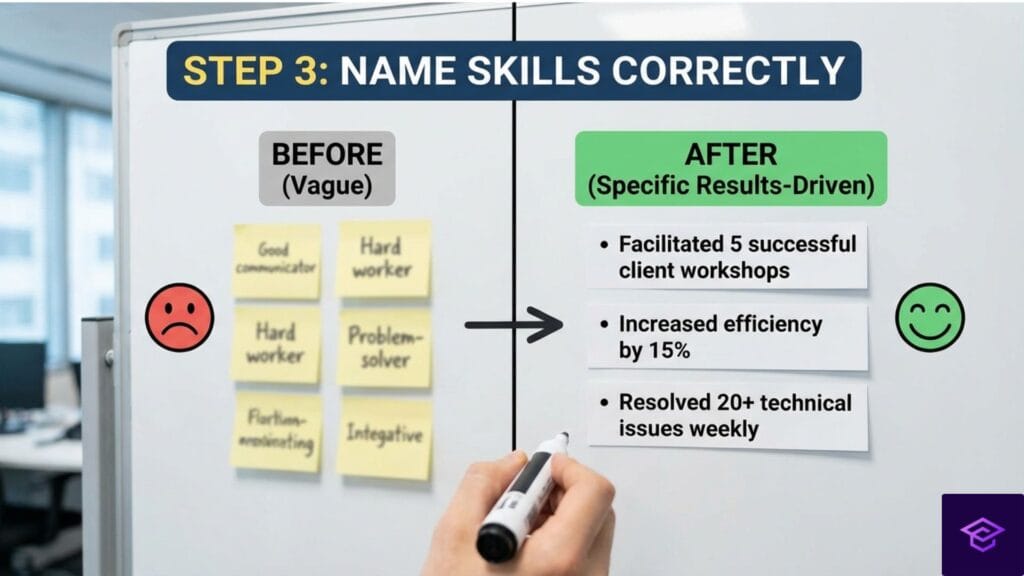
Do this with every transferable skill on your list. That’s the difference between a transferable skill that gets lost on a résumé and one that puts a hiring manager’s scrolling on pause. Getting the articulation of your transferable skills correct is non-negotiable — it’s what makes them real to a person who hasn’t met you.
Step 4 — Match Your Transferable Skills to Real Job Postings
This is where how to identify transferable skills gets genuinely exciting — because this is where you realize just how qualified you already are.
Take three or four job postings in the field you’re targeting. Read through the core requirements carefully — not the “preferred” list, just what’s non-negotiable. What transferable skills keep appearing across multiple postings?
Now compare those patterns to your categorized, properly named transferable skills. Most people match 60 to 80 percent of core requirements without realizing it, because they’ve been naming their transferable skills incorrectly or not giving themselves credit at all. Matching your transferable skills to job postings is also the fastest way to identify gaps — transferable skills you haven’t fully developed yet — so you can address them before your next application.
Step 5 — Rank Your Transferable Skills by Relevance and Energy
Not all transferable skills are created equal — not for your target role, and not for you personally. Just because you’re good at something doesn’t mean you should build a career around it.
Rate each transferable skill on two scales: how good you are at it (1–5) and whether it gives you energy or drains it (+ or –).
| Transferable Skill | Ability (1–5) | Energy (+/–) | Use as Pivot Anchor? |
|---|---|---|---|
| Communication / Writing | 4 | + | ✅ Yes |
| Data Analysis | 3 | + | ✅ Yes |
| Project Management | 5 | + | ✅ Yes |
| Budget Management | 4 | – | ❌ No |
| Public Speaking | 3 | – | ❌ No |
| Training / Coaching | 5 | + | ✅ Yes |
| Reporting / Documentation | 4 | – | ❌ No |
| Relationship Building | 4 | + | ✅ Yes |
Step 6 — Test Your Transferable Skills With Real Conversations
This step is uncomfortable. Do it anyway.
Pick three to five people who’ve worked with you — a former manager, a colleague, a client — and ask them one question: “What do you see as my strongest professional strengths?” Don’t lead them. Don’t prompt them with your transferable skills list. Just listen.

What comes back will almost always surprise you. People consistently underestimate their own transferable skills in exactly the areas others rely on them most. Those gaps between how you see your transferable skills and how others experience them? That’s your most valuable data. It’s the content of your resume, your LinkedIn summary, and your first interview answer. Use it.
Step 7 — Build Your Transferable Skills Narrative
Individual transferable skills are useful. A coherent narrative built around them is what actually gets you hired.
Hiring managers aren’t just looking for a list of transferable skills. They’re trying to answer one question: will this person solve my problem? Your job is to connect your transferable skills into a clear story with three parts: where you’ve been (the experience that built these transferable skills), what you’re great at (specific transferable skills with proof), and where you’re going (why this role makes sense as your next move).
When you can tell that story in under two minutes — in an interview, on LinkedIn, or in a cover letter — you stop being a career changer who needs to be convinced and start being a candidate who brings something genuinely hard to find. That’s the full payoff of learning how to identify transferable skills. Not the list. The story of the list becomes.
The 6 Dimensions Framework: A Smarter Way to Identify Transferable Skills
At CareerMIND, we’ve developed a 6-Dimension framework specifically to help people identify transferable skills more systematically. The 6 Dimensions — Background, Interests, Personality, Skills, Values, and Preferences — give you a complete picture of who you are professionally. Not just your transferable skills in isolation, but how they connect to the kind of work that would actually fulfill you long-term.
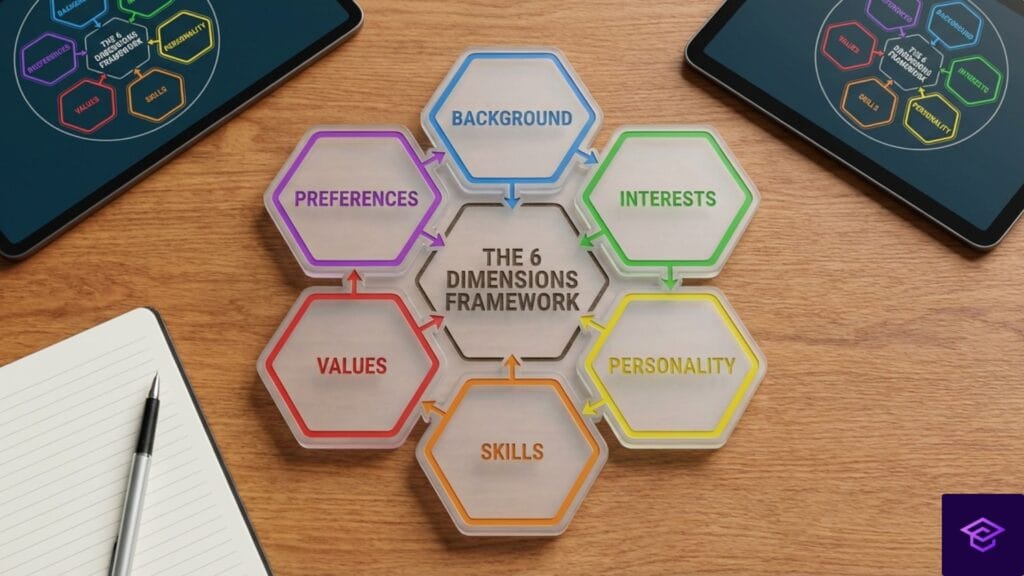
Most tools only help you identify transferable skills on the surface level. They give you a list. They don’t tell you which transferable skills to lean into, which industries those skills translate to best, or whether those roles align with your values and preferred work style. That’s the gap the 6 Dimensions closes.
Take the CareerMIND assessment at CareerMIND dot app — get your 3–5 best-fit career matches in about 10 minutes.
Why Single-Dimension Assessments Fall Short When You Try to Identify Transferable Skills
Traditional personality tests like MBTI tell you what type you are. Generic job quizzes tell you to “follow your passion.” Career coaches — at $300 to $500 a session — walk you through their own frameworks, which may or may not be backed by data. None of that gives you a complete, actionable picture of your transferable skills or how to use them strategically.
When you’re trying to identify transferable skills in a way that actually leads to a better career, you need to understand not just what you can do, but what you genuinely want to do and what environments bring out your best work. That’s what the 6 Dimensions framework is built for — and it’s why CareerMIND at $19/month is a fundamentally different kind of tool for anyone serious about how to identify transferable skills and act on them.
Most Valuable Transferable Skills Right Now
Here are the transferable skills employers across industries are actively seeking in 2026, with examples of how to identify them in your own experience. Run through this list as a final check after completing the 7-step framework — you may spot transferable skills you haven’t credited yourself for yet.
Project Management — Have you coordinated moving parts, people, and deadlines to get something done? That’s a transferable skill, whether the title said so or not.
Data Analysis — Have you tracked numbers, spotted trends, or used information to make decisions? Even basic Excel, combined with logical thinking, qualifies as a transferable skill here.
Content Creation — Written reports, training materials, proposals, or social content? Content creation is one of the most in-demand transferable skills across industries right now.
Sales and Persuasion — Convinced stakeholders, enrolled clients, or persuaded your team to adopt a new idea? Persuasion is a transferable skill that goes everywhere.
Customer Success — Managed relationships, resolved complaints, or helped people get results? Customer-facing experience is a transferable skill that translates to hundreds of industries.
Training and Coaching — Onboarded new hires, mentored colleagues, and ran workshops? The ability to develop others is an extraordinarily valuable transferable skill as companies scale.
The Goal Isn’t a Complete List of Transferable Skills — It’s the Right Five to Seven
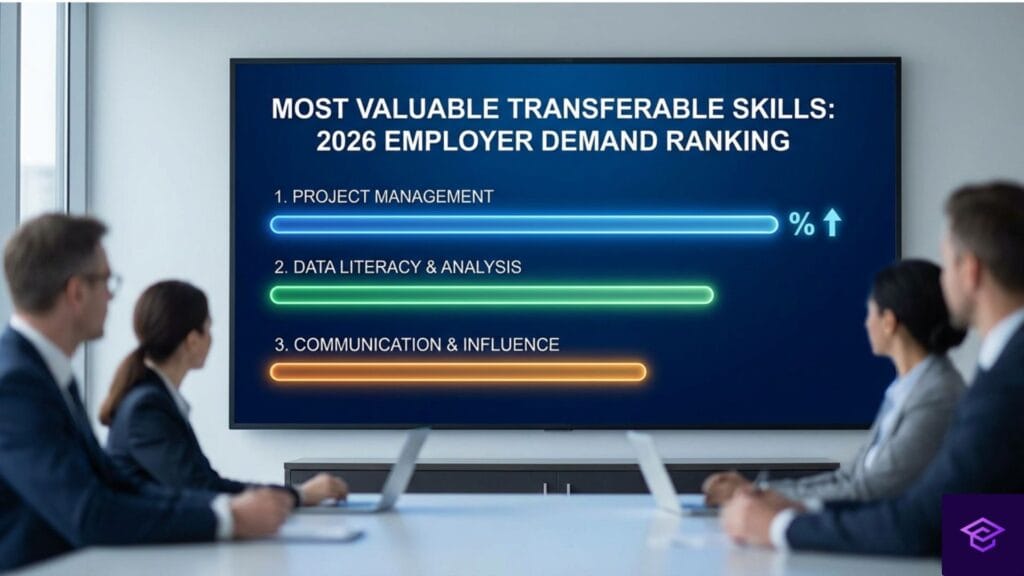
Don’t try to identify every transferable skill you’ve ever had. When you figure out how to identify transferable skills strategically, you learn to filter ruthlessly. Identify the five to seven transferable skills most relevant to where you want to go and build your narrative around those. Quality over quantity, every single time.
Key Takeaways: How to Identify Transferable Skills
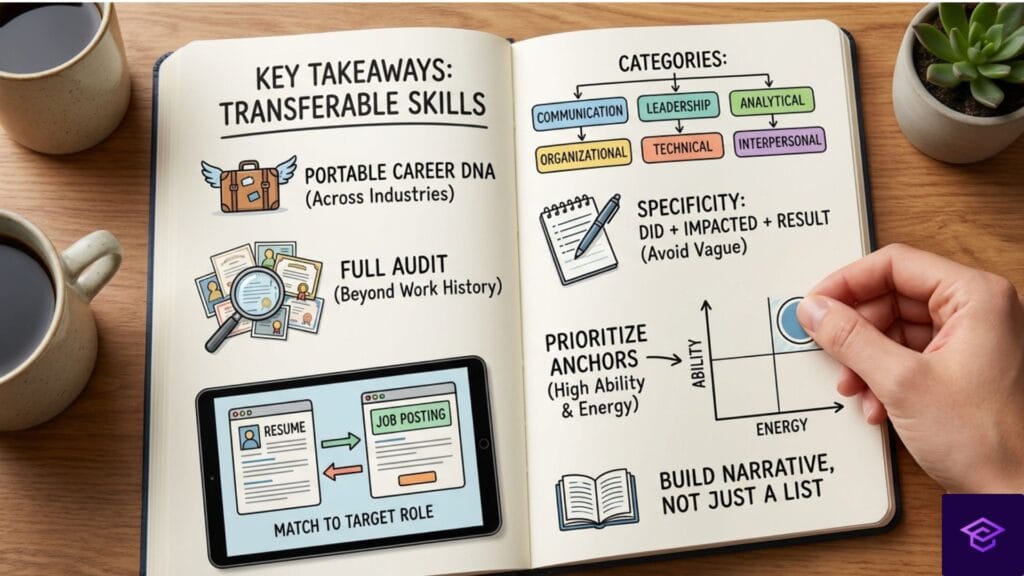
- Transferable skills are portable abilities that move with you across industries and roles — they’re your career DNA.
- Learning how to identify transferable skills is one of the highest-leverage career investments you can make — start with a full audit, not just your official work history.
- Sort your transferable skills into six categories: communication, leadership, analytical, organizational, technical, and interpersonal.
- Name each transferable skill with specificity: what you did + who it impacted + the result. Vague language kills transferable skills on a resume.
- Match your transferable skills to real job postings to see how much you already bring to your target role.
- Rank transferable skills by both ability and energy — prioritize those that score 4–5 AND give you energy. Those are your pivot anchors.
- Build a narrative around your transferable skills, not just a list. The story is what gets you hired.
Ready to Put Your Transferable Skills to Work?
Knowing how to identify transferable skills is step one. Using them strategically to land the right career is step two. And that’s where most people get stuck — they’ve done the work to identify transferable skills but don’t know where those skills actually lead.
CareerMIND’s 6 Dimensions assessment does the heavy lifting for you. In about 10 minutes, it analyzes your background, transferable skills, values, personality, interests, and preferences to match you with careers that actually fit — not just careers that use your transferable skills, but careers where you’ll genuinely thrive.
All for $19/month. Less than a Starbucks run every week.
Start your assessment today at CareerMIND dot app and get your career matches in under 10 minutes.
FAQ: Common Questions About How to Identify Transferable Skills
What are the most common transferable skills employers look for?
The most in-demand transferable skills right now are communication, project management, data analysis, leadership, adaptability, and customer service. These appear across nearly every industry in 2026. When you identify transferable skills in your background, start with these six categories first — you likely have more than you think.
How do I identify transferable skills if I’ve only ever had one job?
One job still contains a full set of transferable skills. List every problem you solved, every person you influenced, every process you improved. Volunteer work and life experience count too. The transferable skills are there — the audit framework in Step 1 of this guide will surface them.
Can volunteer work count as transferable skills?
Yes — volunteer experience is one of the most underused sources of transferable skills. Coordinating events, managing people, fundraising, training others — all of these build real, marketable, transferable skills. If it required effort, communication, or leadership, it counts.
How do I know which transferable skills to highlight for a career change?
Read 10 job postings in your target field. Note what appears consistently. Match those patterns to your transferable skills list. Lead with relevance, not pride — the Step 5 energy-ranking framework in this guide helps you identify which transferable skills to put front and center.
What’s the difference between hard skills and transferable skills?
Hard skills are role-specific — coding, financial modeling, and surgical technique. Transferable skills are portable — communication, analysis, and project management. Most hard skills contain transferable elements: a teacher’s curriculum design is a transferable skill in instructional design. Knowing how to identify transferable skills means seeing the underlying capability, not just the job title.