Table of Contents
Introduction
Most people have no idea how to identify their hidden skills. And honestly? That’s not their fault. Here’s a stat that should bother you: according to Gallup, 85% of employees worldwide are disengaged at work. Not just bored — disengaged. Checked out. Going through the motions. And the biggest reason? They’re in roles that don’t actually use what they’re best at.
We’re taught to list the obvious stuff on a resume — the degrees, the job titles, the software we know. But the abilities that actually make you valuable? The ones that separate you from everyone else applying for the same job? Those are your hidden skills — and most people never stop to find them. Learning how to identify your hidden skills is one of the most underrated moves you can make for your career. Because once you see them clearly, everything changes.
In this guide, you’ll learn exactly how to identify your hidden skills, which self-assessment methods actually work, why these overlooked strengths matter more than ever in 2026, and how to turn them into career clarity — fast.
Why Most People Struggle to Identify Their Hidden Skills
Here’s the thing — humans are terrible at seeing their own value.
It’s called the Dunning-Kruger effect in reverse. The strengths you use effortlessly every day feel so natural that you assume everyone can do them. So you never think to list them. Never think to mention them in an interview. Never think to build a career around them.
That’s exactly why learning how to identify your hidden skills requires stepping outside your own head. Most people go their entire careers without ever doing this work. And it costs them — badly.

Think about it. The person who naturally calms down every heated meeting doesn’t write “conflict resolution specialist” on their resume. The one who spots patterns in messy data and turns them into simple explanations doesn’t call themselves an analytical thinker. But those are real, valuable, transferable abilities — the kind employers are actively searching for.
67% of professionals say they feel stuck in the wrong career. When you don’t know how to identify your hidden skills, you end up in roles that feel like a constant uphill battle. The good news? These overlooked strengths don’t disappear. They just wait to be found.
The Cost of Not Knowing Your Hidden Skills
When you can’t identify your hidden skills, you make career decisions based on incomplete information. You chase job titles instead of fit. You take roles based on salary instead of strengths. And you end up stuck — successful on paper, empty in practice.
That 67% figure tracks hard. When you don’t know what you’re actually great at, you can’t make smart moves. You just react to whatever opportunity shows up. Learning to identify your hidden skills breaks that cycle entirely.
How to Identify Your Hidden Skills: 6 Proven Methods
Okay. Let’s get practical. Here’s how to identify your hidden skills starting today — no career coach required.
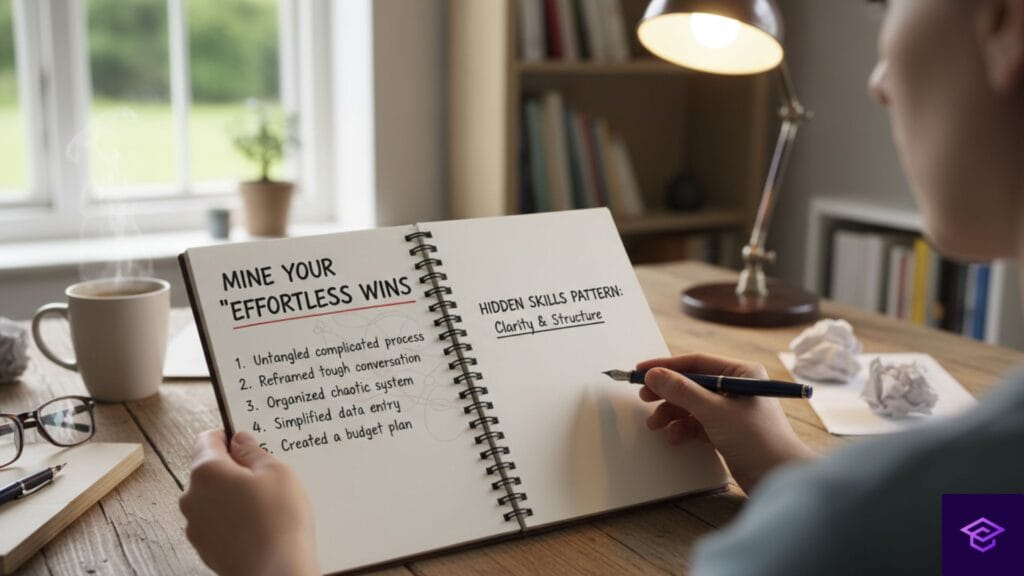
Method 1: Mine Your “Effortless Wins”
Think about the last time someone asked for your help — and it felt almost too easy. Maybe you untangled a complicated process for a coworker. Maybe you helped a friend reframe a tough conversation. Maybe you organized something chaotic into a system that actually worked.
Those moments are gold. When something feels easy to you but hard for others, that’s a natural strength worth paying attention to.
Grab a notebook and write down five times in the past year when you helped someone with something that felt natural to you. Look for the pattern. That pattern is how to identify your hidden skills in the most honest way possible.
Method 2: Ask Three People Who Know You Well
This one feels uncomfortable. Do it anyway.
Ask three people — a coworker, a friend, a family member — this exact question: “What do you think I’m unusually good at? Like, what do I do that you couldn’t easily do yourself?”
Their answers will surprise you. Every time.
These abilities stay invisible because we can’t see them in ourselves. Other people can. This method alone is worth the awkward text message.
Not sure what to do with what you hear? CareerMIND’s 6 Dimensions assessment turns that outside feedback into a structured career profile — for $19/month. Most people wait months to get this kind of clarity. You can have it in 20 minutes.
Method 3: Look at What You Do for Free
What do you do when nobody’s paying you and nobody’s watching?
Do you reorganize spaces? Teach people things? Build systems? Write? Coach friends through decisions? Analyze why things went wrong?
What you choose to spend time on voluntarily tells you a lot about your hidden skills. The things you do for free come from somewhere deep — not obligation, not performance. Those are your real abilities. And they’re often the clearest signal of where your strongest capabilities actually live.

Method 4: Track the Complaints You Never Make
Here’s a counterintuitive one. Most people complain when they’re doing things that drain them. So flip it — what do other people complain about that you genuinely don’t mind?
“I hate presenting to groups.” You love it. “Spreadsheets make my head hurt.” You find them satisfying. “I can’t deal with ambiguity.” You thrive in it.
The stuff that doesn’t bother you is where your hidden skills live. This is a fast, underused technique that most career guides completely miss when teaching you how to identify your hidden skills.
Method 5: Use a Multi-Dimensional Assessment
Look — self-reflection only gets you so far. At some point, you need a structured framework that actually maps your full picture.
That’s exactly what CareerMIND was built for. Instead of a one-dimensional personality quiz, CareerMIND uses 6 Dimensions to help you identify your hidden skills with precision: Background, Interests, Personality, Skills, Values, and Preferences. Together, those six layers reveal your career DNA — including the capabilities you’ve been sitting on without realizing it.
It takes about 20 minutes. It costs $19/month. And it does what three therapy sessions and five self-help books can’t — it shows you specifically where your strengths map to actual career paths.

Method 6: Review Your Peak Performance Moments
Think back to the moments in your career — or even school, or volunteer work — when you felt genuinely in the zone. Not just performing, but flowing. Time disappeared. The work felt meaningful and energizing.
Write down five of those moments. Then ask: what ability was I using in each one?
A teacher who realizes every “in the zone” moment involved breaking down a complicated idea for a student — that’s a communication hidden skill. A project manager whose best moments were all about spotting a risk before anyone else saw it coming — that’s an analytical strength hiding under a job title.
You’ll start to see overlap. That overlap is the core of how to identify your hidden skills. It’s not random — it’s a pattern pointing directly at what you do best.
Self-Assessment Methods That Actually Help You Find Hidden Skills
Most people skip structured self-assessment entirely. Big mistake. Because when you try to identify your hidden skills through guesswork alone, you miss the ones hiding in your blind spots — which are usually the most valuable ones.
Here are the self-assessment methods that consistently surface overlooked strengths that other approaches miss.
The Skills Inventory Method
Grab a blank sheet and split it into three columns: Things I Do Well, Things That Energize Me, and Things Others Ask Me For. Fill each column without filtering yourself — just write. Where all three columns overlap is almost always where your most powerful hidden skills live.
This method works because it separates competence from enjoyment from demand. You need all three for an ability to be truly career-defining. A strength you’re great at but hate using isn’t the one to build a career on.
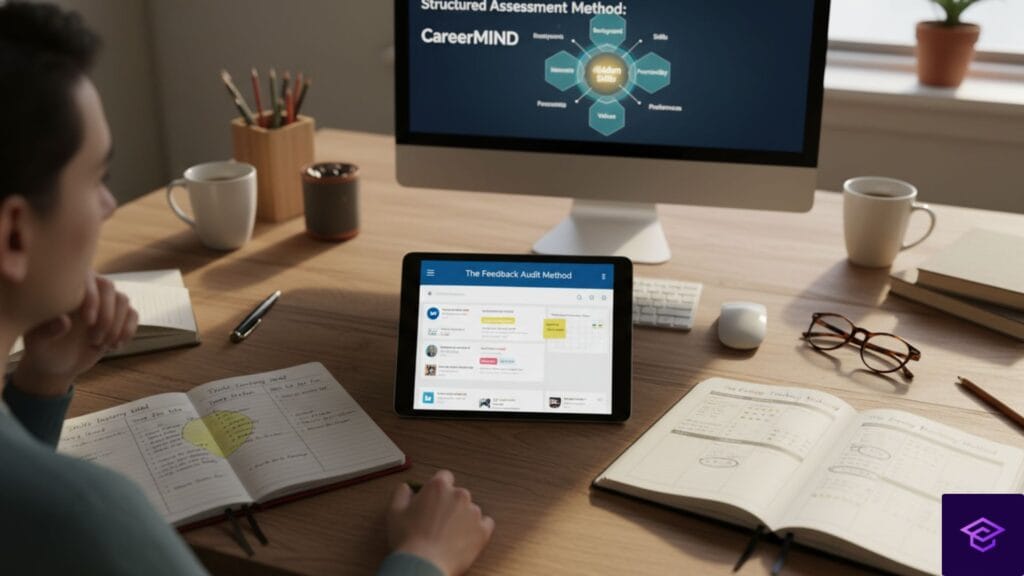
The Feedback Audit Method
Go back through every performance review, LinkedIn recommendation, thank-you email, or compliment you’ve received in the past three years. Look for repeated themes. What do people praise you for again and again?
Most people read feedback and forget it. But patterns in feedback are a direct map to hidden skills that other people already recognize in you — even when you don’t see them yourself. This is one of the most underused self-assessment methods for how to identify your hidden skills with real objectivity.
The Energy Tracking Method
For one week, keep a simple log. After each task or meeting, rate your energy on a 1-5 scale. Did it drain you or fuel you?
At the end of the week, look at everything that scored a 4 or 5. Those high-energy activities are almost always connected to your hidden skills. The work that fires you up is the work your brain is wired for. It’s not a coincidence — it’s a signal.
The Structured Assessment Method
Self-assessment methods work best when paired with a structured framework. That’s where tools like CareerMIND come in. The 6 Dimensions assessment doesn’t just ask what you’re good at — it maps your Background, Interests, Personality, Skills, Values, and Preferences against each other to surface your hidden skills in full context.
Most personality tests tell you who you are. CareerMIND tells you where your strengths belong. That’s a fundamentally different — and more useful — outcome. At $19/month, it’s the most cost-effective structured self-assessment method available for career clarity.
The 6 Types of Hidden Skills Most People Don’t Recognize
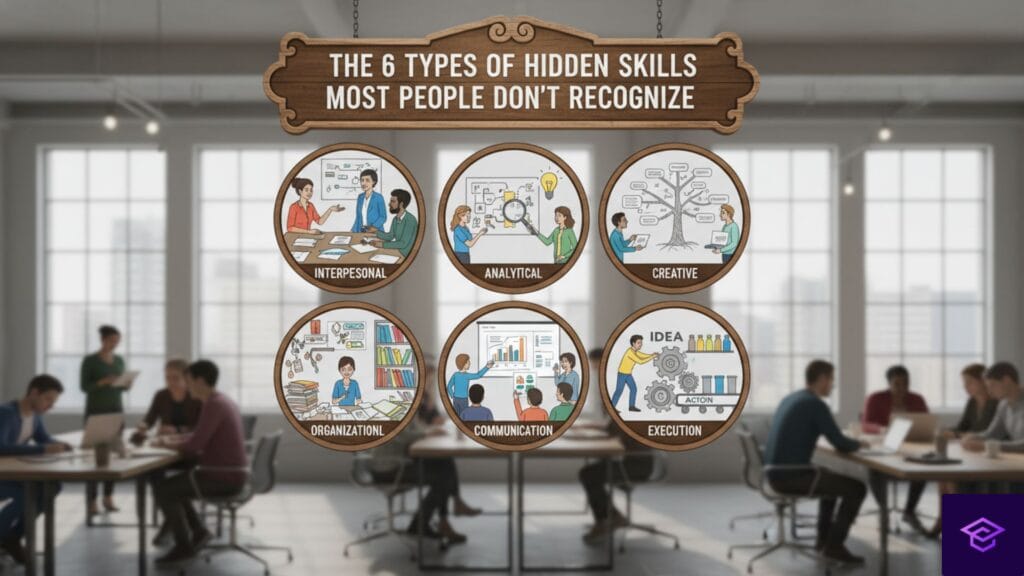
When you’re learning how to identify your hidden skills, it helps to know what categories they fall into. Most of these overlooked abilities fit into one of six buckets.
Interpersonal hidden skills — Reading a room, diffusing tension, making people feel heard. These are massively undervalued and incredibly rare. Think: the person everyone calls before a tough conversation.
Analytical hidden skills — Spotting patterns, connecting dots between unrelated information, seeing what’s missing from a plan. Think: the person who asks “but what about X?” and turns out to be right every single time.
Creative hidden skills — Not just art. This category includes reframing problems, generating unusual solutions, and thinking sideways when everyone else is thinking straight. Think: the person who finds the third option nobody else saw.
Organizational hidden skills — Building systems, creating order from chaos, managing complexity without breaking a sweat. Think: the person who joins a chaotic project and makes it make sense within a week.
Communication hidden skills — Explaining complicated things simply, writing clearly, adjusting your message for any audience. Think: the person asked to “translate” every technical meeting for the rest of the team. This is one of the most valuable hidden skills in any industry.
Execution hidden skills — Actually finishing things. Following through. Translating ideas into action. Think: the person everyone relies on to actually make things happen. In a world full of big talkers, this kind of ability is career gold.
Which Category Fits You?
Most people have strengths across two or three of these categories. Figuring out which ones apply to you is a major step toward understanding where you’ll thrive professionally.
CareerMIND’s 6 Dimensions framework maps directly to these hidden skill types — because your Background, Interests, Personality, Skills, Values, and Preferences all reveal different layers of what you’re actually capable of. It’s $19/month to access the full assessment — less than most people spend on lunch twice a week.
How to Turn Your Hidden Skills Into Career Direction
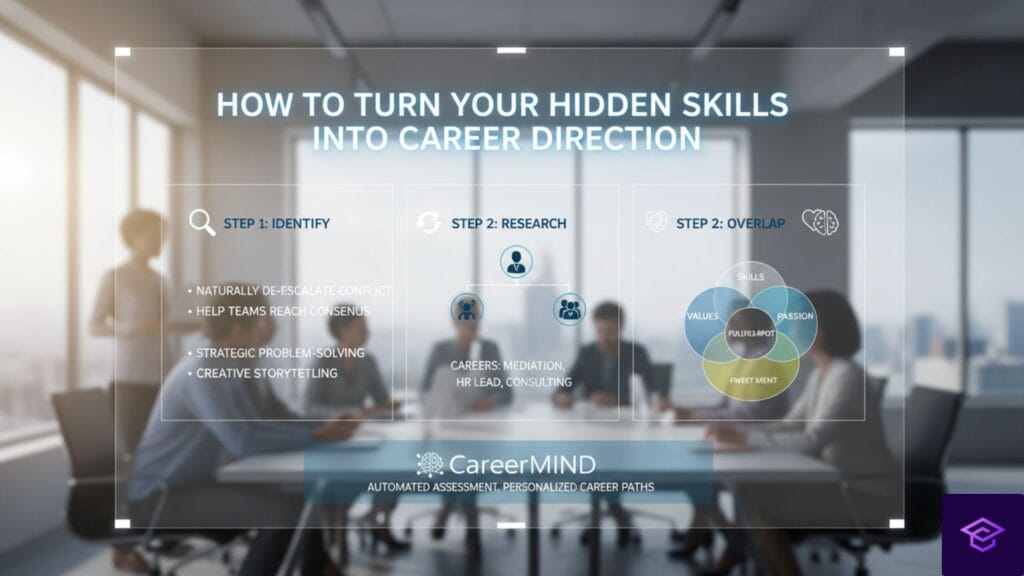
Identifying your hidden skills is step one. Step two is knowing what to do with them.
Here’s a simple framework to put them to work:
First, list the strengths you’ve uncovered. Be specific. Not “I’m good with people” — say “I naturally de-escalate conflict and help teams reach consensus.”
Second, research careers that actually rely on those abilities at their core. Not as a nice-to-have. At their core. If your strongest capabilities aren’t central to the role, you’ll end up underutilized again.
Third, look for the overlap between your hidden skills and your values. Talent without meaning doesn’t lead to fulfillment. The sweet spot is where what you’re great at intersects with what you actually care about.
CareerMIND does all three of these steps automatically once you complete the assessment. The platform takes your profile data and maps it against thousands of career paths — ranked by how well they fit your full 6 Dimensions picture.
Why Hidden Skills Matter More in 2026
AI is automating a lot of the obvious stuff. The technical tasks, the routine workflows, the rote analysis. What it can’t automate? Hidden skills. The ability to read a room, build trust, create meaning, or solve a problem nobody’s ever faced before.
Employers in 2026 are actively hunting for people who know their hidden skills and can articulate them. The job market is shifting fast. The people who win are the ones who know exactly what they bring to the table — including the stuff that doesn’t show up on a traditional resume.
A Note on Hidden Skills and Career Changing
If you’re thinking about switching careers, learning how to identify your hidden skills is non-negotiable. Because the whole point of a career change is that your current role doesn’t use your best abilities. Your hidden skills are exactly what transfers. They’re the bridge between where you are and where you want to be.
Key Takeaways: How to Identify Your Hidden Skills
Learning how to identify your hidden skills is one of the highest-leverage things you can do for your career.
- Hidden skills feel effortless to you — and rare to everyone else.
- Identify your hidden skills by mining effortless wins, asking trusted people, and using structured self-assessment methods.
- Six categories: interpersonal, analytical, creative, organizational, communication, execution.
- Use self-assessment methods: Skills Inventory, Feedback Audit, Energy Tracking.
- CareerMIND maps your hidden skills to real careers — for $19/month.
Ready to Identify Your Hidden Skills and Find the Career That Fits?
Strengths you’ve never been paid fairly for. Hidden skills you’ve never put on a resume. And a career that’s probably not using your best stuff.
CareerMIND changes that. In 20 minutes, the 6 Dimensions assessment helps you identify your hidden skills — then shows you exactly which careers match your full profile.
It’s $19/month. No career coach markup. No generic personality quiz. Just real data about who you are and where you’ll actually thrive.
Take the assessment at CareerMIND.app — and finally find out what you’ve been sitting on.
FAQ: How to Identify Your Hidden Skills
Is it possible to build a career around hidden skills? Absolutely — and honestly, these overlooked abilities are often more valuable than formal qualifications. Employers in 2026 are drowning in identical resumes. Learning how to identify your hidden skills isn’t a soft exercise. It’s a hard career advantage.
What if I genuinely can’t think of any hidden strengths I have? That feeling is proof they’re working — staying invisible. Ask one person what they’d call you for help with. Check your last performance review for repeated praise. These abilities show up in patterns, not lightning bolt moments.
How are hidden abilities different from soft skills? Soft skills are broad — “communication,” “leadership.” Your hidden strengths are specific to you. The precise way you communicate. The particular problem you solve better than anyone else. Generic traits are on everyone’s resume. Your unique capabilities are what make yours different.
Can these strengths change over time? Some are deeply wired and show up across every job. Others develop as you grow. That’s why it’s worth revisiting how to identify your hidden skills every few years — especially after a career shift or major life change.
Why doesn’t a standard personality test reveal your hidden potential? Because personality tests measure how you behave — not what you’re truly capable of. Your real strengths live at the intersection of all six dimensions: background, interests, personality, abilities, values, and preferences. That’s exactly why CareerMIND uses a 6 Dimensions framework instead of a single-factor test. $19/month. 20 minutes. A career match built around who you actually are.