Table of Contents
Introduction
62% of workers have had a career gap. And almost all of them dread one question: “Can you walk me through this?” Here’s the truth — the career gap isn’t the problem. How do you explain it? Done right, it’s actually one of the most powerful parts of your story. This guide gives you the exact framework, real scripts, and resume strategies to explain your employment gap and turn your career gap from a liability into a competitive advantage.
Why a Career Gap Is More Common Than You Think
Career gaps, sometimes called an employment gap or career break, happen to everyone. According to LinkedIn, 62% of workers have experienced at least one career gap. Layoffs, burnout, caregiving, health issues, personal reinvention — the reasons are endless. And yet most people treat the gap like something they need to hide.
That’s the wrong approach. Hiring managers aren’t looking for a perfect, gap-free resume. They’re looking for honesty and self-awareness. The candidates who land offers aren’t the ones who hid it they’re the ones who owned it.

What Hiring Managers Really Think About a Career Gap
Real talk: most hiring managers have seen a career gap hundreds of times. They’re not shocked. What they’re actually evaluating is how you handle the question. Do you get defensive? Do you over-explain? Or do you address it clearly and move on?
A career gap only becomes a red flag when you act like it is one. Whether it’s called an employment gap, a career break, or a work gap on your resume, the label doesn’t matter. How you explain it does. Stay calm, be brief, pivot to your value, and the interviewer moves on too.
The Biggest Mistake People Make With a Career Gap
Treating it like a confession. Too many job seekers open with, “I’m sorry, I know this looks bad, but…” — and that’s the moment they lose the room. You’re not on trial. State the reason simply, show what you gained, and move forward. That’s it.
How to Explain a Career Gap: The ACE Framework
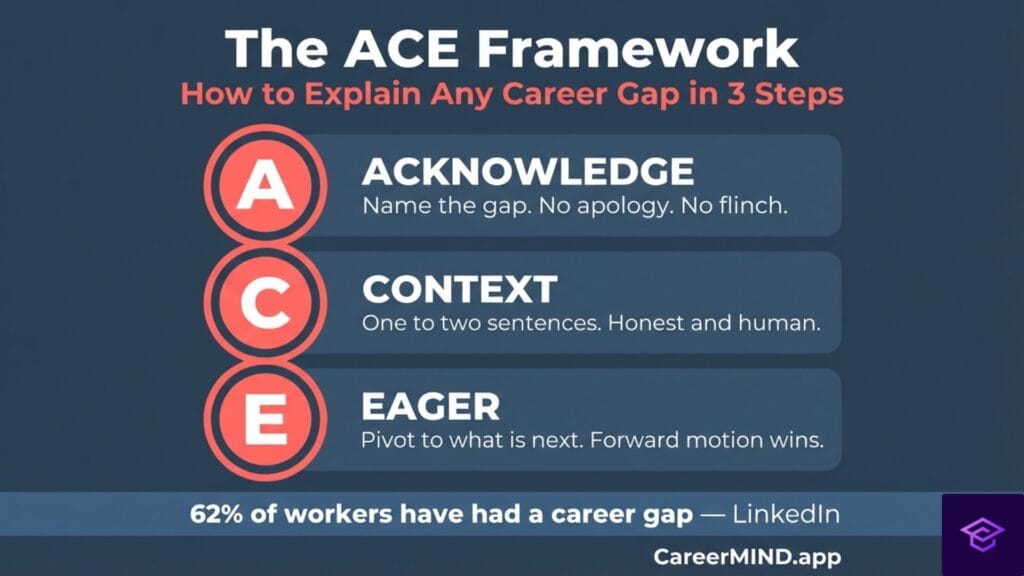
A three-step process represents the cleanest way to address any lapse in employment. Let’s call it ACE: Acknowledge, Context, Eager. It works even if your career gap was three months long or three years long.
Step 1 — Acknowledge the Career Gap Directly
Don’t dance around it. Name it upfront. “Yes — I stepped back for roughly eight months from working full-time. No apology, no flinch. Revealing what you don’t know, and doing it confidently, actually instils trust — it’s a sign of self-awareness and honesty.
Step 2 — Give Brief, Honest Context
One or two sentences is all it takes. The objective is to make the career gap sound relatable and plausible — not to give a recited monologue. Here are examples that work:
- “I raised a sick family member (had to take time off).
- “I got laid off and took the time to reevaluate my path.”
- “I took a leave of absence to focus on my health, and I’m back at 100 percent.”
- “I stepped down voluntarily because I was heading for burnout and needed to recharge.”
I freelanced and learned new skills during my break. Be matter-of-fact, not emotional. State it. Don’t dwell on it.
Step 3 — Pivot to Eagerness
That is the key of what makes your answer land. Right after the context, immediately redirect to what’s in it for you. “During my time off, I also accomplished a certification in X.” Or better yet: “I spent this time clarifying where I want to contribute, and this position is precisely that.” It’s all about forward motion. Interviews make no mistake that how you pursued your job search after the gap was intentional not reactive. You show it in one sentence, and you’re golden.
How to Explain a Career Gap in Different Situations
Not every situation is the same. Here’s how to handle yours based on what actually happened.
Career Gap After a Layoff
Layoffs are so common right now that most interviewers won’t even take a breath. Just tell them straight: “My position was eliminated in a company-wide restructure. I spent a few months being intentional about my next move, as opposed to just taking the first offer.” That makes your time off strategic not desperate.
Career Gap for Personal or Health Reasons
You are not obliged to share your medical history with anyone. Be vague: “I was away dealing with a personal matter that is now fully resolved.” Most interviewers won’t push further. They just want to know it wasn’t performance-related.

Career Gap for Caregiving
Caregiving is one of the most respected reasons for stepping away and one of the most undervalued. Be direct: “I took time away to care for a family member. That chapter is now closed, and I’m fully ready to re-engage.” Simple, dignified, done.
Career Gap With No Career Activity
What if you genuinely did nothing during that time? No courses, no freelancing, no volunteering — just life. Own it. “I needed to step back and reset. I’m returning sharper, more motivated, and clearer about what I want.” That’s human. Interviewers respect honesty far more than a polished excuse.
Do You Have to Mention Mental Health When Explaining a Career Gap?
No. You’re never legally required to disclose a mental health condition when addressing this question. A safe framing: “I took time to manage a personal health matter, which is now resolved.” You’ve addressed the question, protected your privacy, and moved on. If you want to be more open, that’s your call — never your obligation.
Career Gap Explanation Scripts You Can Use Right Now
The best interview prep for a career gap is having the words ready before you walk in. Here are five scripts to adapt to your specific situation.
Script 1 — Career Gap After Burnout
“I hit a point where I was running on empty and starting to underperform. Rather than power through and deliver mediocre work, I made a deliberate decision to step back. I rested, reconnected with what I love about this field, and honestly — I’m more motivated right now than I’ve been in years. That time away reset everything in the best possible way.”
Script 2 — Career Gap for Caregiving
“My parent was diagnosed with a serious illness. I chose to step back and be fully present during that period — it was the right call for my family, and I have no regrets. Now that things are stable, I’m ready to bring my full focus back to my career, and I’m genuinely excited about this opportunity.”

Script 3 — Longer Career Gap (1+ Years)
“I stepped away for about [X] years. During that time, I [brief context]. It was a significant period away, but it gave me clarity I didn’t have before — about what environment I thrive in, what kind of work actually energizes me, and what I have to offer at this stage. That clarity is a big reason why I’m here.”
Script 4 — Career Gap After a Layoff
“My role was eliminated when my company went through a major restructure. I took a few deliberate months to think about what I actually wanted next rather than applying reactively everywhere. I’m glad I did. I came out of that period much clearer, and this role aligns with exactly where I want to go.”
Script 5 — Career Gap for Personal Reinvention
“I reached a point where I knew I needed more than a new job I needed a real rethink of my direction. I used that time to assess my strengths, explore different paths, and get honest about what I want from my career. That process led me here. And I’m confident this is the right next move.”
Not sure which direction to return to after your career gap? That’s exactly what CareerMIND solves. Our AI maps your Background, Interests, Personality, Skills, Values, and Preferences so you don’t just survive the career gap interview, you walk in knowing exactly where you’re headed. Try it at careermind.app.
What to Do During a Career Gap (If You Still Have Time)
Not everyone reading this is looking back at a career gap that’s already over. If you’re currently in one, this section is for you. What you do — or don’t do — during that time can shape how you talk about it for years.
Treat Your Career Gap Like a Project
The people who come out of a career gap strongest are the ones who treated it with intention, even if it started unintentionally. That doesn’t mean grinding online courses 12 hours a day. It means having a loose structure — a goal, a few activities, a direction.
Even one concrete thing per week, a course module, an informational interview, a freelance project, gives you something real to point to. Small actions add up to a compelling story.

Stay Connected to Your Industry During a Career Gap
One of the biggest mistakes is going dark. Disappearing from LinkedIn, stopping conversations, losing touch with your network. The professional world moves fast. Time away doesn’t mean you have to fall behind.
Follow industry news. Comment on posts. Attend a virtual event or two. Keep your skills sharp with free resources. None of this takes more than 30 minutes a day but it means that when you’re ready to return, re-entering the workforce feels like a step forward, not a catch-up scramble. Hiring managers can tell the difference between someone who stayed connected during their career break and someone who went completely dark.
Document What You Learn During Your Career Gap
Keep a simple running list of anything you read, watched, completed, or worked on during your time away. You don’t need to publish it anywhere. But having that list means you’ll never be caught flat-footed when an interviewer asks, “So what have you been up to?” You’ll have real, specific answers, and specific answers always beat vague ones.
How to Address a Career Gap on Your Resume
Nailing the interview answer is only half the battle. Your resume needs to handle it before you even get in the room.
Use a Hybrid Resume Format
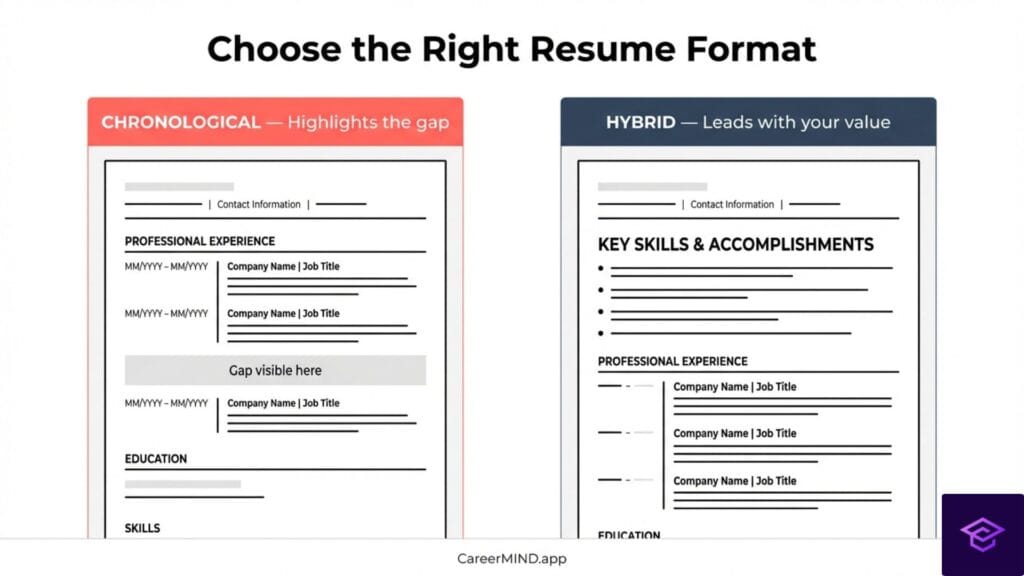
A hybrid resume leads with skills and accomplishments before listing your work history. It doesn’t hide the employment gap — but it doesn’t lead with it either. Your value comes first. This format works especially well when your work history has breaks, since it shifts the reader’s focus to what you can do, not the timeline of when you did it.
Add a Career Break Entry
LinkedIn now supports “Career Break” as an official profile section. Do the same on your resume. A single line — “Career Break (2023–2024). Family caregiving and professional development” — handles things proactively. No mystery, no question mark.
List Any Activity During the Career Gap
Freelance work, volunteering, online courses, consulting if you did it, it belongs on your resume. Even one short course signals that you stayed sharp during that time. And don’t forget: most companies run resumes through an ATS (applicant tracking system) before a human ever sees them. Using the phrase “career break” or “employment gap” as a section label rather than leaving a blank helps the ATS parse your work history cleanly instead of flagging the gap as missing data.
Quick Resume Tip for Short Career Gaps
If your career gap is under six months, list employment dates by year only (2022–2023) instead of month and year. It’s a widely accepted practice that softens the visibility of any short gap without misrepresenting anything.
How to Turn Your Career Gap Into a Strength
Here’s what most people miss: this gap on your resume isn’t just something to survive in an interview. Handled right, it becomes one of the most memorable parts of your story.
Think about it. Most candidates sound the same — same roles, same progression, same buzzwords. But someone who stepped away, made a deliberate choice, and came back with clarity? That stands out. Hiring managers remember the person with the compelling “why” far longer than the one with a perfectly linear resume.

Reframe Your Career Gap as a Strategic Move
The language you use matters. Instead of “I wasn’t working,” say “I stepped back intentionally.” Instead of “I had a gap,” say “I took time to realign.” Small shifts in framing change the entire tone — from passive to purposeful. That’s the difference between a career gap that raises eyebrows and one that earns respect.
Your Career Gap as a Positioning Asset
Think about what a standard resume looks like to a hiring manager reviewing 200 applications. Same companies, same titles, same unbroken climb up the ladder. Then they hit yours, and there’s a career gap. That pause in your timeline forces them to stop and ask a question. And a question is an opening.
An opening to tell a story nobody else in that stack can tell. An opening to show that you made a hard choice, lived through something real, and came out the other side with more self-awareness than the candidate who never stopped moving. That’s not a weakness. That’s differentiation. Most people never frame their career gap that way — which is exactly why it works when you do.
Common Career Gap Fears and Why They’re Overblown
Before we wrap up, let’s address the fears that keep people up at night about having a career gap on their resume. Because most of them? Way bigger in your head than in reality.
Fear 1: “Employers Will Automatically Reject Me Because of My Career Gap”
This is the most common fear — and the least supported by evidence. Hiring managers are people. They’ve seen career gaps, lived through career gaps, and in many cases had their own. What actually triggers rejection isn’t the gap itself. It’s the candidate who can’t explain it, gets defensive about it, or clearly hasn’t thought about what comes next.
Fear 2: “My Skills Are Too Outdated After a Career Gap”
Skills do fade — but rarely as fast as people fear. Most core professional skills are durable. And any gaps in technical knowledge can be addressed with a short course or self-study before you start applying. The bigger issue is confidence, not capability. If you’ve been away for a year or more, spend two to four weeks doing a quick skills audit and patching the obvious holes. That’s usually enough.

Fear 3: “No One Will Take Me Seriously After a Long Career Gap”
The labour market has changed. Remote work, layoffs, burnout, caregiving demands, most hiring managers today understand that time away doesn’t define someone’s professional worth. What defines you is how you show up in the interview, what value you bring to the role, and how clearly you can articulate where you’re going after your career gap. It’s one line on a resume. Your skills, your energy, and your story are everything else.
Career Gap Red Flags: What NOT to Say in an Interview
Knowing what to say about your career gap — whether you call it an employment gap, a career break, or simply time away — matters. But knowing what NOT to say? That’s what separates a good answer from a great one. Interviewers hear these red flags constantly, and they leave a mark.
Don’t Over-Apologise
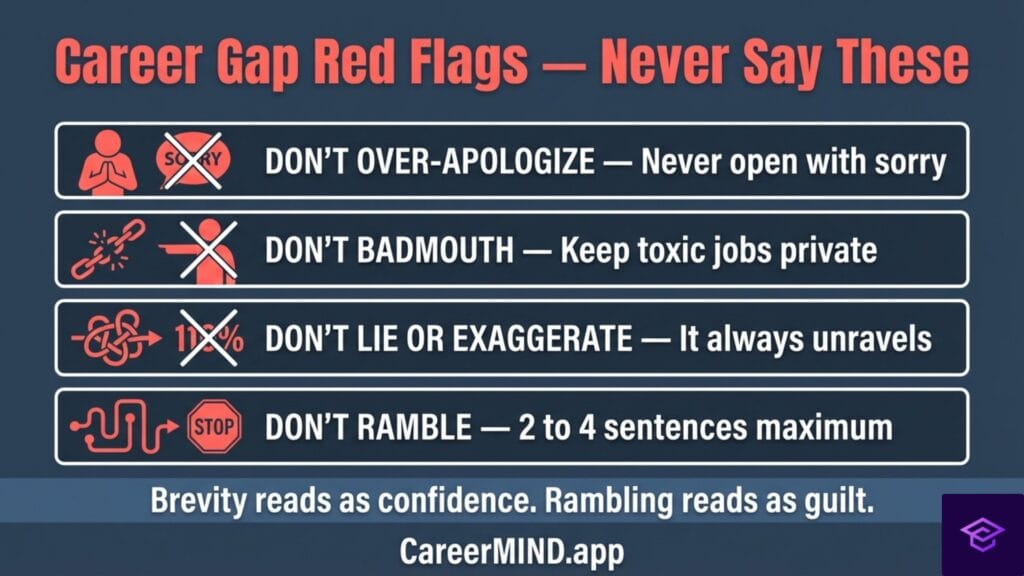
This applies to any career gap explanation. Opening with “I’m so sorry, I know the career gap looks terrible” — before the interviewer has formed any opinion about your career gap signals insecurity before the interviewer has even formed an opinion. You’ve just told them how to feel about it. Never apologise for it. State it, explain it, move on.
Don’t Badmouth Your Former Employer
Even if a toxic job drove you to step away, keep that to yourself. “I left because my manager was a nightmare” is a one-way ticket out of the candidate pool. Frame your departure as a proactive choice, not a reaction to someone else’s behaviour.
Don’t Lie or Exaggerate
Inventing freelance clients that don’t exist or claiming certifications you haven’t completed will unravel fast in the background check, the reference call, or the first week on the job. Honesty is always the safer play. Interviewers respect a clean, simple truth far more than an elaborate story that doesn’t hold up.
Don’t Make It Longer Than It Needs to Be
Two to four sentences is all you need. The moment you go past 60 seconds, you’re signalling anxiety. Say your piece, land your career gap pivot, and let the interviewer steer forward. Brevity reads as confidence. Rambling reads as guilt.
Key Takeaways: Handling Your Career Gap
- A career gap is normal — 62% of professionals have one.
- Use the ACE framework: Acknowledge, give Context, show Eagerness.
- Never apologise for it. Own the gap as part of your story.
- Adapt your explanation to the reason — layoff, burnout, caregiving, health, or reinvention.
- On your resume, address the career gap directly with a Career Break entry.
- The right career gap answer is brief, honest, and forward-looking. Practice it out loud.
- Reframe your career gap as a strategic pause — not a period of absence.
- Avoid the four red flags: over-apologising, badmouthing, exaggerating, and rambling.
Frequently Asked Questions About Career Gaps
How do I explain a career gap without lying?
You don’t need to lie — just be selective. “I took time away for personal reasons that are now resolved” is honest and professional. Keep it brief, skip the oversharing, and pivot to your value. Explaining it is about clarity, not confession.
How long of a career gap is too long?
There’s no hard rule. A gap of one to two years is very common, especially post-pandemic. For an absence of three or more years, lean into readiness — what you’ve learned and why you’re the right fit today. Employers care less about the length than about your energy and capability right now.
Should I address my career gap in a cover letter?
If the gap is visible on your resume, yes, one sentence is enough. “After stepping away to [reason], I’m ready to bring my skills to [company].” Name it, neutralise it, move on. Don’t make the gap the focus of your letter.
What if I have multiple career gaps?
Explain each briefly and separately. Don’t let them read as a pattern — frame each as a distinct chapter with a clear reason and outcome. Context removes any anxiety from a hiring manager reviewing your history.
Does a career gap hurt in every industry?
Not at all. Startups, creative fields, and tech companies are far more flexible about gaps than traditional corporate employers. In fast-moving industries, your skills and portfolio often speak louder than an uninterrupted work history.
Is a gap year the same as a career gap?
Not exactly — but they’re handled the same way. A gap year typically refers to intentional time off, often taken after graduation or between major life stages, for travel, volunteering, or personal development. An employment gap or career break is broader and can happen at any career stage for any reason. Interviewers treat both the same: they want to know what you did, why you did it, and why you’re ready now. The explanation framework is identical.
Your Career Gap Might Be Telling You Something Bigger
Sometimes a gap on your resume isn’t just an interruption. It can be a signal that the career you were in wasn’t the right fit to begin with. A lot of people use a career break as a reset, only to re-enter the workforce heading in the exact same direction. That’s when a career change conversation becomes worth having.
If you’re returning from a career gap and still unsure what direction to take, that’s exactly what CareerMIND is built for. Our AI-powered assessment maps your Background, Interests, Personality, Skills, Values, and Preferences across 6 Dimensions of Career Fit — so you return with real clarity, not just a polished interview answer.
At $19/month, it’s less than a Starbucks run per week. And it could change everything.