Table of Contents
Introduction
You’re 30. You’ve built a decent career. The resume looks good. The salary is respectable. Your parents are proud.
So, why do you hate Sunday nights?
If you’re Googling how to change careers at 30, then here’s one thing no one ever tells you about switching jobs: You are not running behind. You’re right on time. The average American changes careers 5-7 times, and 30 is the most often cited mark for making your first major pivot. There is something you have that most 22-year-olds do not — clarity about what you don’t want.
Here’s the other truth: It is easier to figure out how to change careers at 30 than it is at 22. You have skills. You have self-awareness. You have a network. What you need is a plan, one that turns what you have into something else rather than simply torching it.
This guide reveals how to change careers at 30 without going back to school, spending all your savings , and choosing a career that you’ll hate in 6 months.
Why So Many Professionals Research How to Change Careers at 30
Let’s start with context.
Based on Gallup (link to a study), 85% hate their job.” That’s not a typo. Most people are working, not engaged in the work they are doing, but rather just going through the motions so they can get paid and ask themselves, ” Is this it?”
How to change careers at 30 is a question that usually emanates from one of three places:
You climbed the wrong ladder. You had done everything “right” — you’d gotten the degree, the job, the promotion. But at some point, you realized you’re winning in a direction you don’t want to win. Your industry is changing. You’re recFINE Technology, automation, or market changes are causing your current job to be less relevant or enMOREique and less fulfilling than it once was.

You’ve outgrown the work. What seemed thrilling at 25 feels empty at 30. You desire more purpose, more freedom, or just something that fits who you have become. Sound familiar?
The good news: 30 is the ideal age to start thinking of how you’re going to change careers, even if you need to learn how to change careers at 30. You’re young enough to take a risk, old enough to be strategic about it.
The Biggest Myths About How to Change Careers at 30
Myths that keep people stuck. Before I share a strategy, let’s kill some myths.
Myth No. 1: ”I’m Too Old to Start Over”
You’re not reinventing yourself when you learn how to change careers at 30. You’re redirecting. You are not a liability with your skills, network, and professional maturity.
Myth 2: “I’m Gonna Hafta Take a Huge Pay Cut.” I hear this one all the time.
Not necessarily. An effective way to change careers at 30 is to think in terms of transferable skills. I know many people who keep or take a 10-15% hit for the short term, and within 2/3 years, they become vibrant again.

Myth 3: “I Must Go Back to School”
Sometimes, but rarely. Most people are looking into how to change careers at 30 because they think they need another degree. In truth, targeted certifications, online courses , or self-directed learning are often sufficient.
Myth 4. “I Should Do What I Love”
Passion is overrated. When you’re trying to figure out how to change careers at 30 (or any other age, really), focus on the intersection of your skills, the market’s demand for what you can do, and your interests, not amorphous “passion.”
Step 1: Identify Why You Want to Change Careers at 30
Before you can figure out how to change careers at 30, it’s important to know why you want to do it.
What’s Not Working in Your Current Career?
Be specific. “I hate my job” isn’t enough. And identifying the root cause now will help you keep from jumping into another mismatch down the road.
Is it the work itself? The company culture? The industry? Your boss? Lack of growth? Misalignment with your values?
What Would Make You Excited About Monday When You Change Careers at 30?
Don’t overthink this. What kind of problems are you trying to solve? Where are you most productive? Now, what does success look like to you — not at 22?

What Are You Willing to Sacrifice?
Deciding how to switch careers at 30 involves some trade-offs. Would you be willing to accept a temporary pay cut? Invest time in new skills? Begin at a slightly lower stratum? Relocate if needed?
Knowing your boundaries prevents buyer’s remorse later.
Step 2: Audit Your Transferable Skills When Changing Careers at 30
Here’s where most people screw up how to change careers at 30. Those are the ones who concentrate on what they don’t have instead of what they do.
You have more skills than you realize that can be transferred.
Hard Skills You Can Transfer When You Change Careers at 30
Software, tools, and platforms proficiencies, industry expertise, analytical skills, project management capabilities, budgeting, and financial literacy
Soft Skills That Matter in Any Career at 30
Communication (written, verbal, presentation), leadership and team management, problem-solving, stakeholder management, and negotiation.
Hidden Skills Most People Miss
Skills to handle stress, knowledge of corporate politics, knowledge of how business is done (I’ve seen too many MBAs fresh out of school who have no clue about anything pragmatic), professional network, self-discipline, and time management are some examples.
Write down everything you’ve done. Then prompt: “What skills were involved in this?” The numbers that are relevant to other fields will amaze you.

For instance, if you have been working in sales, you possess persuasion skills, relationship-building prowess, pipeline management abilities, and endurance. Those same skills apply to marketing, account management, business development, consulting, and beyond.
One way to help you figure that out is by learning how to list transferable skills on a resume, which can also be incredibly important in how to change careers at 30.
Step 3: Research Target Careers Using the 6 Dimensions Framework
Now that you know why you want to make a change and what you have to offer, the next step is to decide where to go.
I am not suggesting you do a web search to find “best careers for 30 year olds.” That’s lazy research, and it leads to generic answers.
The 6 Dimensions Approach to How to Change Careers at 30
When researching how to change careers at 30, use this comprehensive framework:
1. Background – What experience have you built? Your 8-10 years of work history contains valuable industry knowledge and context.
2. Interests – What naturally draws you in? Not “passion,” but topics and activities that consistently engage you.
3. Personality – How do you process information? Are you introverted or extroverted? Do you prefer structure or flexibility?
4. Skills – What can you do well? Both the obvious skills on your resume and the hidden ones you take for granted.
5. Values – What matters most to you? Autonomy? Impact? Financial security? Work-life balance? Team collaboration?
6. Preferences – How do you want to work? Remote? In-person? Solo? Team-based? Fast-paced? Methodical?
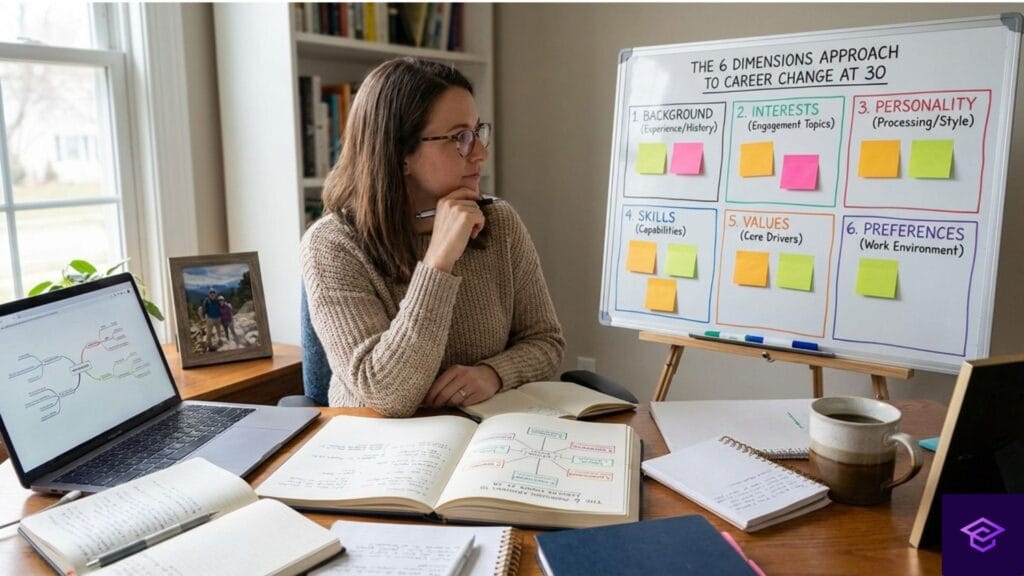
When exploring how to switch careers at 30, find a position that checks off at least 4 of these 6 boxes. Here’s how you find the careers that actually fit.
How to Research Careers Effectively at 30
Informational Interviews: Discover people who are doing the jobs you’re interested in. Ask: What does a normal day look like? What has surprised you about this job? What skills are essential? How did you break in?
Job Shadowing: Spend a day with the person in your field of interest. You will learn more in 8 hours than in 8 weeks of searching the internet.
Skill Gap Analysis: Measure your skills against job descriptions. What’s missing? What can you learn quickly?
Market Demand: Check LinkedIn, Indeed, and Glassdoor [link to BLS] for job availability, salary range (does it pay what you need?) , and growth in the industry.
Struggling to identify which careers fit your profile? CareerMIND’s AI-powered assessment analyzes your unique background, skills, and values across all 6 dimensions to show you 3-5 careers that match who you are – not generic lists. Find your match in 10 minutes.
Step 4: Build a Transition Plan (Don’t Quit Yet)
Here’s where most people get it wrong about how to change careers at 30: they leave their job and then try to figure it out. Don’t do that.
Option 1: The Side Hustle Transition for Changing Careers at 30
Keep your current job and build skills in the industry you’re targeting. Freelance nights and weekends, pick up side jobs, make a portfolio, network in the field you want to go into.”
This is the least risky way to learn how to switch careers at 30. You hang in there, keep your income while you check it out.
Option 2: The Internal Pivot
Can you switch roles within your current employer? Lateral moves across departments, special projects that allow to learn new skills, volunteering for cross-functional teams.
We as a family are having the same conversation right now. What is the best way to learn how to change careers at 30 (sure, your story led there)? Companies already trust you.

Option 3: The Strategic Education Path
Sometimes, changing careers at 30 involves new credentials — short certifications (Google, HubSpot, AWS), bootcamps (coding, UX design, data analytics), or even part-time offerings if it’s an absolute necessity.
But be strategic. Don’t just rack up degrees. Obtain credentials that correlate directly with job opportunities.
Option 4: The Calculated Leap
If you have 6-12 months of savings, a clear job goal, transferable skills and a robust network, you might be ready to take that clean break. But when you switch careers at 30, this should be the rare exception, not every day-of-your-life reality.
Step 5: Rebrand Your Resume and LinkedIn for a Career Change at 30
When it comes to figuring out how to change careers at 30, your resume requires an overhaul. You’re not just applying to any old job. You’re telling a new story.
Resume Strategy for How to Change Careers at 30
Lead with a summary that bridges your past to your future:
“8-year customer acquisition marketer looking to move into product management. Demonstrated approach to user needs, cross-functional collaboration, and data-driven decision making.”
Reframe your experience around transferable skills:
Don’t write: “Managed sales team of 12 reps.”
Do write: “Led high-performing team through goal-setting, coaching, and performance management – driving 30% YoY growth.”
The second version translates to any industry and shows you understand how to change careers at 30 strategically.
Show evidence of your pivot: Certifications, side projects in your new field, volunteer work, and relevant coursework.
LinkedIn Profile Updates for Changing Careers at 30
Your headline is valuable real estate:
“Sales Go → Product Management | Helping Teams Create Products Customers Love.”
Craft a LinkedIn About section that narrates your transition: why you’re moving, what you’ve got to offer from your past, and where you think you’re headed.
Step 6: Network Strategically (Non-Negotiable for Career Change at 30)
That said, here’s the reality about how to change careers at 30: The vast majority of opportunities come from people, not from job boards.
Leverage Your Existing Network First
Announce your career change to everyone. Former coworkers, college pals, familial connections, LinkedIn connections. Send messages like:
“Hey, I’m exploring a transition into [Artificial Intelligence Strategy], and I know you have experience there. Would you be open to a quick 20-minute call? I’d love to learn about your path.”

Join Professional Communities in Your Target Field
Industry associations, Slack groups, local meetups, online forums. Show up. Contribute. Build relationships.
Attend Industry Events Where People Discuss How to Change Careers at 30
Conferences, webinars, workshops – anywhere people in your target field gather. Ask good questions. Follow up with people you meet.
Offer Value Before Asking for Favors
Don’t just take. Share relevant articles. Make introductions. Offer your expertise. Understanding how to change careers at 30 means understanding that relationships open doors that resumes can’t.
Step 7: Prepare for the Mindset Battle of Changing Careers at 30
Let’s talk about the part of how to change careers at 30 that nobody warns you about: the psychological warfare.
You Will Doubt Yourself
You’ll work alongside 25-year-olds who have more experience. You’ll ask yourself if you’re going to make the biggest mistake of your life. You’ll feel like an imposter.
This is normal when you change careers at 30.
Combat Strategies for the Mental Game
Reframe “starting over” as “strategic redirection.” You’re not erasing your past. You’re building on it.
Celebrate small wins. Every new connection, skill learned, and interview is progress.
Find a peer group. Connect with others, figuring out how to change careers at 30. You’re not alone.
Be patient. Career changes take 6-18 months on average. It’s a marathon, not a sprint.
Real Example: How Sarah Successfully Changed Careers at 30
Sarah worked as an accountant within the corporate world and was earning $68,000 a year. Great pay, steady employment, soul-destroying labor. She was 30, and it was time for her to become a UX designer.
Months 1-3: Finished Google UX Certificate ($240) and Coursera’s Interaction Design Specialization. Created 3 practice projects for her portfolio, financial apps (her previous career was accounting).
Months 4-6: I became a member of the UXPA (UX Professionals Association) and attended 8 local meetups. Did 15 informational interviews with UX designers ranging from Capital One and Robinhood to local fintech start-ups.
Months 7-9: Freelancing on Upwork, did some smaller UX projects (redesigning a budgeting app’s dashboard, user research for a tax software startup). Made $3,200 total but won real client work for job portfolio.

Months 10-12: Strategically applied to UX roles at fintech companies, presenting herself as “the UX designer who actually understands finance.” Played off her unique perspective: “I speak design and accounting too.”
Month 13:He took a UX Designer position at a fintech startup for $58,000 (a 15% pay cut). She was newly made Senior UX Designer after a year and a half with $74,000, greater than her previous account’s salary.
Sarah wasn’t just lucky to have figured out how to change careers at 30.
Want to find out what kind of careers suit your personal profile? Try CareerMIND – Our AI takes a look at your background, skills, and goals to instantly show you personalized career matches in 10 minutes. Avoid years of trial and error. $19 a month, which is less than Netflix.
Key Takeaways: How to Change Careers at 30
- You’re not too old. 30 is actually the perfect age with enough experience to be valuable and enough runway to make it count.
- Don’t start over. Redirect. Your past skills and experience are assets when you change careers at 30, not baggage.
- Use the 6 Dimensions framework. Match careers to your Background, Interests, Personality, Skills, Values, and Preferences.
- Build while employed. Side hustles, networking, and skill-building happen before you quit.
- Relationships matter more than resumes. Network strategically in your target field.
- Be patient. Most successful career changes at 30 take 6-18 months from planning to landing a new role.
Ready to Change Careers at 30? Here’s Your Next Step
Learning how to switch careers at 30 isn’t about following someone else. Unveiling another you not by cloning a fake one, but by designing a new and better self for who you’ve become.
Start with clarity, not guesswork.
Check out CareerMIND – our AI-backed tool scans your profile against all 6 dimensions (Background, Interests, Personality, Skills, Values, Preferences) and gives you 3-5 careers that actually fit you!

No generic lists. No personality tests that tell you to “follow your passion.” Nothing but customized matches tailored to your individual mix of experience, skills and aspirations.
Discover your career match in 10 minutes. $19/month– that’s less than Starbucks once a week and 1000x the value if you’re serious about how to change careers at 30.
Start your career clarity journey today.
Frequently Asked Questions: How to Change Careers at 30
Q: Is 30 too old to change careers?
No. People change careers an average of 5-7 times [link to BLS career stats] over their working life, and one of the most common ages to pivot is 30. You’ve had enough experience to be taken seriously and yet: You’ve got plenty of time to create a fresh path when you change your career at 30.
Q: How long does it take to change careers at 30?
Most career transitions that are a success take between 6-18 months from the onset, and the initial planning phase, to secure your new opportunity. This encompasses things like building new skills and a network, and searching for work. The timeline can vary depending on how different the field you want to work in is from your current one.
Q: Do I need to go back to school to change careers at 30?
Rarely. Most people learning how to change careers at 30 can use short-term certifications, online courses or hands on experience in the place of a full degree. In other words, focus on proving skill, not on collecting credentials.
Q: Will I have to take a pay cut if I change careers at 30?
It depends. If you’re pivoting with transferable skills, you could possibly keep your current salary. If you have to move to technical capacities where you don’t know the job yet, prepare for a 10-20% reduction in pay initially. Many recover within 1-3 years. It’s also worth mentioning that Sarah is a 15% cut that she blew past within 18 months.
Q: What’s the best career to start at 30?
There’s no universal “best career.” The right career fits with your skills, values, interests, and lifestyle. Apply the 6 Dimensions system to find out which careers are right for you & who you really are when changing careers in your 30s.