Table of Contents
Introduction
You’re 40. You’ve busted your ass for 20 years. And you hate your job. Maybe it happened slowly. Or maybe one Monday morning, you just knew. You’re in the wrong career.
Now you’re asking yourself: Is 40 too late to switch careers?
Here’s the answer: No. It’s not too late.
No, 40 is the right age, in fact. You have only 25 years left to work! That’s plenty of time to develop an entirely new career. This guide will tell you precisely how to change careers at 40. Step by step. No BS.
Let’s go.
Why Changing Careers at 40 Makes Sense
When you switch careers at 40, you’re not starting from zero all over again.
By 40, you have advantages that younger workers lack. Real work experience, 20 years of it. You have skill sets that translate to any job. You’ve built a professional network. You likely have some money saved. And, most importantly, you know what you do not want.

A few of the people I meet who are trying to figure out how to change careers at 40 aren’t talented. They lack a plan. This is your plan.
Step 1: Figure Out What You Actually Want
When it comes to how to change careers at 40, forget about “follow your passion.” That’s bad advice. Passion changes. Passion doesn’t pay bills. Passion is just a guess.
Instead, use the 6 Dimensions Framework to make sure you get a good fit. First, look at your background. What jobs have you done? What industries are you already familiar with? Second, think about your interests. What makes time fly? What do you read for fun? Third, consider your personality. Do you enjoy working with people, or are you more comfortable working alone? Do you want structure, or do you prefer freedom?”
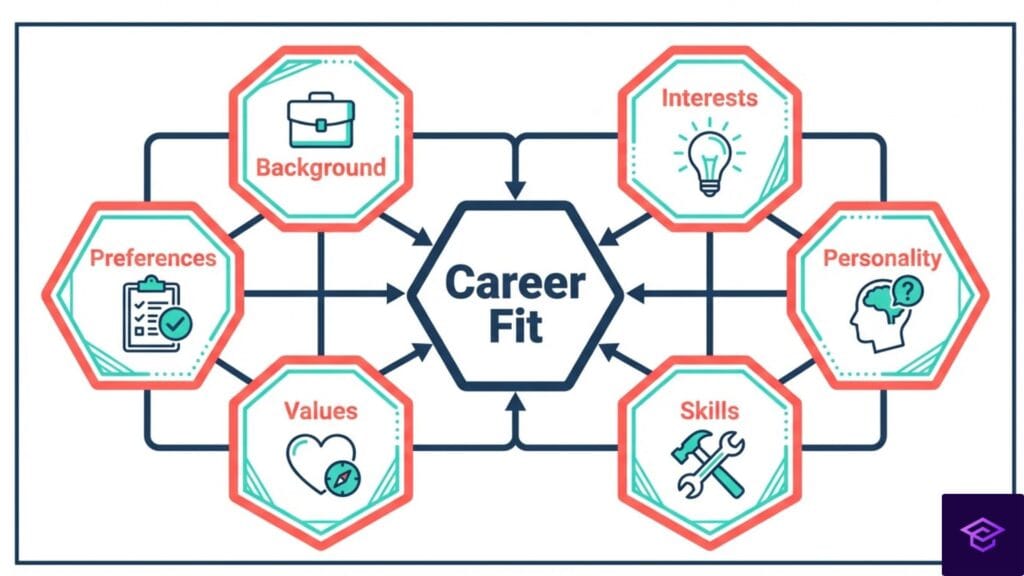
Fourth, assess your skills honestly. What are you really good at? Really good at? Fifth, clarify your values. What matters most to you? Is it money? Impact? Work-life balance? Creativity? And sixth, define your preferences. Office or remote? A big company or a small one? Fast-paced or steady?
When most people change careers at 40, they only take into account one or two of these dimensions. It’s also why they choose the wrong career. It takes all six to get real career satisfaction.
What to do: Take 2 hours. Fill in true responses to each dimension. Be specific. No generic answers.
Skip the Guesswork
The AI working for CareerMIND does this for you. It examines all 6 dimensions of your career DNA. Then it pairs you with real careers that do.
Step 2: Find the Right Career Path
Now you know what you want. Time to get jobs that suit when making a career change at 40.
Pick an Adjacent Move
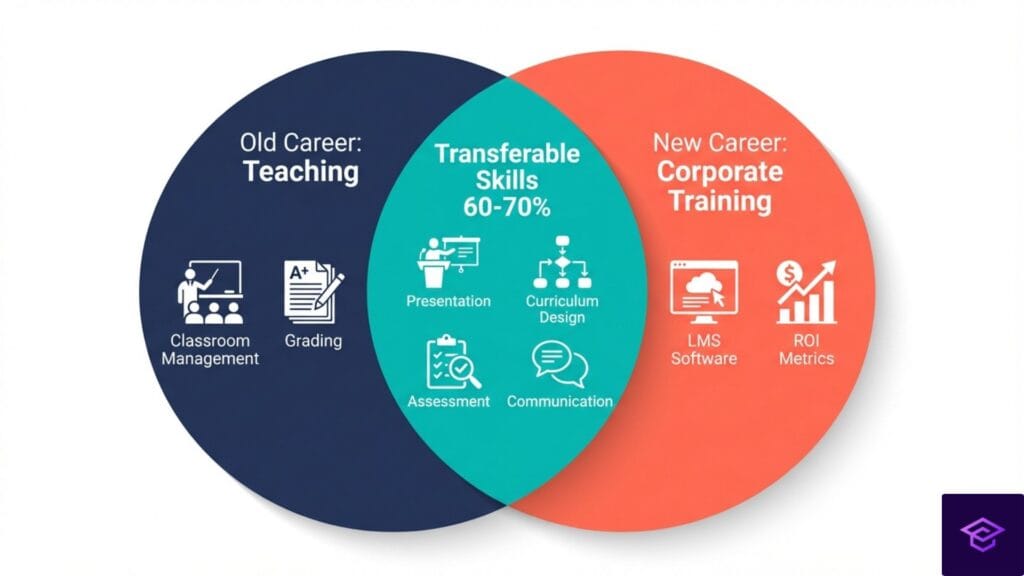
The simplest way to change careers at 40 is to make an adjacent move. Seek jobs that deploy something like 60 percent of your existing skills in a new way. For instance, a teacher might transition to corporate training. An accountant could transition to a financial analyst. A marketing manager can move into product marketing. A sales rep can become a customer success. You can explain these moves more easily; they tend to be lower-risk and land faster — when you’re learning how to change careers at 40.
Look at Growing Industries
Some fields are actively recruiting experienced workers — right now. Tech companies want human beings for project management, sales, operations — nothing that requires a line of code. Healthcare is also expanding in operations, administration, and compliance. EdTech companies have a hunger for talent with training and curriculum experience. Even cybersecurity offers a wealth of nontechnical functions for career changers at 40.
Select industries that value experience and judgment, not simply youth and hustle. These firms are smart enough to realize that maturity is a benefit, not a liability.
Know Where to Look
Skip the generic job boards like Indeed when figuring out how to change careers at 40. Instead, try industry-specific sites. AngelList is a great tool for tech jobs. Idealist focuses on nonprofit positions. Built In focuses on startup jobs. Google Career Certificates has a job board for its graduates.

Seek employers with a reputation for hiring career changers. Amazon, IBM, Salesforce, and Deloitte have programs tailored particularly to people who change careers at age 40. They prefer skills-based over classic backgrounds.
Avoid Age-Coded Job Posts
Certain job descriptions covertly discriminate on the basis of age, even if that’s illegal. Be wary of phrases like “recent graduate” or “digital native.” “Terms like ‘high-energy startup culture’ or job titles including ‘rockstar’ and ‘ninja’ are off-putting to older workers,” Mr. Reed said.
Instead, seek out the posts that say “experienced professional,” “10+ years appreciated,” or “mature judgment required.” These firms want your goods when you switch careers at 40.
Do Informational Interviews
This is the most powerful action you can take to change careers at 40. What are 5 people who currently have your target job doing? Message them on LinkedIn. Ask for 15 minutes. If you’re respectful and specific, most people will say yes.
Ask them basic questions: How’d you get this job? What’s a normal day like? What skills really matter? What do you wish you had known before you started?
In this specific LinkedIn message, say: “Hi [First name], I’m scouting how to change careers at 40 from [current field] to [target field]. Could we talk for 15 minutes? I would love to know how you got into [role].” Simple. Direct. It works.
Action step: Choose 3 target jobs. Research salaries on Glassdoor. Chat to 3 people who are actively doing each job.
Step 3: Learn the Skills You Need
Here’s the real way how to change careers at 40: You do not actually need all of the qualifications mentioned in job descriptions. You need about 70% of them. The rest they know can be learned on the job.
Find Your Skill Gaps
Create three short compilations as you plan how to change careers at 40. First, list the skills you already have. Second, add any skills you will need to learn for the job to your goal list. Third, develop a list of “nice to have” skills. Now do this: Forget about the first, longer list and concentrate solely on the second one. Completely ignore the third list. Those nice-to-have skills don’t matter.
Learn Fast and Cheap
You don’t need a $50,000 master’s degree to change careers in your 40s. If being introduced to the content, online courses from Coursera, Udemy, or LinkedIn learning will be in the $20-200 range. Bootcamps for coding, data analysis, UX design , and — yes — marketing charge $3,000 to 15,000. Certifications from Google, HubSpot, AWS, or PMI cost nothing to $500.
Pick ONE skill. Learn it inside out in 90 days. When figuring out how to change careers at 40, don’t be a jack-of-all-trades. Go deep on one thing. That’s how you demonstrate expertise quickly.
Build Proof You Can Do It
Don’t just learn the skill. Show your work publicly. Want to be a UX designer? Redesign 2 bad apps and publish the case studies online. Want to do marketing? Run a little campaign for a local business and document the results. Want to analyze data? Create a public-facing dashboard in Tableau and post to LinkedIn. Want to write professionally? Post 10 excellent articles on Medium.
When you’re changing careers at 40, your portfolio is a… dating profile. It’s more potent than any certificate or degree. Employers like to see that you really did some work; they don’t just want the lines on your résumé.
Action step: Pick one skill to master. Invest $200-500 maximum. Build one complete project. Make it public and shareable in 90 days.
Step 4: Rewrite Your Story
Your current resume is indicative of your former career. And that’s not going to cut it when you are changing careers at 40. You have to utterly re-contextualize your experience for your new role.
Create Your Transition Story
As every interviewer is going to ask: “Why are you switching careers at 40?” Have a confident answer ready.
Here’s what you shouldn’t be saying: “I’m burned out” or “I can’t stand my boss anymore” or “I’m ready for a change.” Such answers make you come across as desperate or unpleasant.
Here’s what to mention and the way to say when you’re explaining how do I change my career at 40: “I had a strong background in [old field], using/learning/leveraging [certain transferable skills] for over a decade. I am making the switch to [new field] now because of [specific reason that demonstrates you know what industry is about]. I’ve done courses on [courses, projects, networking]. What is most thrilling to me? [Part of new role]”
Keep it short. Keep it positive. Keep it confident. Practice until it sounds natural.
Fix Your Resume
Have a hybrid resume layout that prioritizes skills over your work history chronology. Begin with a 3-to-4-line summary that takes you straight to the NEW position, not the old one. 8-10 core competencies that are relevant to your target role. Then you need to rewrite every single bullet in your experience section to highlight transferable skills.
We have an example for how to change careers at 40. A teacher’s resume could say “Taught 120 students in five classes each day.” “But a corporate trainer’s resume should not say “Passed out multitudes of participation awards” but instead, say “Tutored 200+ hours of interactive instruction for diverse adult learners with 95% engagement.” Same work. Different framing. That’s the key.
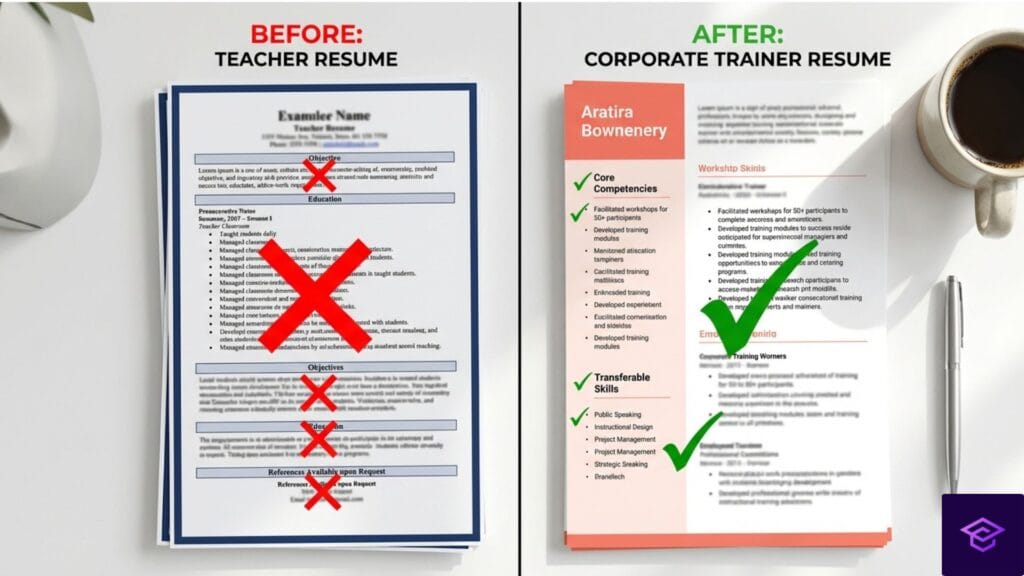
Be sure to always incorporate phrases verbatim from job descriptions. If they ask for “stakeholder management,” say you “managed cross-functional stakeholders.” If they ask for “data-driven decisions,” say you “drove strategy using data analysis.” Make it easier for them to say yes.
Update LinkedIn
Your LinkedIn headline should read “[New Role] | Learning How to Change Careers at 40 | [Your Value Proposition]. Your About section is where your 3-paragraph transition story lives. Your Featured features portfolio projects, certificates, and work samples. And above all, get active. Leave genuine comments on industry posts 3-5 times a week. Create visibility before you have to need it.
Action step: Spend this week rewriting your entire resume and LinkedIn profile. Seek advice from someone currently working in the industry you want to enter. Edit in accordance with their feedback.
Step 5: Apply Smart and Get Interviews
Here’s how to change careers at 40 by using a strategic approach to job hunting, not just desperate applications.
The 80/20 Strategy
Only apply to posted jobs online for 20% of your job search hours. Dedicate 30% of your efforts to contacting connections and hiring managers directly. Network, get visible, and build relationships in your target industry 50% of the time.
What’s up with this collapse when you switch careers at 40? For the reason that referrals curb applications any day. The best jobs at your level go through relationships, not job boards. Act accordingly.
Write a Career-Changer Cover Letter
When you are seeking to make a change in your career at 40, your cover letter is more important than your resume. This is where you draw the line to connect your old career with your new one. Confine it to 3 paragraphs and fewer than 250 words.
The first paragraph tells why you want this job at this company. Show you’ve done research. Paragraph 2 shares your story of how to change careers at 40, where transferable skills are the bridge between past work and a new role. Paragraph three is where you prove to them that you’re ready via courses taken, projects built, and preparation performed.
Try to be as precise and assertive as possible in every sentence. Generic cover letters get ignored. Personalized ones get interviews.
Network the Right Way
Network for 6 months before you’re really in need of a job. Touch base with former colleagues and let them know you’re considering how to change careers at 40. (here is the link: Join Private/discord Reddit pagesBy Industry- join Slack groups/ channels ) Go to virtual events and be there, literally. Offer help to people before you ask them for anything.
But real networking doesn’t feel transactional; it feels natural. You’re also forming real relationships with people who work in your chosen field. Some will become mentors. Some will become colleagues. Some will refer you to jobs. But this only works if you start early and bring value first.
Use Your Age as a Strength
When employers bring up fears about your level of experience while you’re changing careers at 40, turn it into an asset. Tell “I will bring 20 years of professional judgment. “I’ve seen what the system does and what doesn’t work. I save companies time and money, “he said.
Or “I’ve overseen teams and budgets, complex projects. I know how to play the game and get shit done.” Or “I’m at the point where my priority is real impact, not climbing ladders or being part of office politics.”
Frame your age and experience as precisely what makes you valuable because it is.
Action step:This month, apply to 5-10 super-targeted jobs. Send 10 people in your network a message. Go to 2 industry events or webinars.
Step 6: Handle the Money Part
Let’s be brutal about the money when you hit 40 and change careers.
Do the Math
Before you do any of that, get crystal clear on your numbers. Figure out what your monthly costs are — the amount it takes simply to survive and a more comfortable lifestyle. Check your emergency fund balance. Research what you can expect to make in your target role on Glassdoor or Payscale. Then try this two-step calculation: Your total savings divided by monthly expenses equals months of runway.
You ideally want 6-12 months of runway. 3 months is the very minimum. If it’s less than three months, don’t quit your current job. Accrue some savings first while you learn about how to change careers at 40.
Don’t Quit Cold Turkey
The most successful career changers at 40 are employing bridge strategies rather than going cold turkey. You might freelance or consult in your old field while you gain new skills nights and weekends. You might work part-time in your new field while keeping a full-time job. You could look to your current employer for a shorter work week or take a sabbatical. You might work on a contract basis in your targeted area to gain real experience.
When you change careers at 40, build a bridge between where you are now and where you want to be. And you can’t just jump off a cliff and hope to land safely.
Negotiate Like You’re 40
There’s something you’ve got when you want to change careers at 40 that a 25-year-old does not. Use it during salary negotiations. If base salary isn’t where you want it, request a signing bonus in the range of $5,000-10,000 to compensate for some of that transition cost. Request extra vacation days. Demand and professional development budget. Bargain for an early review at 6 months with the possibility of a raise. Push for remote work flexibility.
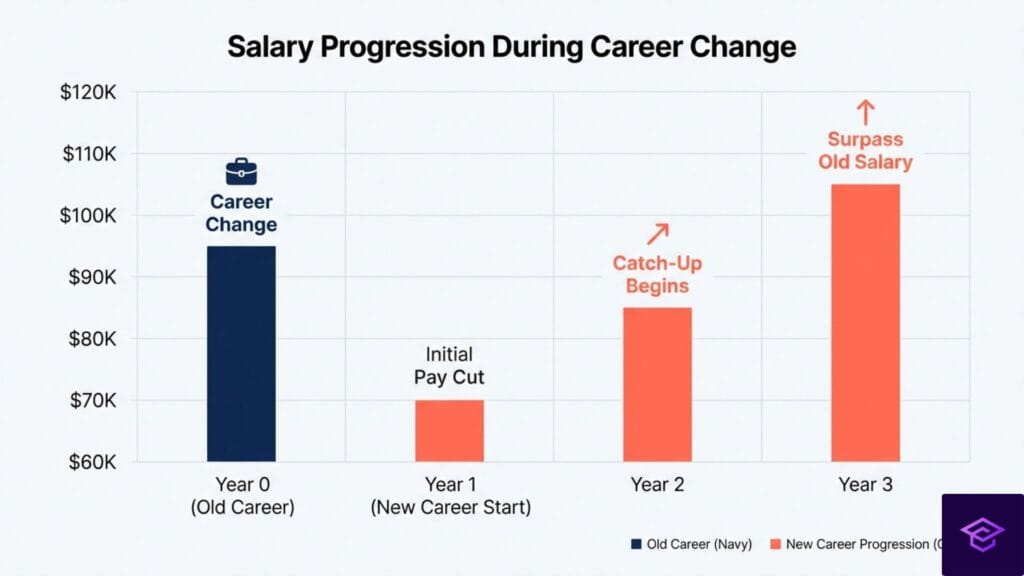
Base salary isn’t the only part of the picture. Factor in total compensation, including quality of health insurance, 401(k) match, stock options, and savings from working at home on your commute and work clothes, and enhancements to the quality of life.
Action step: Make sure you have 3-6 months of living expenses saved up before moving. Choose the type of bridge that’s best for you and your family.
Real People Who Changed Careers at 40
Sarah, 42: Teacher → UX Designer
Sarah was a high school English teacher for 18 years. She was completely burned out. She enrolled in a 6-month UX bootcamp at night while continuing to teach. She created 3 portfolio projects, redesigning education apps – with her unique angle on it: teaching experience. She landed a job in UX at an EdTech company. Her salary rose to $85,000 from $62,000. Total timeline: 14 months from decision to job offer. Sarah’s experience shows that it is indeed possible to learn how to change careers at 40.
Mike, 44: Lawyer → Product Manager
Mike had hated his job as a corporate attorney, but had loved problem-solving and systems-thinking. He moved internally first, from legal to operations to special projects. He earned Google’s PM certificate online. At his company, he shipped a couple of small products. He then leveraged those case studies to get a PM role at a B2B SaaS startup. He took a $140,000 salary reduction to $135,000 for the year, while his hours decreased 70%. Total timeline: 22 months. Mike’s philosophy on how to change careers at 40 was about internal transitions first.
Jennifer, 46: Marketing Manager → Financial Planner
When Jennifer Stein got laid off from her job in corporate marketing after 20 years, she turned to what had already become a passion: helping friends with financial planning. She earned her CFP certification while working full-time, studying nights and weekends for 18 months. She then began a hybrid role at her company as both a marketing professional and an employee-focused financial wellness professional. She started a client base on the side. Two years later, she took a full-time position at a fee-only wealth management firm. Her salary dropped, from $95,000 to $70,000 at first, but it’s now at $120,000. Total timeline: 30 months. Jennifer’s “How to change careers at 40” included keeping a day job during the transition.
See? You can change careers at 40 successfully, but only if you follow a proven system.
FAQ About How to Change Careers at 40
Is 40 too old to change careers?
No. The question “How to change careers at 40?” hangs in the fear of age. But you’ve got more than 25 years left ahead of the grind. That’s plenty of time to start gaining expertise, get promoted, and make a real difference in another field.
Will I have to take a pay cut when changing careers at 40?
Sometimes yes, usually 10-30% initially. However, most people get caught up within 2 or 3 years. Lateral moves frequently keep salary the same or result in a raise.
How long does changing careers at 40 take?
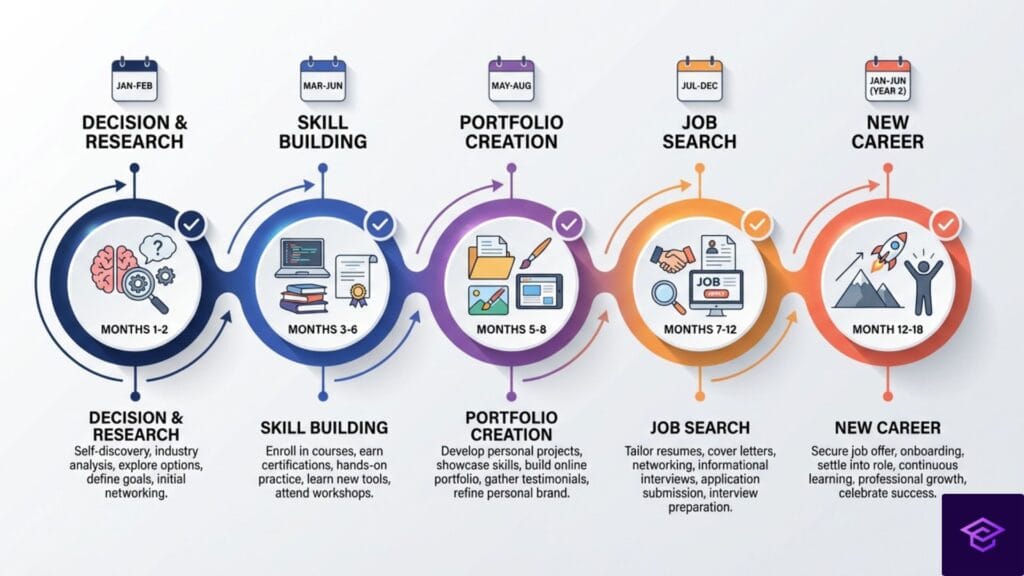
Plan for 6-18 months total. The research and planning take 1-2 months. Upskilling takes 3-6 months. Job searching takes 3-6 months. Some people move faster. Some take longer.
Do I need grad school to change careers at 40?
Rarely. For most professions, certificates and boot camps are a better option. They are faster, cheaper, and more practical. Exceptions: Nursing, therapy, law, and teaching within some states.
What if I fail when changing careers at 40?
And, if all else fails, you can always fall back on your old career with additional expertise — and more value to the industry. (Failing, really, is spending another 25 years miserable.)
Should I quit my job first when learning how to change careers at 40?
No. Keep working. Create your transition on nights and weekends. Don’t quit unless you have at least 12 months of savings.
What about ageism in hiring?
Some companies have age bias. Many don’t. (Many, in fact, would rather hire older workers for their judgment and dependability. Frame age as an asset when you transition careers at 40.
Mistakes to Avoid When Changing Careers at 40
Don’t sit around until you’re 100 percent ready. You will never feel 100 percent ready when learning how to change careers at 40. Start before you feel ready. That’s how everyone does it.
Don’t try to do everything at once. Change your industry OR your role, not both at the same time. Keep other variables stable.
Don’t count out 20 years of valuable experience. Find the through-line. Your transferable skills are gold when you’re changing careers at 40.

Grad school does not have to be your automatic go-to. Most careers don’t require it. Skill up quicker and cheaper through focused certifications.
Listen to those who have done what you are attempting to do. Well-meaning friends will worry. Your parents will express concerns. Only take advice from people who have actually successfully changed careers themselves.
Your Action Plan for This Week
Learning how to change careers at 40 begins with doing, not thinking.
Day 1-2: Work through the 6 Dimensions Framework exercise. Write detailed, honest answers.
Day 3-4: Research 3 job targets. Identify your skill gaps. Check salary ranges.
Day 5-6: Reach out to 5 people on LinkedIn for informational interviews. Use the template provided.
Day 7: Sign up for ONE class or certification. Set a 90-day completion deadline.
That is exactly how to change careers at 40. One focused step at a time. Not overwhelming. Just systematic.
Start today. Not tomorrow. Today.
Need Help Finding the Right Career?
The main problem most people changing careers at 40 have is this: They lack clarity. They know what they don’t want. They don’t know what they DO want.
CareerMIND solves this problem.
Our AI reviews all 6 Dimensions of your career DNA. Then it connects you with real careers that really represent who you are. What you get: A 50-question assessment, AI-powered career matching, salary data, and growth outlooks to the granular level, step-by-step transition plans for your top matches.
No more wondering how to change careers at 40. No more expensive coaching sessions. Just good, clear direction in less than an hour.
It’s cheaper than one therapy session. And it could change the next 25 years of your life.