Table of Contents
Introduction
Finding your career path doesn’t have to be a frustrating walk in the dark. But 67% of professionals are stuck in the wrong job, and 85% of people hate their jobs, according to Gallup’s most recent workplace survey. If you’ve spent a 2 a.m. Googling session searching for “what’s the right career for me” — well, first of all know you’re not alone and there’s nothing wrong with you.

The problem isn’t you. It’s that nobody taught you a concrete process for how to figure out what you want to do with your career. Schools say “pick a major.” Career tests measure personality. Parents give advice from 1985. Unfortunately, none of this in the current job market.
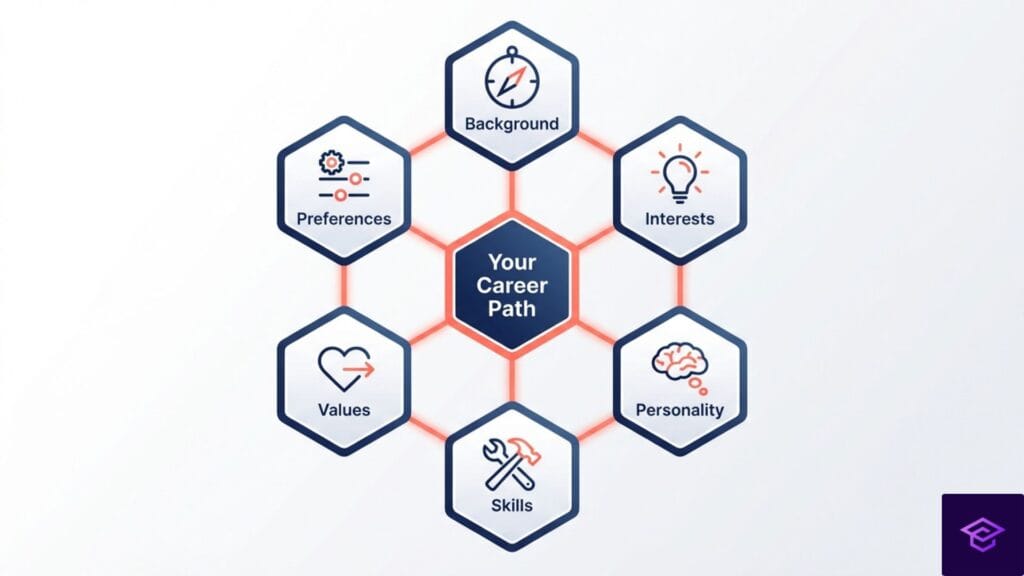
What does is a 6-dimension framework that systematically aligns careers with who you really are—not who you think you should be. In this guide, you’ll discover step by step how to find your career path in 30 days with the same process that has completely changed people’s lives and helped countless numbers finally get the clarity they so desperately wanted.
Why Most People Struggle to Find Their Career Path
But let’s begin with why it is so hard in the first place to figure out your career path.
According to The Bureau of Labor Statistics, the average American switches careers every 5-7 years. That is not job changes — that’s career pivots. And here’s the real kicker: most people do not know how to find their career path because they were never teached an actual process.

Schools tell you to choose a major. We have career counselors who give you tests that measure just one or two things. Parents dispense advice from what worked in 1985. And none of this is actually going to help you discover your career path in the job market that we have today.
The Problem With Traditional Career Advice
Conventional strategies for how to find your career path are inadequate, because they lack nuance. A personality test can tell you that you are an INFJ, but it won’t tell you whether you should be a therapist or writer or nonprofit director.
Career aptitude tests evaluate your skills, but they leave out your values. “Follow your passion” is great advice, but passion without market demand equals unemployment.
Real life: Sarah, forked out $2,500 for a career coach who told her to “follow your passion for art.” Three years and $40,000 of debt out of art school now, she’s working retail because there are 15 qualified people for every entry-level museum job. Her passion was real. The advice was incomplete.
If you want to do an awesome job of finding your career path, you will require a holistic approach.
How the 2026 Job Market Affects Your Career Path
Before you start trying to find your career path, understand what’s changed in the job market.
According to LinkedIn’s 2025 Workforce Report, the fastest-growing career fields in 2026 are:
- AI and Machine Learning Specialists – 40% growth, $120-180K average salary
- Sustainability Coordinators – 33% growth, $65-95K average salary
- Data Analysts – 28% growth, $70-110K average salary
- UX Researchers – 25% growth, $90-135K average salary
- Healthcare Technology Roles – 24% growth, $75-130K average salary

For 58% of knowledge workers, remote work is now permanent. That means when you’re finding your career path, where you are geographically is less important than ever.
The average time it will take to transition careers successfully by 2026? 6-12 months with a plan on it. Without one? Three to five years of drifting.
Specialized skills plus soft skills, like communication and adaptability, are what those in the job market are looking for. Once you find your career track, zero in on fields that allow you to grow in both areas.
The 6 Dimensions Framework: How to Find Your Career Path Step-by-Step
At CareerMIND, we’ve analyzed thousands of successful career matches. The people who know how to find their career path don’t just look at one factor. They examine six dimensions.
Dimension 1: Background (What Have You Done?)
Your resume is made up of your education, work experience, and life experience. When you are figuring out how to figure out what to do with your life, start by taking an inventory of what you already have.
This isn’t to say that you need to stay stuck in your current area. It’s about understanding what your transferable skills are and seeing the patterns. Perhaps you’ve always favored roles in which you are fixing things. You might perform your best under pressure. These patterns are data.
How to Audit Your Background to Find Your Career Path
Include every job, internship, volunteer position and major project you’ve completed. For each one, list out what you actually did — not merely your title there — and the aspects you loved or loathed.
Look for themes. If you loved the researching part but not the presenting it, maybe. Did you like working alone or with people? This clarity helps speed you on the path that’s right for you.
Real example: Marcus was in restaurant management for 8 years. He detested the late hours and unruly customers, so he figured he needed to get out of hospitality all together. But when he audited his background, he knew what made him happy was improving systems and training personnel. He transitioned to corporate training and development — calling on his hospitality background in a 9-to-5 job. Same skills, better fit. That’s what thinking strategically about your past to find a vocation looks like.
Dimension 2: Interests (What Draws You In?)
Interests are things you naturally feel drawn to in subjects and activities. When you are searching for your career path, listen to what you read about, watch or talk about for free.
Do you find yourself losing hours to studying climate science? Marketing psychology? Urban planning? Those interests are little hints about where you will find fulfilment.
Turning Interests Into Career Direction
The error people make when they are trying to find the right career path is believing interests have to be something that becomes a job. Wrong. Just because you are interested in history does not require that you become a historian.
So, instead, aim to work where you can engage with those interests indirectly. Love psychology? Think of UX research, HR strategy, or marketing. The idea is to target a career that lies where your interest meets the demand.
Real example: Jennifer had an obsession with true crime podcasts. She believed that she would have to be a detective or criminologist in order to discover her career path. Here, she became a cybersecurity analyst — solving puzzles, grappling to understand digital crimes and using that kind of analytical thinking. Mrs. James makes a healthy, middle-class income to do what she’d research for free. That is the magic of aligning interests with market demand.
Dimension 3: Personality (How Do You Operate?)
Personality impacts the way you work best. Introverts might choose a career with deep focus time. Extroverts may do well in jobs working directly with clients.
But personality isn’t destiny. How to find your career path is about knowing what you already do and getting into places that your behavior doesn’t automatically get you into trouble.
Personality Factors That Impact Your Career Path
CConsider how you process information. Do you like the concrete information, or do you think big picture? Do you use logic or values to make decisions? Then what about a little structure or flexibility?
These are not good or bad qualities. They are filters to help you discover the roles in which you’ll excel and find your career path.
Typical Personality Pairings that are Not in Sync With Career Choices
In a fast-paced startup, someone who gets bogged down in the minutiae could fall behind. A big-picture thinker in a compliance role could feel stifled. When you’re figuring out your career path, personality fit is at least as important as skill.
Real example: David is very logical, introverted. He worked a job in sales because it paid decent. He worked 60-hour weeks but was miserable — and he underperformed. When his job turned to data analysis — same company, different role — he excelled. Same person, right environment. That is what happens when you have found the intersection of your career and who you are as a person.
Dimension 4: Skills (What Can You Do?)
Skills are your proven abilities. When considering what to study when you don’t know what you want to do, keep in mind the difference between hard skills (technical proficiencies) and soft skills (interpersonal strengths).
Here’s what most people miss: You have skills that you haven’t listed on a resume. Can you make complex subjects easy to understand? That’s a skill. Can you calm tense situations? That’s a skill. Can you recognize patterns in data? Skill

How to Identify Skills That Lead to Your Career Path
Ask three people who know you well: “What am I weirdly good at? Their responses will highlight skills that you may take for granted. When your career path emerges, those latent skills often wind up being their most precious assets.
Don’t simply catalogue what you can do. Rate your skill level and how much fun you are having. If I’m excellent at something that brings me no joy, then I have the wrong career.
Key skills in demand for 2026 (according to LinkedIn’s Skills Report):
- Technical: Python, SQL, cloud computing, data visualization
- Soft: Strategic thinking, emotional intelligence, persuasive communication
- Hybrid: Project management, business analysis, digital marketing
The sweet spot when you find your career path? Roles where your natural skills overlap with market demand.
Dimension 5: Values (What Do You Need?)
Values are non-negotiables. Knowing how to find your career path means knowing what’s important to have in order for you to feel fulfilled.
Do you value autonomy? Work-life balance? Impact? Compensation? Prestige? No wrong answers, only misaligned careers.
Why Values Matter When You Find Your Career Path
You can have the greatest job on paper, but if it runs counter to your core values, you’re going to be miserable. The reward of pay will never justify the sacrifice of quality time with family — not when you’re in a job that demands 70-hour workweeks.
When you’re trying to figure out how to find your career path, it’s time to be honest about what you really need (hint: not what you tell yourself you think you should want).
Real example: Amanda was a corporate lawyer earning $180,000 a year. On paper, she’d made it. In fact, she clocked an 80-hour workweek, missing her kids’ childhoods. Family was everything to her Value 1.uito But her work, in effect, gaslit me about it daily. And it was at a decent-sized, in-house legal department of a tech company — making $130,000 but with 40-hour weeks. She took a pay cut but discovered her career path matched her values. She’s never been happier.
Dimension 6: Preferences (How Do You Want to Work?)
Preferences are about work style. Remote or in-office? Independent or collaborative? Structured or flexible? Fast-paced or steady?
These may seem small in the grander task of finding your career path, but preferences are what make up your daily experience. The perfect job, with the wrong preferences, is sheer hell.
Matching Preferences to Career Paths
If you’re seeking flexibility, a corporate job with strict hours may not be an option. If you love structure, freelancing could be chaotic. The key to finding your career path lies in knowing how and that is being realistic about having a realistic work style preference.
Real example: Tom realized he wanted to be an entrepreneur. He left his steady job, opened a business — and didn’t like it. The income that came in haphazardly stressed him out. A lack of structure had made him nervous. He wasn’t lazy — he just really liked stability and knowing what the expectations were. When he returned to a corporate job that offered some possibility of advancement, he was happy. You may have your career path and simply prefer traditional employment. That’s okay.
READY TO DISCOVER YOUR PERFECT CAREER MATCH?
You’ve learned the 6-dimension framework for how to find your career path. Now see it in action.
Take CareerMIND’s free 5-minute assessment and get 3-5 personalized career matches based on YOUR unique profile—not generic personality types.
Over 50,000 professionals have used this exact system to find their career path in 30 days or less.
Practical Steps: How to Find Your Career Path Starting Today
Now that you know what the 6 dimensions are, here’s how to figure out your career using this framework.
Step 1: Complete a Comprehensive Self-Assessment
This is the one thing most people don’t follow when figuring out what they want to do in their career. Don’t. Take a few moments to truly document the six dimensions.

Leverage tools like CareerMIND’s A.I.-based assessment, which assesses all six dimensions and delivers tailored career fits. Typical career tests only consider one or two features. To truly discover your path in life, you need the full vision.
Time investment: Two to three hours / Write-in answers, 10 minutes with an AI assessment tool.
Step 2: Research Careers That Match Your Profile
When you have a sense of your 6-dimension profile, then look for (or create a new) career that fits. When you’re learning how to find your career path, don’t focus too narrowly at first.
Here’s how to research effectively:
1. Use the Bureau of Labor Statistics Occupational Outlook Handbook (bls.gov/ooh) – Search by interest areas and see salary ranges, growth projections, and required education. This is the gold standard for career research.
2. Explore LinkedIn’s “People Also Viewed” – Look at profiles similar to your target career and see their actual career paths. You’ll discover how people transitioned into these roles.
3. Check industry-specific job boards:
- Tech: Built In, Dice, AngelList
- Nonprofits: Idealist, DevNetJobs
- Creative: Behance, Dribbble, Coroflot
- Healthcare: Health eCareers, Nurse.com
- Education: HigherEdJobs, K12JobSpot
Example careers by 6-dimension alignment:
- High autonomy + analytical skills + impact values: Data scientist for nonprofits ($85-120K, 28% growth through 2030)
- People-oriented + creative interests + flexible preferences: UX researcher, remote ($90-135K, 25% growth)
- Detail-focused + structured environment + financial values: Financial analyst ($70-95K, 9% growth)
- Big-picture thinking + tech skills + learning values: Product manager ($110-160K, 19% growth)
The career that fits you might be one you’ve never heard of. That’s why research is critical when you’re trying to find your career path.
Step 3: Conduct Informational Interviews
It’s helpful to read about how to figure out your career path on the internet. Better yet, talk to people who actually hold jobs you’re considering.
Contact 3-5 people in careers that seem interesting to you. Inquiries like what was their day-to-day like, and what do you wish someone would have told you when you began your career or about the type of personality that really thrives in your field.

Questions to Ask When Finding Your Career Path
- What does a typical day look like?
- What skills matter most?
- What do people underestimate about this career?
- What values does this job satisfy or violate?
- How did you break into this field?
- What would you do differently if you were starting today?
These conversations fast-track your ability to find your career path by giving you insider perspective.
How to get interviews: Use LinkedIn to find people in target roles. Send a short message: “Hi [Name], I’m researching a career transition into [field] and would love 15 minutes of your insight. Would you be open to a quick call?” Response rate: 30-40%.
Step 4: Test Before You Commit
Try out your hypothesis before you make a radical career shift. In trying to discover how to find career path, small experiments trump big leaps.
Can you do field freelance work? Take a course? Volunteer? Shadow someone? The point is verifying whether this path feels right before you commit years.
Testing strategies:
- Freelance projects: Upwork, Fiverr, Freelancer for low-stakes testing
- Online courses: Coursera, Udemy, LinkedIn Learning ($30-50)
- Volunteer: VolunteerMatch.org for skill-based volunteering
- Job shadowing: Ask during informational interviews
- Side projects: Build a portfolio before quitting your day job
Real example: Before Lisa left her teaching career for UX design, she took a $50 course on Udemy, redesigned her school’s website as a volunteer project and completed three small freelance gigs via Upwork. Total cost: $200, plus 3 months of evenings. She made sure she loved the work before spending $15,000 on a bootcamp. That’s the way to find your career path without burning your life down.
Step 5: Make a Decision and Create an Action Plan
Eventually, you have to decide. Deciding how to find your career path also means deciding when you just don’t know.
Once direction is chosen, establish a roadmap via 30-60-90 day plan. What do you need to work? What types of networking do you feel you need to be doing? What apps do you have to apply with?
Your career’s trajectory isn’t a destination, but rather a journey. Your plan needs to have checkpoints, milestones where you can take a moment and look back and decide if it’s still something that makes sense.
30-60-90 Day Plan Template:
Days 1-30: Skill building phase
- Complete 1-2 online courses
- Build 1-2 portfolio projects
- Connect with 10 people on LinkedIn in target field
- Read 3 books or industry reports
Days 31-60: Network and test phase
- Conduct 5 informational interviews
- Attend 2-3 industry events or webinars
- Start freelance project or volunteer work
- Update resume and LinkedIn for new direction
Days 61-90: Application phase
- Apply to 15-20 positions
- Continue networking (aim for 3-5 conversations weekly)
- Refine portfolio based on feedback
- Follow up on applications strategically
Common Mistakes to Avoid When Finding Your Career Path
Knowing how to find your career path also involves knowing what not to do.
Mistake 1: Relying on One Data Point
Don’t rely on only one personality test for how you find your career path. One dimension isn’t enough. You need the full picture.
The cost: Harvard Business Review research shows that professionals who change careers through one-factor evaluations have a 58% rate of regret in two years. Those who use comprehensive approaches? Only 12% regret rate.
Mistake 2: Waiting for Perfect Clarity
You’ll never have 100% certainty. People who start out on their career path end confidently moving with 70% clarity and tweaking as needed.
Real example: Mike waited 5 years for the “perfect” bombshell career swap. It never came. When he finally got underway, at what he estimates was 70% confidence in cybersecurity — and on his current path — he pivoted within six months as new information came to light. He squandered 5 years by waiting for something that was never going to be certain.

Mistake 3: Ignoring Market Reality
Your dream career must be one that can actually exist in the real world with viable opportunities. Part of finding your career is researching the job market demand, salary status and growth potential.
Reality check questions:
- Are there actually jobs posted in this field? (Search Indeed, LinkedIn Jobs)
- What’s the salary range? (Use Glassdoor, Payscale, levels.fyi)
- Is this field growing or shrinking? (Check BLS Occupational Outlook)
- What’s the barrier to entry? (Education, certifications, experience)
Mistake 4: Following Someone Else’s Path
What cured your friend, or college roommate, or parent might not be the solution for you. You need to honor your own unique 6-dimension profile to find careers that fit you.
Maybe your friend would do well in sales because she’s extroverted and competitive. Perhaps you are miserable at the same job, because to you deep work and autonomy matter. Different paths, both valid.
How Long Does It Take to Find Your Career Path?
There is no one-size-fits-all timetable for when you should find it. Some people have clarity in weeks. Others take months or years.

More than speed, use a methodical approach. The 6-Dimension model provides you with a methodical path to discover where your career should lead, rather than aimlessly roaming.
Realistic timelines:
- Self-assessment phase: 1-2 weeks
- Research and exploration: 3-4 weeks
- Informational interviews and testing: 4-8 weeks
- Decision and planning: 1-2 weeks
- Execution (skill-building, job search): 3-6 months
Total time to find your career path and start transitioning: 3-6 months on average when using a structured approach.
On average, people using comprehensive career assessments like CareerMIND identify 3-5 strong-fit careers within 30 days. From there, it’s about testing, learning, and refining.
Key Takeaways: How to Find Your Career Path
If you remember nothing else about how to find your career path, remember this:
- Career clarity requires examining all 6 dimensions: Background, Interests, Personality, Skills, Values, and Preferences
- Generic advice and single-factor tests won’t help you find your career path effectively—you need a comprehensive framework
- Testing career ideas before committing saves time and regret—use freelancing, courses, and informational interviews
- Finding your career path is a process of gathering data, not waiting for inspiration or a lightning bolt moment
- Market demand matters—your ideal career must exist in reality with jobs, salary ranges, and growth potential
- The 2026 job market favors remote-friendly, tech-adjacent, and specialized roles—use this to your advantage
- Most people find their career path in 3-6 months using a structured system, not years of wandering
Ready to Find Your Career Path in 30 Days?
You now know how to find your career path using the 6-dimension framework. But reading about it and actually doing it are different things.
CareerMIND’s AI-powered assessment analyzes all 6 dimensions and gives you 3-5 personalized career matches in under 10 minutes. For $19/month—less than your Netflix subscription—you get:
✓ Complete 6-dimension career profile
✓ 3-5 personalized career matches with salary data
✓ 30-day action plan customized to your situation
✓ 24/7 AI career coach for questions
✓ Job search and application tracking tools
Over 50,000 professionals have found their career path using this exact system. Most gain clarity within 30 days.
Stop Googling “how to find your career path” at 2am. Start getting answers tailored to who you actually are.
Take the CareerMIND assessment now and find your career path in 30 days or less.
Frequently Asked Questions: How to Find Your Career Path
How do I find my career path if I have no idea where to start?
Begin with The 6-Factor Self-Assessment: Background, Interests, Personality, Skills, Values and Preferences. Get personalized matches in just 10 minutes with CareerMIND’s AI assessment. Then research 3-5 related career fields and do some information interviewing. What you need is a methodical practice, not perfect clarity from the outset.
Can I find my career path at 30, 40, or older?
Yes. Most people will switch careers 5-7 times during their lifetime and, of those, 2-3 times they are making a radical change. It is a positive — you know what you don’t want. Look for transferrable skills and value matches. The 2026 job market is about diversity of experience.
What if I’m interested in multiple career paths?
Test each systematically. Rank which align the best using the 6-dimension framework. Validate your top 2-3 options via informational interviews, freelance projects or courses. One can collect hobbies into one job or do multiple from which to choose a career.
How do I know if I’ve found the right career path?
Strong alignment across 4-5 of the 6 dimensions and you’re rockin’. Ask: Is this playing to my strengths and in line with what I value? Do I see myself in 3-5 years? Confirm, too, market reality: jobs that are available, a decent salary, growth in the field.
What’s the difference between a job and a career path?
A job is a specific position. A career path is a series of connected employment opportunities. When you choose the path of your career, you are manifesting a direction in which to grow and develop skills—not just collect another paycheck