Table of Contents
Intoduction
The average person spends more time picking a Netflix show than considering if it’s suitable for their career. And then they wonder why Sunday nights are a thing of dread, why Monday mornings are brutal. The reason they’re smashing every work-related goal but feel empty inside. That emptiness is not a motivation problem. It’s not a work ethic issue. It’s a career fit issue, and it’s more common than people think.
According to Gallup’s 2025 State of the Global Workplace report, over 77% of employees worldwide are either disengaged or actively disengaged at work. That’s not a coincidence. That’s a global career fit crisis playing out in real time — in offices, on Zoom calls, and in 2am Google searches for “what career is right for me.”
Here’s what changes when you finally understand your career fit: everything. Your energy. Your direction. Your Monday mornings.
What Is Career Fit — Really?
Career fit is the extent to which who you are, your strengths, values, personality, and interests, match up with what your career really requires of you day in and day out.
Simple concept. Brutal to get wrong.
Many people confuse career fit with enjoying your job. But that’s not quite it. You can excel at components of a role while still having abysmal alignment in the aggregate. You can have tasks you hate, but still be doing well at the macro level. The question is not “do I like this?” It’s “Does this career work with who I actually am or against it?
Consider what a bad career fit may look like in practice. You’re a creative free spirit stuck in a rigid, process-heavy role. You care about impact, and your work goes into a system that never changes anything. You’re a free mind being corralled through a checklist. That type of misalignment wears you down in a way that’s difficult to articulate — until you realize what career fit really is.

Now flip it. When your career matches the way you automatically think, what you truly care about, and what you’re good at without trying to force it, work doesn’t feel like work. Not because it gets easier, but because the toil feels worthwhile.” That’s what strong alignment delivers.
And not paying attention has consequences: greater stress, faster burnout, worse performance, and finally a painful career shift that many people might have avoided in the first place.
Career Fit vs. Career Success — Why They’re Not the Same Thing
This is the part nobody talks about — and it’s where a lot of high achievers get blindsided.
You can be extremely successful by every external measure and still have terrible alignment between who you are and what you do. The promotion happened. The salary is great. Your LinkedIn looks impressive. And yet something feels fundamentally off every single day.
That’s not ingratitude. That’s not a midlife crisis. That’s the gap between career success and career fit — and they are not the same thing.
Career success is about external outcomes: titles, compensation, recognition, advancement. It’s measurable by other people’s standards. Career fit, on the other hand, is about internal alignment. It’s whether the work you do every day matches your values, engages your genuine interests, uses your real strengths, and fits how you naturally operate.

You can have one without the other. Plenty of people are objectively successful in careers that drain them. And plenty of people are in modest, low-profile roles that feel deeply right — because the fit is there.
The most dangerous version of this is when external success masks poor internal alignment for years. The salary keeps going up. The title gets better. So you keep going, assuming the discomfort is just part of being ambitious. Until one day the exhaustion becomes impossible to ignore and you realize you’ve been optimizing for the wrong thing the entire time.
This is why understanding your career fit isn’t a luxury for people who are struggling. It’s essential for everyone — including and especially the people who look like they have it figured out.
Why Career Fit Matters More Than Your Paycheck
Here’s a number that reframes everything. According to the Bureau of Labor Statistics, the average American holds over 12 jobs before age 54. Most of those moves aren’t strategic. They’re escapes — people running away from misalignment toward anything that feels different.
Without understanding their actual alignment, they often land in a slightly better version of the same problem.
Salary can’t fix a bad career fit. Neither can a promotion, a fancier title, or extra PTO. These things might dull the pain temporarily. But the misalignment is still there underneath — and eventually it resurfaces, usually louder than before.

On the flip side, when alignment is strong, the results are measurable. Research consistently shows that people with high career fit report greater job satisfaction, stronger performance, lower stress, and longer career tenure. They’re not just happier — they’re more successful by almost every standard you can track.
Here’s what makes this so quietly destructive: most people have never assessed their career fit at all. They chose their first career based on what seemed practical at 22, what their parents suggested, or what paid decently. And they’ve been running with it ever since — never stopping to ask whether it actually fits.
That ends here.
The 6 Dimensions of Career Fit
Real career fit isn’t one-dimensional. It’s built across six distinct dimensions — and all six matter when you’re evaluating how well your career actually matches who you are.
1. Background — Your Foundation for Career Fit
Your education, work history, and accumulated knowledge form the bedrock of your professional identity. Strong alignment on this dimension means your career builds on what you already know — it leverages your history rather than ignoring it.
When background aligns with your career, you enter every role with a natural advantage. When it doesn’t, you feel it as constant catch-up mode or imposter syndrome that never quite goes away.
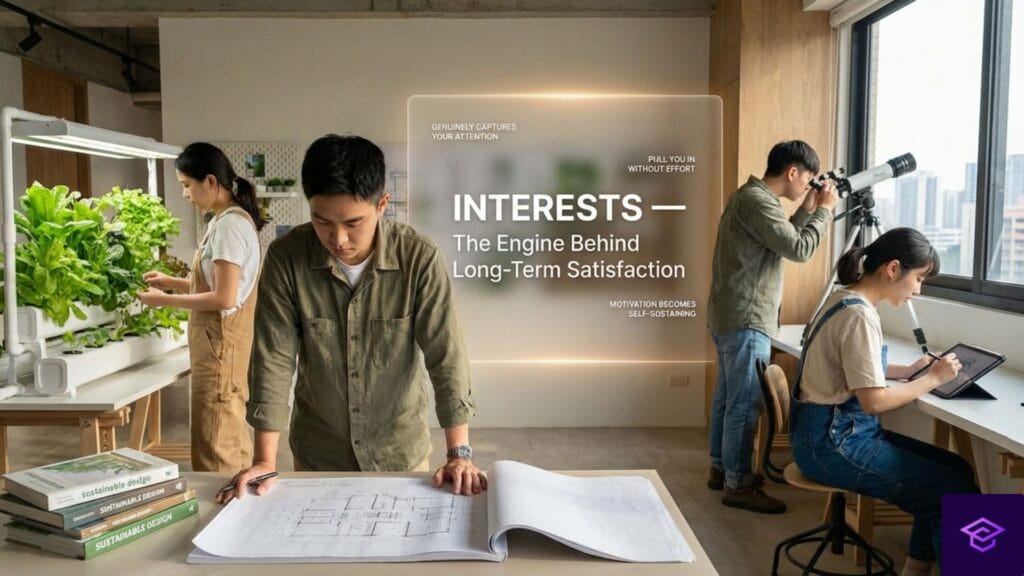
2. Interests — The Engine Behind Long-Term Satisfaction
What genuinely captures your attention? What topics pull you in without effort? Your interests are among the strongest long-term predictors of satisfaction at work. When your work connects to what you authentically care about, motivation becomes self-sustaining — no external push required.
Poor alignment on this dimension feels like forcing yourself through tasks that drain you even when they’re technically easy. Strong fit here feels like getting paid to think about things you’d think about for free.
3. Personality — Stop Fighting How You’re Wired
Are you energized by collaboration or deep solo work? Do you thrive with structure or navigate ambiguity well? Do you lead naturally or execute brilliantly? Personality shapes how you work best — and certain careers demand certain personalities. Misalign here and you’re fighting your own nature every single day.
This is why personality is non-negotiable in any serious career fit assessment. It’s not about labels. It’s about understanding how your wiring matches what your career actually asks of you.
4. Skills — What Performance Is Built On
Your transferable and specialized skills — what you’re genuinely great at, not just trained to do. Strong alignment on this dimension puts your core abilities front and center. Weak fit forces you to spend most of your time where you’re perpetually catching up, even when you’re technically qualified on paper.
The real question here isn’t just “can I do this job?” It’s “does this job let me do what I’m actually exceptional at — most of the time?”
Take someone like Rayan — a 33-year-old marketing manager who’s objectively good at his job but dreads every Monday. His skills dimension scores high. But his values dimension? Almost zero alignment. That single gap explains everything he’s been feeling. That’s what a real career fit analysis surfaces that a salary review never would.

5. Values — The Hidden Heart of the Matter
This one breaks people quietly. Your values determine what kind of work feels meaningful — autonomy, impact, security, creativity, competition, service. When your career violates your values, no salary fixes the problem. According to Harvard Business Review, values misalignment is one of the top reasons high performers voluntarily leave jobs they’re objectively succeeding at.
Performing above and beyond with no one needing to ask is what happens when your career aligns with your values. That’s the deepest layer of alignment — and when it is in place, all the other things get easier.
6. Preferences — The Practical Side of the Equation
How do you like to work? In what environment do you thrive? Remote vs. in-person, fast-paced vs. steady, structured vs. flexible — these are no small details. They’re daily truths that either lift or exhaust you.” If you’re getting your preferences wrong, you’re busy fighting your environment in addition to all of the other challenges you face.
When all six dimensions fit — or at least mostly align — it translates into a career fit you can actually feel. When they’re off, it’s like wearing a shoe that’s almost the right size.” You can walk in them. But not without pain.

Curious where you land across all 6 dimensions? CareerMIND’s assessment maps your complete career fit profile against hundreds of career paths in under 10 minutes.
The Career Fit Mistake Most People Make
Here’s the thing: almost everyone gets it wrong when they start thinking about their career fit: they only look at one dimension.
They take a personality test and call it done. Or they chase a career that aligns with their interests but ignore the fact that it conflicts with their values. Or they double down on their strongest skills without ever asking whether using those skills every day actually feels fulfilling.
Single-dimensional thinking is why so many career pivots fail. Someone burns out in finance, decides the problem is the industry, moves to a nonprofit, and burns out again six months later. Because the real issue wasn’t the industry. It was a values misalignment that followed them into the new role.
Real career fit requires looking at all six dimensions together, not in isolation. A career that scores well on interests but poorly on values is still a poor fit. A career that uses your best skills but conflicts with your personality will still exhaust you. The full picture matters.

This is also why generic personality assessments — MBTI, Enneagram, even StrengthsFinder on its own — only get you partway there. They’re valuable tools, but they measure one dimension when you need six. And they don’t map your profile to actual career options you can act on.
Most people only make progress when they get out of single-dimensional thinking and start viewing the entire career fit. Because suddenly the issue has a name. And a problem with a name can be solved.
Signs Your Career Fit Is Off
Not sure whether this applies to you? Here are the clearest warning signals.
Consistent Monday morning dread. Not occasionally — consistently. That pattern isn’t an attitude problem. It’s a signal worth taking seriously.
Emotional disconnection from your work outcomes. You complete the tasks, hit the deadlines, but genuinely don’t care how it turns out. Detachment like this is a classic symptom of misalignment — especially when values are off.
Exhaustion that sleep doesn’t fix. This is psychological and emotional depletion — the kind that builds when you’re spending 40+ hours a week in a role that fundamentally doesn’t match who you are. Rest doesn’t touch it because the source isn’t physical.

Recurring fantasies about completely different work. Not a different company — different work entirely. When this thought keeps coming back, your instincts have already diagnosed the problem. Your conscious mind just hasn’t caught up yet.
Feeling like you’re performing a version of yourself that isn’t real. Always adjusting, shrinking, adapting to fit what the role demands — never fully yourself at work. That gap between who you are and what your career requires is the career fit gap in plain sight.
If two or more of these resonate, it’s time to stop hoping it improves on its own.
How to Improve Your Career Fit in 30 Days
Fixing your alignment doesn’t mean blowing up your career overnight. It means getting clear first — then moving. Here’s a practical 30-day framework.
Week 1 — Assess Honestly. Get a real picture of where you stand across all 6 dimensions. What do your Background, Interests, Personality, Skills, Values, and Preferences actually look like right now? Write it out without filtering. This is just data — not a verdict on your choices.
Week 2 — Find the Gaps. Compare who you are with what your current career actually demands. Where is the friction coming from? Which dimension is most misaligned? Usually, there are one or two critical gaps — not six. Find those, and you’ve found your starting point.
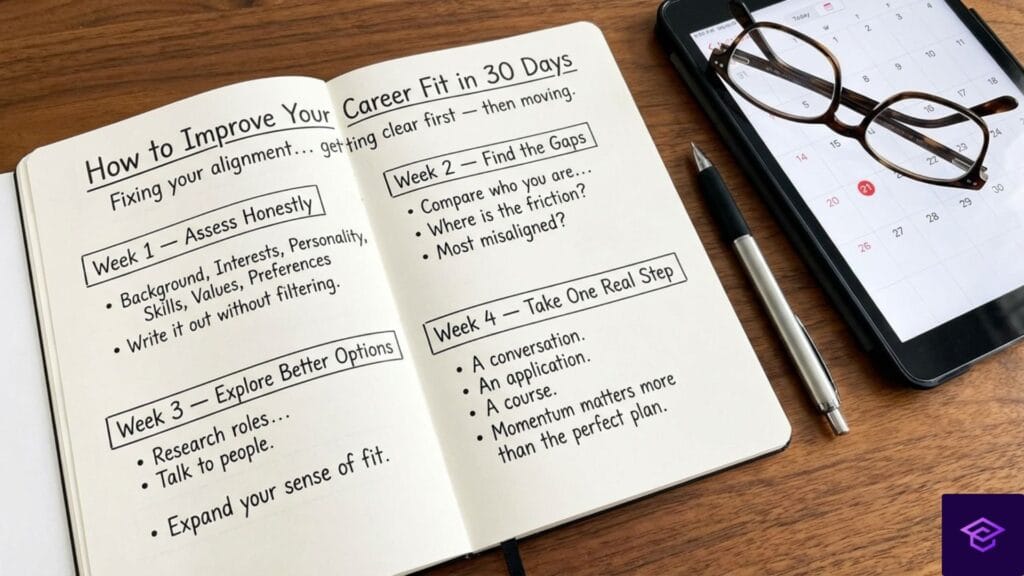
Week 3 — Explore Better Options. You don’t need the perfect answer yet. You need a direction. Research roles, industries, and environments that would better match your profile. Talk to people at work who genuinely interest you. Expand your sense of what a strong career fit could realistically look like for you.
Week 4 — Take One Real Step. A conversation. An application. An informational interview. A course. One concrete move in the right direction. Momentum matters more than the perfect plan.
CareerMIND does this entire 30-day process for you — in 10 minutes flat. Instead of spending months figuring it out alone, CareerMIND’s AI-powered assessment evaluates all 6 dimensions and matches you with careers that actually align — for $19/month. Less than a Starbucks run each week. And it could save you years of the wrong path.
Which of the 6 career fit dimensions do you think is most misaligned for you right now? Drop it in the comments.
Key Takeaways
- Career fit is the alignment between who you are and what your career demands — measurable, not abstract.
- Career success and career fit are not the same thing — you can achieve one while completely missing the other.
- True alignment spans 6 dimensions: Background, Interests, Personality, Skills, Values, and Preferences.
- The biggest mistake people make is evaluating only one dimension — all six matter together.
- Poor alignment drives burnout, disengagement, and avoidable career pivots that cost you years.
- Strong alignment leads to higher satisfaction, better performance, and longer career tenure.
- You don’t need to blow up your career to fix it — clarity first, action second.
- The 30-day framework gives you a real path: assess, find gaps, explore options, act.
Ready to Find Your Career Fit?
You now understand what career fit is, why it matters more than your salary, and what poor alignment looks like in daily life. You have a 30-day framework you can start today.
The next step is finding out exactly where you stand.
CareerMIND’s AI-powered assessment evaluates all 6 dimensions and delivers a personalized career match report in about 10 minutes. No vague labels. No generic advice. Just clear, data-driven guidance built around who you actually are.
For $19/month — less than one Starbucks run a week — you get the clarity that most people spend years searching for on their own.
Frequently Asked Questions About Career Fit
What is career fit and why does it matter?
Career fit is the alignment between your unique traits — interests, personality, values, skills, background, and preferences — and what your career actually demands. It matters because misalignment is one of the leading causes of burnout, job dissatisfaction, and unnecessary career changes. When alignment is strong, motivation comes naturally, performance improves, and long-term success becomes significantly more achievable.
How do I know if I have good career fit?
Strong career fit feels like work that challenges you without constantly depleting you — a role where your natural strengths get used regularly and what you do actually matters to you. Weak alignment shows up as persistent exhaustion, emotional disconnection, and the recurring feeling that you’re performing a version of yourself that doesn’t quite fit.
Can I improve my career fit without changing careers completely?
Sometimes — yes. If the misalignment is around environment or preferences, targeted changes like remote work, team moves, or adjusted responsibilities can meaningfully improve your situation. But if the core gaps are around values or personality, the misalignment tends to run deeper and a bigger career shift may ultimately be necessary.
How long does it take to improve my career fit?
With the right tools, most people achieve meaningful clarity within 30 days. CareerMIND evaluates your complete career fit profile across all 6 dimensions in under 10 minutes — compressing weeks of self-analysis into one focused assessment.
What’s the difference between job fit and career fit?
Job fit is about a specific role at a specific company. Career fit is the bigger picture — whether the entire field, function, and work environment aligns with who you fundamentally are. Chasing job fit without addressing the bigger alignment question is why so many people keep switching companies and still feel stuck.
Is a career fit assessment worth it?
Absolutely — when it’s comprehensive. Generic personality tests give you one narrow slice of the picture. A real career fit assessment evaluates all 6 dimensions and maps your profile to actual career paths. CareerMIND does exactly this for $19/month — making professional-grade clarity accessible to anyone serious about finding the right path.
Can career fit change over time?
Yes — and it’s important to get this. Your career fit isn’t fixed. Your values change, your skills advance, and your tastes evolve as you grow. A career that was a good fit at 25 may no longer feel like the right place to be at 35 — not because anything went wrong, but simply because you changed. It is why periodic reassessment is important. What was positioned five years ago may not be aligned at the moment, and that’s information to pay attention to instead of forcing it.
How is career fit different from a personality test?
Most personality tests measure one dimension — typically personality type or behavioral tendencies. Career fit is a multi-dimensional evaluation that looks at six factors simultaneously: your Background, Interests, Personality, Skills, Values, and Preferences. It then maps that complete profile to career options. A personality test tells you who you are. A career fit assessment tells you where you belong.