Table of Contents
Introduction
Here’s something nobody in the “skills” conversation wants to say out loud: not every high demand skill is right for you.
AI, data analytics, and cloud computing top every high demand skills list in 2026. But learning a skill the job market loves doesn’t mean it’ll work for your career. 67% of professionals feel stuck — a big reason is they chased the “right” skills instead of the right-for-them skills.
This guide draws on data from LinkedIn, the World Economic Forum, and career assessment patterns across thousands of professionals to give you an answer that’s actually personalized — not another generic list.
In this guide, we break down the high demand skills employers want most in 2026 — and how to figure out which ones actually belong on YOUR list. Because building the wrong skills costs you 6–12 months, you don’t get back.
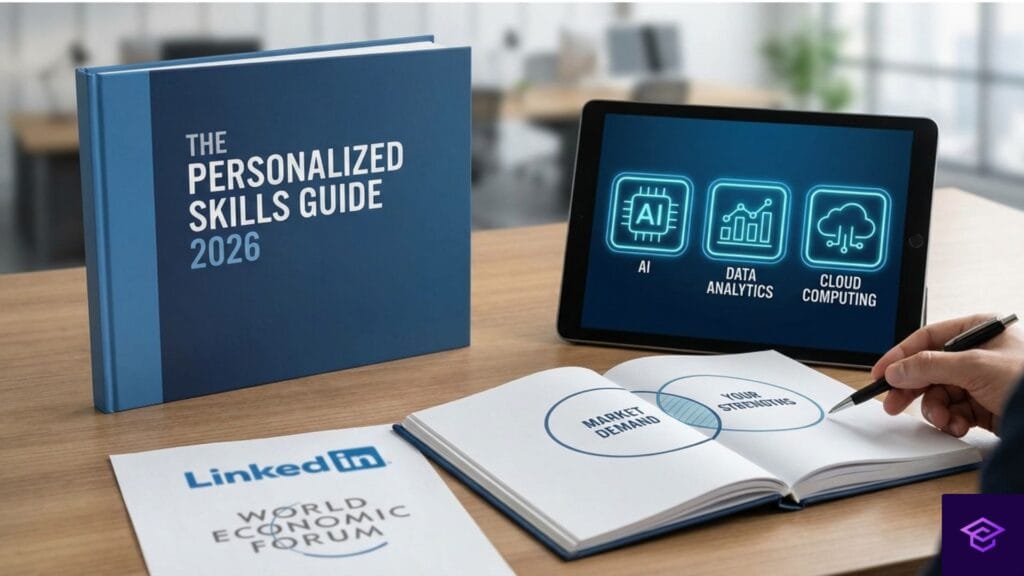
Every January, LinkedIn and the World Economic Forum release their “most in-demand skills” reports. Everyone shares them. Most people do nothing. Or worse — they pick a skill at random and grind through it for months only to realize it doesn’t connect to any direction they actually want.
The problem isn’t the high demand skills lists themselves. The problem is they’re written for the job market as a whole — not for you. “Data analysis” is objectively a top high demand skill. But if you hate numbers and thrive in people-facing roles, learning data analysis will feel like pushing a boulder uphill.
High demand skills only create value when they sit at the intersection of what the market wants AND what you’re wired to do well. Finding that intersection requires more than a Google search.
The High Demand Skills Employers Want Most in 2026
Let’s get into the actual data first — because you need to know what’s on the table before you can decide what’s right for you.
According to LinkedIn’s 2026 Workforce Report and the World Economic Forum’s Future of Jobs data, these are the skills employers are actively hiring for right now:
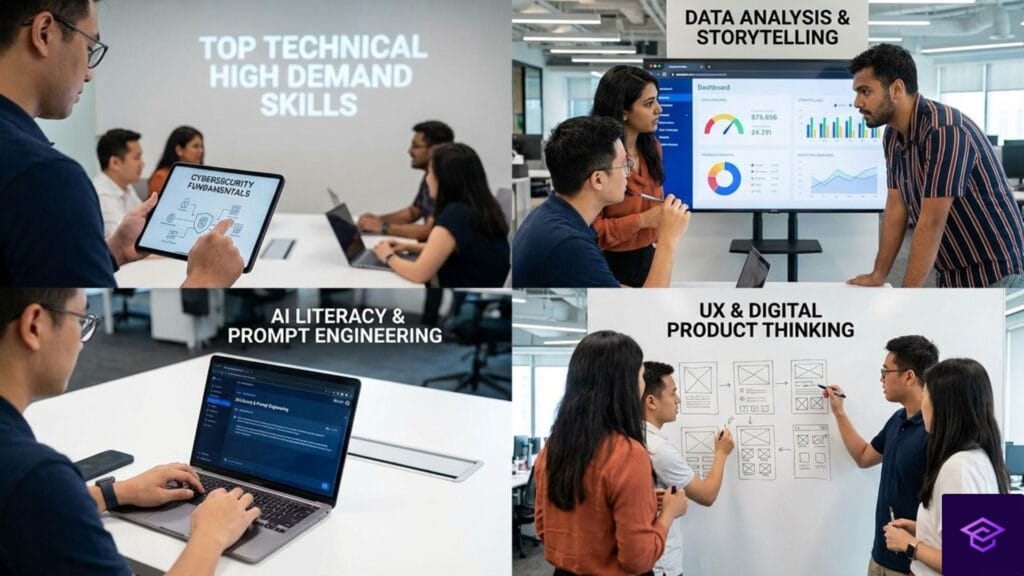
Top Technical High Demand Skills
AI Literacy and Prompt Engineering
This is the big one. You don’t need to build AI systems — but you do need to know how to work with them. Employers across every industry are looking for people who understand how to use AI tools to increase output, automate tasks, and solve problems faster. This is no longer just a tech skill. It’s a baseline.
Data Analysis and Data Storytelling
Raw data means nothing without interpretation. The ability to pull insights from data — and communicate them in a way that drives decisions — is one of the most valued high demand skills across marketing, operations, finance, healthcare, and beyond.
Cybersecurity Fundamentals
As everything moves online, every company needs people who understand digital risk. You don’t have to be a security engineer — even a working understanding of cybersecurity makes you significantly more hireable in IT, operations, and management roles.
Cloud Computing and SaaS Fluency
Working in cloud environments is no longer optional for tech-adjacent roles. Basic SaaS fluency — Salesforce, HubSpot, Notion — is valuable across almost every business function.
UX and Digital Product Thinking
People who understand user psychology, map customer journeys, and think in systems — not just features — are in serious demand right now.
Top Human High Demand Skills
Complex Problem Solving
The ability to break down ambiguous, multi-variable problems and drive toward solutions is the single highest-valued skill across industries, according to WEF. Ironically, it’s also one of the hardest to train. Which is why people who already have it are worth so much.
Communication Across Formats
Written, verbal, and visual the ability to convey ideas clearly and persuasively in multiple formats is massive. In a remote-first world, clear asynchronous communication alone can make or break careers.
Emotional Intelligence and Leadership Presence
As AI handles more routine cognitive tasks, uniquely human skills — empathy, social awareness, conflict resolution, the ability to inspire and motivate teams are becoming more valuable, not less.

Adaptability and Learning Agility
The half-life of skills is shrinking fast. Employers don’t just want someone who has the right skills today. They want someone who can keep acquiring new ones without constant hand-holding.
Cross-Functional Collaboration
Translating between technical and non-technical stakeholders is one of the most consistently underrated high demand skills on the market.
Technical Skills vs. Human Skills: What’s Actually Winning
Here’s a take that might surprise you: in 2026, the most career-defining high demand skills aren’t technical ones.
Technical high demand skills get you in the room. But human skills — the ones AI literally cannot replicate — are what get you promoted and create long-term career security. The World Economic Forum’s data is blunt: more than half of the fastest-growing skills through 2027 are human skills — creative thinking, resilience, self-awareness, and curiosity.
The smartest move isn’t to pick one or the other. Stack them. Lead with a core technical skill that opens doors. Build it on a foundation of human skills that make you irreplaceable once you’re in. That combination — technical depth plus human range — is the formula for career leverage in any economy.
How to Match High Demand Skills to Your Specific Career Path
You know the landscape. Now comes the harder question: which of these high demand skills should YOU actually build?
Most people skip the thinking and chase whatever trend has the most LinkedIn posts that week. That’s how you end up six months into a course you hate, with no clearer direction. Here’s a better approach. Ask yourself these five questions before you invest a single hour in skill-building.
What Problems Do I Actually Enjoy Solving?
If you love untangling complex systems, data analysis might suit you. If you thrive in people-facing roles, communication and leadership skills are your higher-value play. High-demand skills that align with the problems you’re drawn to don’t feel like grind. They feel like flow.
Think about the last time you lost track of time at work. What were you doing? That’s a signal. The skills that sit closest to that feeling are the ones worth doubling down on — because natural engagement translates directly into faster learning and better results.

What Skills Are You Already Using Without Calling Them Skills?
Most people have high-demand skills they’re already using — they just haven’t named them. Translating between teams? That’s cross-functional collaboration. Breaking messy projects into clear steps? Complex problem solving. Calming a frustrated client? Emotional intelligence. Spotting the pattern in a confusing dataset? Analytical thinking.
Audit your last 30 days of work. Write down every task you handled. Then map each one to the skill it requires. You’ll almost always find 2–3 high demand skills you’ve been building for years without realizing it. That’s your foundation — not square one.
What Does Your Target Role Actually Require?
Go deep on job postings for the specific roles you want — not the industry in general, but the actual jobs. Pull 10–15 listings. Highlight every skill that appears. What shows up in every single one? What’s listed as “required” vs. “preferred”? That overlap is your priority list. Those are the high demand skills worth building right now, not the ones trending on TikTok.
Pay attention to the language employers use, too. “Stakeholder communication” and “executive presence” are just fancy ways of saying strong communication skills. “Data-driven decision making” means basic data literacy. Decoding the jargon tells you what’s actually expected — and how close you already are.

Which Skills Will Still Matter in 5 Years?
Not all high demand skills age the same. Some are durable: communication, problem solving, adaptability, and leadership. Others are time-sensitive — specific software tools, platform-dependent skills, or narrow technical specializations that automation is actively replacing.
A good rule of thumb: invest 70% of your skill-building time in durable, high-demand skills that compound across roles and industries. Invest 30% in the timely technical skills that open doors in your specific target field right now. That split gives you both immediate hirability and long-term career security.
What’s the Fastest Path from Where You Are to Where You Want to Go?
This is the most practical — and the most ignored — question. Everyone always thinks about what skills to build, but doesn’t think about the most efficient order, given your current starting point.
If you’re an aspiring product manager with a project background, those bridge skills are AI literacy and basic data analysis — they’re hot in the product space and build on the organizational and communication strengths you already possess. That is a 3–6 month sprint, not a 2-year reinvention. The best way I can describe this is to map your journey from your current position, not the mythical “starting from zero.”

High Demand Skills by Career Stage
The right high demand skills to build depend heavily on where you are in your career. What a recent grad needs to prioritize is completely different from what a senior professional should focus on. Here’s a quick breakdown:
| Career Stage | Priority High Demand Skills | Why Now |
|---|---|---|
| Early Career (0–3 yrs) | AI literacy, data analysis basics, communication, adaptability | Build the foundation. These skills open doors across every industry and compound fast when you’re starting out. |
| Mid-Career (4–12 yrs) | AI strategy, executive communication, systems thinking, and emotional intelligence | You have context and experience. Now stack the skills that turn individual contributors into irreplaceable leaders. |
| Senior Level (12+ yrs) | AI strategy, executive communication, systems thinking, emotional intelligence | At this level, human skills dominate. The ability to lead through ambiguity and communicate vision is what separates good from great. |
Not sure which stage you’re really in — or which skills within your stage deserve priority? That’s exactly the kind of personalized answer CareerMIND is built to give you.
The 6-Dimension Framework for Choosing the Right Skills to Build
Most career tools treat skill-building like a shopping list. Here are the high demand skills, go pick some. But skills don’t exist in a vacuum. CareerMIND maps your career DNA across six dimensions — and every one of them affects which high demand skills will actually work for your path.
Background — High demand skills build fastest when they sit adjacent to what you already know. A marketing pro picking up data analytics moves faster than someone starting cold.
Interests — Skills you’re genuinely curious about don’t feel like work. If AI tools fascinate you, AI literacy will come naturally. If they bore you, forcing it produces mediocre results.
Personality — Introverts often thrive with technical mastery. Extroverts often get more traction from communication and leadership skills. Neither is better — both are real.
Skills — Building on a genuine strength is 3x faster than building from weakness. Lean into what you’re already good at and compound from there.
Values — High demand skills need to point toward work that actually matters to you. If you value creativity, a career built purely on data processing will feel hollow no matter the salary.
Preferences — Remote or in-person. Solo or team-based. Fast-paced or structured. These shape which high demand skills belong in your specific career context.

When you know your profile across all 6 dimensions, choosing which high demand skills to build stops being overwhelming. It becomes obvious. CareerMIND maps exactly this — giving you a personalized career DNA report that tells you not just what you could do, but what you’re actually wired for.
Want to see your 6-dimension profile? Take the CareerMIND assessment at careermind dot app — results in 20 minutes.
The Fastest Ways to Build High Demand Skills in 2026
Once you’ve identified which high demand skills are right for your path, the next question is how to build them efficiently. Because time is finite and most skill-building advice is tragically slow.
Project-based learning beats courses. Building something real forces your brain to wrestle with the skill. Want to develop high demand skills in data analysis? Find a real dataset and analyze it. Learning that sticks comes from doing, not watching.
Stack adjacent skills. A communicator who adds data skills becomes a “data storyteller” — rarer than either alone. Stacking adjacent high demand skills creates a profile nobody else has.
Micro-credentials move faster than degrees. A targeted Google certification or portfolio project carries more weight with hiring managers than a two-year program costing $30,000. Build the high demand skill. Show the work.
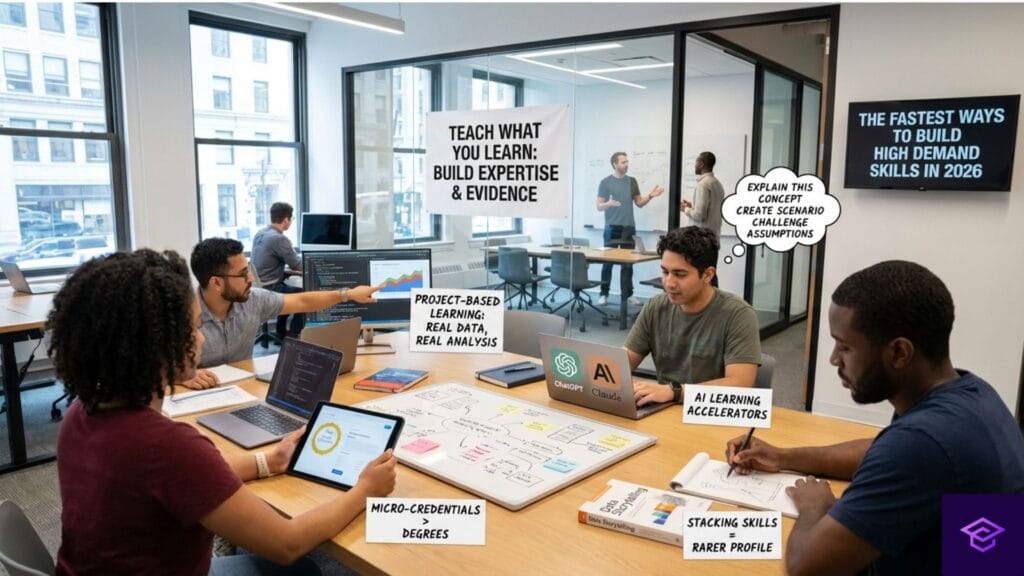
Use AI to learn faster. ChatGPT and Claude are extraordinary learning accelerators. Ask them to explain concepts, create scenarios, and challenge your assumptions. People using AI to build high demand skills are pulling ahead fast.
Teach what you learn. This sounds backward but it’s one of the most underrated accelerators. Writing about a high demand skill you’re building — even a short LinkedIn post — forces the kind of clarity that passive study never does. And it builds public evidence of your expertise as a side effect. The people who teach while they learn move twice as fast and get noticed while doing it.
Key Takeaways
- High demand skills only create value when they match your background, interests, and values — not just market trends.
- Top skills in 2026 include AI literacy, data analysis, and cloud (technical) plus problem solving, communication, and emotional intelligence (human).
- The right high demand skills depend on your career stage — early, mid, and senior professionals should prioritize different skill sets.
- Stack technical depth with human range — that’s the formula for career leverage.
- CareerMIND’s 6-dimension framework — Background, Interests, Personality, Skills, Values, Preferences — gives you a personalized high demand skills roadmap.
- Project-based learning and adjacent skill stacking are the fastest paths to skill fluency.
Ready to Know Which High Demand Skills Actually Fit You?
Not sure which high demand skills fit your career DNA? Most people guess — and waste months building skills that don’t connect to any direction they actually want.
CareerMIND gives you a personalized answer in 20 minutes. It maps your career DNA across all 6 dimensions and shows you exactly which high demand skills, careers, and paths align with who you actually are — not who the job market says you should be.
$19/month. Less than a single coaching session. Less than your Netflix subscription. No generic advice. Just yours.
Frequently Asked Questions
Which high demand skills should I focus on based on my career stage?
Career stage matters a lot. Early-career professionals should prioritize AI literacy, data analysis basics, communication, and adaptability — skills that open doors across industries. Mid-career professionals benefit most from cross-functional collaboration, data storytelling, complex problem solving, and leadership presence. Senior-level professionals should focus on AI strategy, executive communication, systems thinking, and emotional intelligence. The right high demand skills shift as your experience and responsibilities grow.
What are the most high demand skills in 2026?
The most in-demand skills in 2026 include AI literacy, data analysis, cybersecurity, cloud computing, complex problem solving, communication, emotional intelligence, and adaptability. The most career-resilient professionals build both technical and human high demand skills.
How do I know which high demand skills to learn for my career?
Start with your background, strengths, and interests — then do a gap analysis against real job postings for your target roles. The best high demand skills to build sit at the intersection of what you’re wired for and what the market values most.
Are soft skills considered high demand skills?
Absolutely — and their value is growing, not shrinking. The World Economic Forum lists complex problem solving, creative thinking, emotional intelligence, and adaptability among the fastest-growing high demand skills through 2027. As AI handles more routine tasks, human skills become the primary career differentiator.
How long does it take to build a high demand skill?
For most technical high demand skills, 3–6 months of focused, project-based learning is enough to reach a marketable level. Human skills develop through deliberate practice over time. The fastest learners use AI tools to accelerate both.
Can CareerMIND help me figure out which high demand skills to build?
Yes. CareerMIND maps your profile across 6 dimensions — Background, Interests, Personality, Skills, Values, and Preferences — so instead of guessing, you get a personalized high demand skills roadmap based on your career DNA.
About CareerMIND
CareerMIND is an AI-powered career guidance platform built for the 67% of professionals who feel stuck, unfulfilled, or just plain lost when it comes to their career direction. Not because they’re not smart or hardworking — but because nobody ever helped them figure out what they’re actually wired for.
Most career tools give you a generic personality type and a list of job titles. CareerMIND goes deeper. It maps your career DNA across six dimensions — Background, Interests, Personality, Skills, Values, and Preferences — to give you a personalized picture of which careers, roles, and high demand skills actually fit who you are. Not who you think you should be.
The assessment takes about 10 minutes. The clarity it creates? That lasts a lot longer.
At $19/month, CareerMIND costs less than a single session with a career coach — and unlike a one-time conversation, it’s available whenever you need it. Whether you’re a recent grad figuring out your first move, a mid-career professional feeling the itch to pivot, or a senior leader asking “what’s next?” — CareerMIND gives you a data-backed direction grounded in your specific career DNA.
No vague advice. No generic lists. Just clarity.
-> Start CareerMIND assessment at careermind.app