Table of Contents
Introduction
73% of professionals under 35 are experiencing severe career confusion right now.
If you’re scrolling job boards at 2 AM, questioning years spent in the wrong field, or feeling paralyzed by endless options—you’re not alone. This phenomenon has become the defining professional crisis of 2026, affecting millions across all industries and experience levels.
The Rising Tide of Career Confusion
What Does Career Confusion Really Mean?
Career confusion isn’t simple job indecision. It’s deeper than that.
It’s the persistent anxiety that your skills might become obsolete before you master them. The paralyzing fear that choosing one path permanently closes dozens of others. The overwhelming sensation of standing at an intersection with a hundred different roads, none feeling remotely right.

Think of it like standing in front of a massive buffet with thousands of dishes from every cuisine imaginable. Sounds amazing, right? Except you’re so overwhelmed that you can’t even pick up a plate. That’s how career confusion feels in 2026—an abundance of opportunities creating a scarcity of clarity.
This manifests in recognizable patterns: endlessly researching “best careers for 2026,” saving jobs you never apply to, starting side hustles you abandon within weeks, or staying in positions you’ve outgrown because choosing anything else feels impossible. Many professionals report feeling stuck between too many options and no clear direction.
The Alarming Statistics
LinkedIn’s 2026 Workforce Report reveals that career confusion affects 73% of professionals under 35—a 34% increase from just five years ago. But this epidemic isn’t limited to young workers. Nearly 58% of all working adults have seriously considered complete pivots within the past year.
Gallup’s State of the Global Workplace reveals that only 23% of employees feel engaged at work—the lowest figure in a decade. The American Psychological Association reports that work-related stress has reached clinical levels for nearly 40% of working adults.
The World Economic Forum’s Future of Jobs Report 2026 estimates that 44% of workers’ core skills will be disrupted by 2028. McKinsey’s research shows that 375 million workers globally may need to switch occupational categories by 2030 due to automation and AI.
These aren’t just statistics. They’re millions of real people questioning whether their years of education and experience still matter in today’s rapidly changing landscape.
Digital Overload and Career Confusion
The Paradox of Unlimited Choice
Here’s the paradox nobody prepared us for: unlimited options create unlimited career confusion.
LinkedIn now lists over 35,000 distinct job titles. Every day, roles appear that didn’t exist a year ago, intensifying this phenomenon. “AI Ethics Consultant.” “Digital Wellness Coach.” “Metaverse Real Estate Agent.” “Carbon Credit Analyst.” These aren’t fringe positions—they’re actively hiring, often at six-figure salaries.
Sounds amazing, right? Wrong.

Psychologist Barry Schwartz’s research on choice overload proves what you’re feeling: beyond a certain threshold, more options decrease satisfaction and increase anxiety. When you can be anything, deciding what to be becomes paralyzing.
A 2025 study from the Decision Science Institute found that professionals facing more than 50 options took 3x longer to make decisions and reported 60% less satisfaction with their final choices compared to those with 5-10 options. The research is clear: abundance breeds paralysis, not empowerment
Information Overload Creates Paralysis
Remember when researching careers meant visiting your school counselor and reading a few brochures? Now it means:
Scrolling through 50+ job boards. Reading 200 Reddit threads about which coding bootcamp to choose. Watching 30 YouTube videos about “highest paying careers.” Following 15 influencers who contradict each other. Joining 8 Discord servers about different industries.
Exhausted yet?
The Harvard Business Review published research in late 2025 showing that professionals spend an average of 23 hours per week consuming career-related content online, yet 71% report feeling more uncertain after all that research. Why? Because consuming information feels productive while actually making decisions feels risky.
Vicious cycle. Research. Compare. Overthink. Repeat.
But information overload is only part of the story. The very technology enabling this flood of information is simultaneously reshaping which careers even exist.
Technology’s Role in Career Confusion
AI and Job Market Uncertainty
Let’s address what’s keeping you up at night: will AI make your skills obsolete?
The honest answer? Maybe. And that uncertainty is driving massive career confusion.
By 2026, we’ve watched AI write novels, compose symphonies, diagnose diseases more accurately than specialists, generate marketing campaigns that outperform human-created content, and write code faster than experienced developers. GitHub Copilot now writes 46% of code in files where it’s enabled.

According to Goldman Sachs’ 2025 report, generative AI could expose 300 million jobs to automation. Not eliminate—expose. Meaning uncertainty for hundreds of millions of workers who don’t know if their skills will matter in five years.
A Stanford-MIT study from early 2026 found that 68% of students are avoiding certain paths entirely due to AI concerns, even paths they’re genuinely interested in. Fear of obsolescence is literally reshaping decisions across entire demographics.
The Gig Economy’s Hidden Cost
The gig economy sold us freedom. Be your own boss. Work from anywhere. Set your own rates. Fire bad clients.
Delivered? Partially. But at a cost that created different forms of career confusion nobody mentioned.
The Bureau of Labor Statistics reports that 38% of U.S. workers now participate in the gig economy in some capacity—up from 16% in 2020. Upwork’s 2026 Freelance Forward report shows that 64 million Americans freelanced last year.
But here’s what those optimistic statistics miss: the profound identity ambiguity that comes with gig work.
Traditional careers provided structure. You were a teacher, an accountant, a nurse. You knew what that meant. Gig workers don’t have that clarity. You’re simultaneously a freelancer, consultant, entrepreneur, side-hustler, and portfolio careerist. What are you really? How do you answer when someone asks what you do?
This identity ambiguity creates significant uncertainty. There’s no roadmap. No clear progression from junior to senior to manager to executive. Success is self-defined, which sounds liberating until you realize you have no idea what you’re working toward or how to measure progress.
Plus the economic reality: 78% of gig workers report income volatility that creates constant stress (Freelancers Union, 2025). You’re never truly settled. Always hustling for the next client. Never knowing if next month will be feast or famine.
Universities Teaching Yesterday’s Skills
Here’s an uncomfortable truth: higher education is broken for career preparation, creating massive post-graduation career confusion.
Not academically broken. Broken in the sense that universities are training students for jobs that increasingly don’t exist while ignoring the skills employers actually need.
A 2025 survey by the National Association of Colleges and Employers found that 67% of employers believe recent graduates lack essential job-ready skills, despite higher graduation rates than ever. The World Economic Forum’s research shows that 50% of all employees will need reskilling by 2027, yet only 16% of workers have access to adequate training programs.

Real example: Computer Science graduates learn algorithms and data structures (important!) but often graduate without knowing how to use the collaboration tools, cloud platforms, or AI-assisted development environments that every entry-level job requires. Marketing students face similar challenges when their traditional advertising education doesn’t include TikTok growth hacking, SEO mastery, or influencer partnership management.
The lag between curriculum development and market needs has stretched from 2-3 years to 5-7 years. By the time universities update programs, the skills they’re teaching are already being replaced.
The result is cruel irony for students: you invest four years and tens of thousands of dollars (average student loan debt hit $38,792 in 2025, per Federal Reserve data), graduate with credentials, and discover your education hasn’t actually prepared you for available jobs.
When Degrees Don’t Provide Direction
Remember when studying engineering meant you’d become an engineer? When nursing school guaranteed you’d work as a nurse?
Those days are gone.
The Federal Reserve Bank of New York’s 2026 Labor Market report shows that 43% of recent college graduates are underemployed—working in jobs that don’t require a degree. But even among those in “degree-appropriate” jobs, 52% work in fields unrelated to their major.
Your biology degree leads to tech sales. Literature degree to UX writing. Psychology degree to data analysis. Business degree to social media management. The connections between education and outcomes have loosened to near meaninglessness for many professions.
This isn’t inherently bad. Flexibility has value. But it does mean that four years and significant debt provides almost zero clarity. Students graduate with credentials but no clearer professional direction than when they started. Many report feeling more lost because they invested so heavily in a path that didn’t lead where promised.
Social Media’s Impact on Career Confusion
The Comparison Trap
Open LinkedIn. Scroll for 90 seconds.
You’ll see: a 24-year-old announcing their promotion to Senior Director. A former classmate launching their third startup (this one already valued at $10M). An influencer sharing their “simple side hustle” that generates $50K monthly. Someone with half your experience landing your dream job.
Close app. Feel terrible.
This is comparison culture, and it’s poisoning decision-making.
A 2025 study published in the Journal of Social and Clinical Psychology found that 30 minutes of daily LinkedIn usage increased dissatisfaction by 41% and uncertainty by 38%. The constant exposure to others’ curated success makes your own path feel inadequate by comparison.

But here’s the insidious part: comparison culture doesn’t just make you feel bad—it actively derails your decisions. You start pivoting based on what looks successful externally rather than what actually fits you internally. Someone’s making money in crypto? Time to learn blockchain. Everyone’s becoming a content creator? Better start a YouTube channel. Tech is hot? Maybe you should learn to code.
The result? Scattered paths built on FOMO rather than genuine interest or sustainable planning. You’re constantly chasing the next opportunity that looks good on social media instead of building something aligned with your actual strengths.
Behind the Highlight Reel
Social media shows you the promotion. Not the 60-hour weeks, three failed projects, and borderline burnout that preceded it.
The product launch. Not the two years of failed prototypes and maxed-out credit cards.
The book deal. Not the 47 publisher rejections and weekend writing sessions that lasted three years.
The “overnight success.” Not the decade of grinding nobody witnessed.
You’re comparing your behind-the-scenes—with all its mundane tasks, setbacks, and slow progress—to everyone else’s carefully curated highlight reel. This perception gap distorts your understanding of how paths actually develop.
Research from the American Psychological Association (2026) shows that social media content triggers upward social comparison in 89% of viewers, leading to decreased satisfaction and increased anxiety about professional choices. The effect is strongest among those already experiencing uncertainty—exactly the people most likely to seek advice on these platforms.
The consequence? You develop completely unrealistic expectations about progression timelines, success metrics, and what daily work should feel like. When reality doesn’t match the Instagram version, you assume you’re on the wrong path rather than recognizing you’re seeing a fundamentally distorted picture.
While social media distorts our perceptions, real economic forces are creating tangible barriers to career stability.
Economic Turbulence and Career Confusion
Navigating an Unstable Job Market
2026’s job market feels like a roller coaster designed by someone with a cruel sense of humor.
January: Tech giants announce record profits and aggressive hiring. March: Same companies lay off 40,000 workers. May: “Labor shortage” headlines dominate news. July: Recession fears spike unemployment. September: Recovery announced. November: More layoffs.
Whiplash. That’s what workers are experiencing.
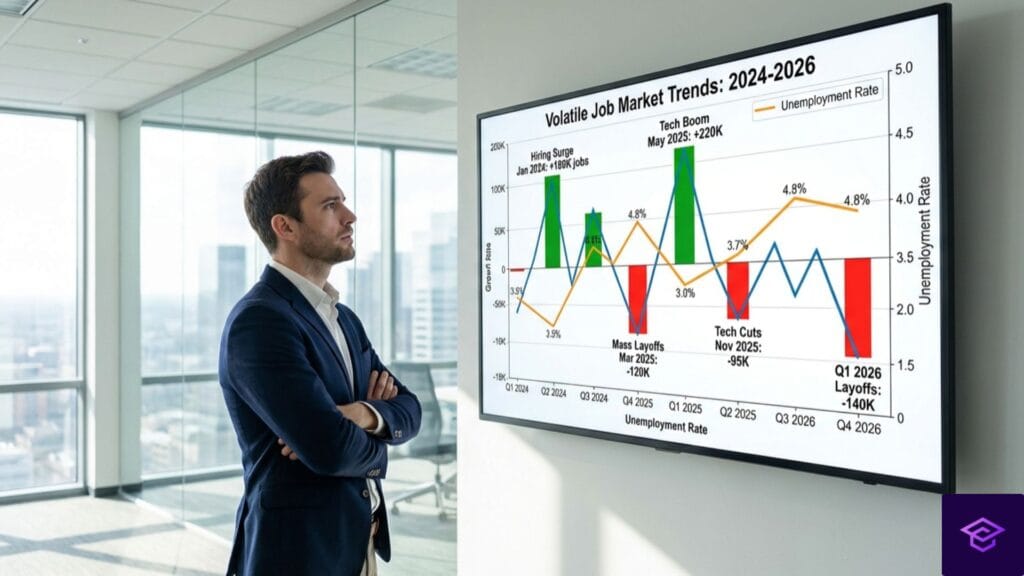
The U.S. Bureau of Labor Statistics reports that job market volatility has increased 217% since 2020. Mass layoffs affected 1.2 million workers in 2025 alone—despite overall unemployment remaining relatively low at 3.8%. This paradox of simultaneous hiring and firing creates profound uncertainty.
Real example: Amazon announced 27,000 layoffs in March 2025 while simultaneously posting 30,000 open positions in different departments. Workers watch colleagues with 15 years of experience get cut while entry-level positions go unfilled. The logic? There is none. At least none that employees can predict or plan around.
This instability makes traditional long-term planning feel absurd. Why spend five years building expertise in a department that might be eliminated in a cost-cutting round? Why commit loyalty to a company that views you as an expendable line item? The rational response to this uncertainty is questioning what moves to make.
The Purpose vs. Paycheck Dilemma
Here’s where things get truly painful: you’re not just choosing what you want to do. You’re trying to balance passion with survival in an economy that makes both increasingly difficult.
Median rent in major U.S. cities hit $2,087 in 2025 (Zillow). Healthcare costs increased 7.3% year-over-year (Kaiser Family Foundation). Groceries up 5.8% (Bureau of Labor Statistics). Student loan payments resumed after the pandemic pause. Meanwhile, real wage growth has been essentially flat when adjusted for inflation.
Translation? Many people feel forced to prioritize paycheck over purpose simply to maintain basic financial stability.
But the cruel catch: taking a high-paying job you hate leads to burnout, resentment, and eventual crisis that often results in dramatic (and expensive) changes. Following your passion might mean financial instability that creates different but equally serious stress.
Lose-lose. Pick financial security and risk your mental health. Pick passion and risk your financial health. This dilemma paralyzes millions of professionals who can’t see a path that satisfies both needs.
Previous generations could more easily separate work from identity and purpose. You worked to fund your actual life. Today’s workers—especially Millennials and Gen Z—expect careers to provide income and purpose and identity and community and fulfillment. When one job can’t deliver all of that (and what job realistically could?), uncertainty sets in.
A 2025 Deloitte survey found that 49% of Gen Z and 44% of Millennials would consider taking a pay cut to work for a company better aligned with their values. Yet 73% of those same respondents report high stress about their financial situation. The cognitive dissonance between these positions? That’s the modern dilemma in action.
Breaking Free from Career Confusion
Enough diagnosis. Time for solutions.
The 3-Step Self-Assessment Framework
Stop researching careers. Start researching yourself.
Step 1: Skills Inventory
Create three columns:
Column 1: Skills I Actually Have – List everything you can do competently. Technical skills, soft skills, knowledge areas. Be honest. Not skills you wish you had—skills you possess right now. Include things you take for granted: maybe you’re exceptional at explaining complex topics simply, or you can calm angry people, or you spot patterns others miss.
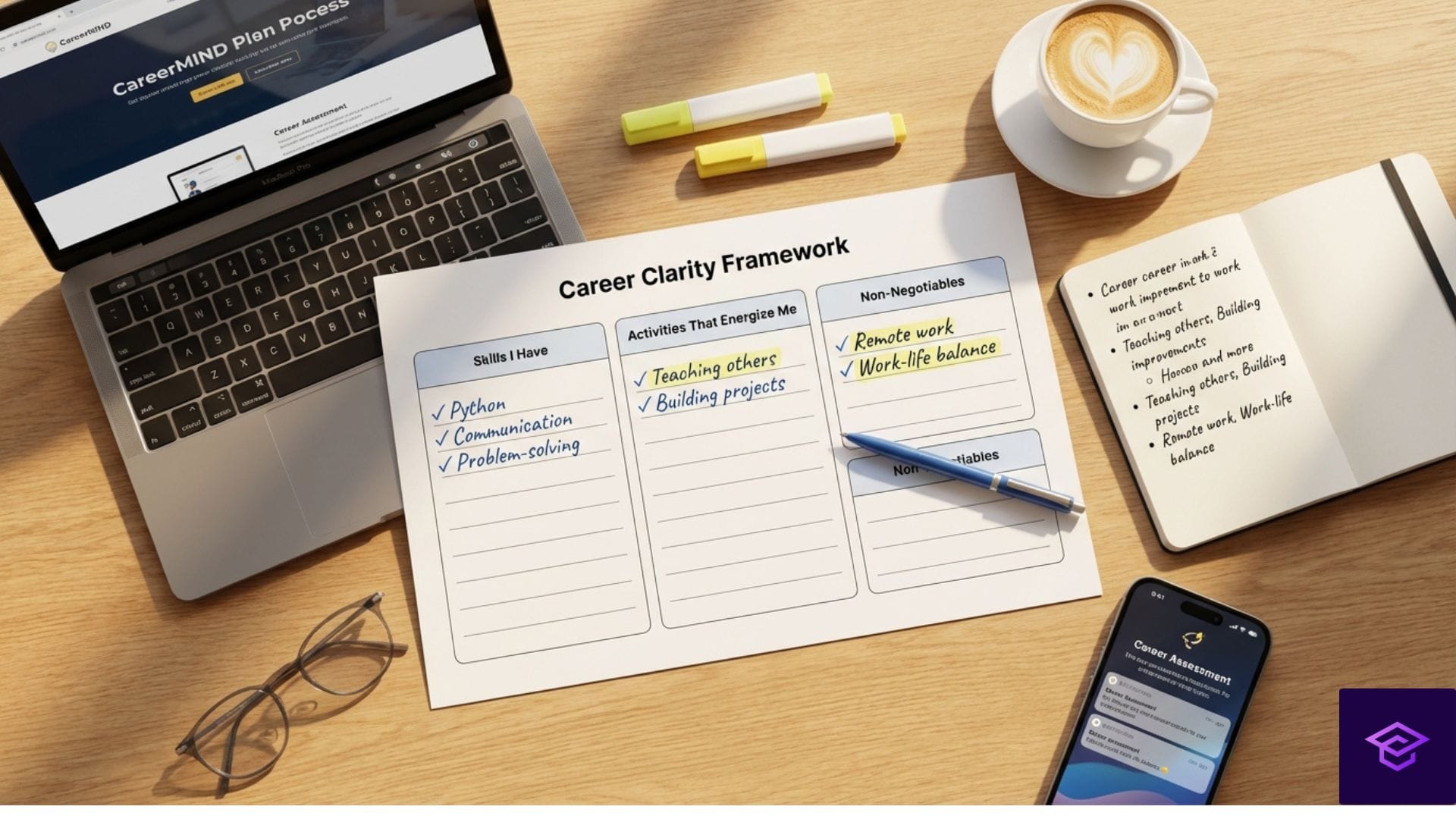
Column 2: Activities That Energize Me – What work tasks make time disappear? When do you feel most engaged? This isn’t about job titles—it’s about the actual activities. Maybe you love solving complex problems but hate routine maintenance. Maybe you thrive presenting to groups but wilt in one-on-one interactions. Maybe you’re energized by starting projects but bored by finishing them.
Column 3: Non-Negotiables – What absolutely matters to you? Not what should matter—what actually does. Maybe work-life balance is genuinely more important than prestige. Maybe remote work is essential. Maybe creative freedom trumps higher salary. Maybe learning opportunities matter more than job security. Be honest about your real priorities.
This framework, adapted from Stanford’s Design Your Life program, provides clarity not through eliminating options but through understanding what you’re working with. When you know your skills, preferences, and priorities, the overwhelming array of options becomes more manageable. You can eliminate entire categories that don’t fit and focus energy on areas with genuine potential.
Step 2: Reality Check Your Assessment
Now test if your self-assessment matches reality.
Validate Your Skills – Don’t just assume you’re good at something. Get evidence. Ask three people who’ve worked with you: “What do you think I’m genuinely good at?” Their answers might surprise you. Maybe the skill you think is your superpower is just average, while something you dismiss as “everyone can do that” is actually rare and valuable.
Track Your Energy Patterns – For one week, keep a simple energy log. After each work task or activity, rate it 1-10 on how energized or drained you felt. Patterns emerge fast. You might discover that “creative work” energizes you only when it’s collaborative, not solo. Or that “meetings” drain you except when you’re leading them. Specificity matters.
Stress-Test Your Non-Negotiables – Are they actually non-negotiable, or just preferences? Here’s the test: Would you turn down your dream job if it violated this? If “remote work” is non-negotiable but you’d relocate for the perfect role, it’s a strong preference, not a deal-breaker. Know the difference. Real non-negotiables should be short—3 to 5 maximum. Everything else is negotiable with the right trade-offs.
This reality check prevents self-deception. You’re not looking for the career that fits who you wish you were. You’re looking for the career that fits who you actually are.
Step 3: Pattern Recognition and Path Identification
Now connect the dots between your assessment and actual career options.
Look for Skill Clusters – Group your skills into themes. “Python + data analysis + explaining complex ideas simply” points toward data science, analytics, or technical education. “Calming upset people + problem-solving + written communication” suggests customer success, support leadership, or conflict resolution roles. The clusters reveal directions you might never have considered.
Match Activities to Roles – Research what people in different careers actually do daily. Not job descriptions—real accounts. If you’re energized by “solving novel problems with tight deadlines” but drained by “maintaining systems and documentation,” you want innovation or consulting roles, not operations or IT support. If you thrive on “teaching others” and “building things from scratch,” maybe you want instructional design, developer advocacy, or technical training.
Apply Your Non-Negotiables as Filters – Use them to eliminate entire categories fast. If “no long commute” is non-negotiable, remote-friendly industries move to the top. If “continuous learning” is essential, eliminate stable-but-stagnant sectors. If “creative freedom” matters most, corporate hierarchy-heavy fields drop off your list. Your non-negotiables aren’t restrictions—they’re efficiency tools that prevent wasting months exploring dead-end paths.
Identify Your Top 3-5 Possibilities – Based on your skill clusters, energizing activities, and non-negotiables, you should now have 3-5 specific directions worth exploring. Not 50. Not “I could do anything.” Three to five concrete options like “UX Research,” “Technical Writing,” “Data Analytics,” “Product Management,” or “Developer Relations.”
Write them down. These become your 30-day experiment candidates.
The goal isn’t perfect certainty—that’s impossible and unnecessary. The goal is narrowing from overwhelming infinity to manageable options you can actually test. That’s what the next step handles.
The 30-Day Career Experiment
Stop trying to make permanent decisions. Start running reversible experiments.
Choose one path you’re curious about. Spend exactly 30 days testing it through low-stakes exploration:
Days 1-7: Information gathering. Read industry publications, watch day-in-the-life videos, join relevant online communities. Goal: understand what people in this field actually do daily.
Days 8-14: Informational interviews. Contact 3-5 people currently in this role. Ask about their path, typical challenges, required skills, and biggest surprises. LinkedIn makes finding people easier than ever.
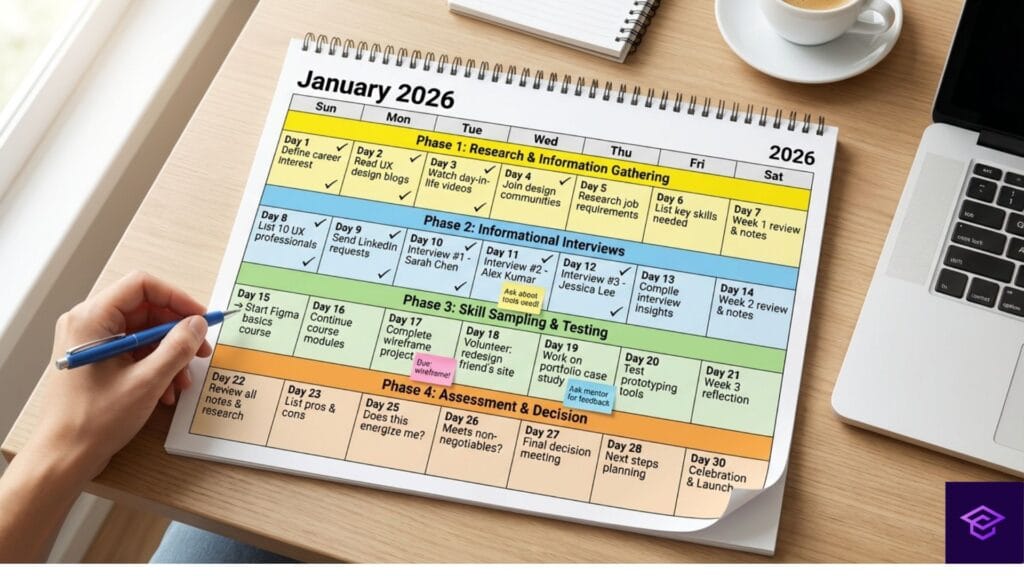
Days 15-21: Skill sampling. Take a short course, complete a mini-project, or volunteer for something that uses relevant skills. The goal isn’t mastery—it’s firsthand experience with whether you actually enjoy the work.
Days 22-28: Reality check. Based on your research and sampling, honestly assess: Does this align with your skills inventory? Would the daily reality energize or drain you? Does it meet your non-negotiables?
Days 29-30: Decision point. Continue exploring this path, pivot to test something else, or eliminate it entirely. Either way, you’ve gained real information instead of endlessly speculating.
This experimentation approach, developed by career coach Jenny Blake and refined by programs like CareerMIND, transforms exploration from overwhelming permanent decisions into manageable experiments. You’re not committing your entire future—you’re testing options with minimal risk.
Run 3-4 experiments. You’ll gain more clarity than six months of passive research.
Building Your Decision Filter
Create a one-page framework. This becomes your compass when opportunities arise.
Answer these questions:
- What are my three most important priorities? (Examples: autonomy, income stability, continuous learning, work-life balance, creative expression, social impact)
- What’s my risk tolerance? (Financial risk, career change risk, uncertainty tolerance)
- What’s my timeline? (Building toward a 2-year goal? 5-year vision? Optimizing for current life stage?)
- What trade-offs am I willing to make? (Lower salary for better culture? Less prestige for more flexibility? Corporate stability over startup excitement?)
- What are my deal-breakers? (Long commutes? High-stress environments? Lack of creative input? Constant travel?)
When facing decisions, evaluate options against this framework. Does an opportunity align with your priorities? Match your risk tolerance? Respect your deal-breakers? This provides structure for decision-making instead of drowning in unlimited possibilities.

Tools like CareerMIND’s Career Clarity Assessment can help you develop and refine this framework through guided self-reflection and evidence-based matching algorithms that consider both your skills and preferences.
The goal isn’t eliminating uncertainty—that’s impossible. The goal is making informed decisions aligned with what actually matters to you, then adjusting as you learn more.
Ready to Take Action?
Career confusion doesn’t have to paralyze you. Download our free Career Clarity Worksheet to implement the 3-Step Framework today, or explore how CareerMIND’s AI-powered platform can help you discover paths that align with your unique skills, values, and goals.
Stop endlessly researching. Start experimenting. Clarity comes from action, not contemplation.
Conclusion
Career confusion in 2026 isn’t a personal failure. Read that again.
You’re not lost because you’re incompetent, unmotivated, or behind. You’re experiencing a rational response to genuinely unprecedented circumstances. We’re navigating technological disruption that’s reshaping entire industries monthly. Economic uncertainty that makes long-term planning feel absurd. Information overload that creates paralysis instead of clarity. Social media that distorts our perception of normal progression.
Previous generations had clearer paths, more stable markets, and fewer overwhelming options. They’re not smarter or more decisive than you—they faced fundamentally different conditions.
But here’s what matters: understanding why this has become epidemic doesn’t solve it, but it does provide perspective. You can acknowledge the external forces creating uncertainty while still taking steps forward. You can make imperfect decisions and adjust as you learn. You can experiment with different paths without committing your entire future to each one.
Your path doesn’t have to be perfect. It doesn’t have to look like the highlight reels you see on LinkedIn. It doesn’t have to follow anyone else’s timeline or definition of success. It just has to be yours—built through honest self-assessment, low-stakes experimentation, and decisions aligned with what actually matters to you.
The clarity you’re seeking doesn’t come from finding the one perfect option. It comes from developing a framework for navigating uncertainty, the courage to experiment despite incomplete information, and the wisdom to adjust as you learn more about yourself and the evolving landscape.
Start small. Run one 30-day experiment. Complete your skills inventory. Build your decision framework. Take one step forward, even if the entire path isn’t visible yet.
That’s not settling. That’s wisdom.
FAQs About Career Confusion
Q1: Why is career confusion so much worse in 2026 than in previous years?
AI threatens 300 million jobs, career options exploded to 35,000+ job titles (versus hundreds traditionally), economic volatility is high, and social media fuels comparison culture. 44% of workers’ core skills will be disrupted by 2028. Previous generations had stable markets and clear paths—fundamentally different conditions.
Q2: Will AI really make my career obsolete?
Possibly, but not definitely. Rather than avoiding entire fields (68% of students do), develop skills that complement AI: creative problem-solving, emotional intelligence, strategic thinking, and complex communication. Focus on skills AI amplifies (strategic thinking, relationship building, creative innovation) rather than replaces (routine analysis, template-based writing, basic coding).
Q3: How do I stop comparing my career to social media?
Thirty minutes of daily LinkedIn increases dissatisfaction by 41%. Limit exposure to 15 minutes daily, unfollow triggering accounts, build your framework based on your priorities, and remember 89% of “overnight success” omits years of struggle. Focus on your month-over-month progress, not others’ outcomes.
Q4: Should I go back to school to find clarity?
Usually no. 43% of graduates are underemployed, and 52% work outside their major. Run experiments first—a $500 online course provides more information than a $50,000 untested degree. If experiments confirm a direction requiring credentials (medicine, law), then pursue education. Don’t use school to avoid decisions.
Q5: I’m paralyzed by too many options. What’s my first step?
Complete the self-inventory (skills, energizing activities, non-negotiables)—2-3 hours provides more clarity than months of searching. Then run one 30-day experiment on the side to test an alternative. The goal is gaining clarity to make one informed move forward. CareerMIND’s assessment identifies matching paths without overwhelming you.