Table of Contents
Introduction
Feeling stuck in your job? You’re not alone — 67% of American workers say they are heading in the wrong direction with their job.
You might need a career assessment to help you rise out of the confusion. Whether you’re a new grad who doesn’t know what to do with your degree, a mid-career professional who’s feeling unfulfilled, or someone else wanting to make a major career move, knowing how this assessment works can be the difference between staying stuck and finding real clarity.
This is the thing about career assessments: They’re not magic. They will not tell you which job to take or promise that you will love your work. But what they will give you are data-driven insights about yourself that few people ever receive.
In this guide, you’ll learn what a career assessment actually measures, how it’s different from a personality test, which kind of test would be best for your situation and its limitations, and how to actually use the results to make better decisions.
What is a Career Assessment?
A career quiz is a formal personality and aptitude tool designed to assist you in determining how your specific skills, interests, values, or personal traits relate to relevant experiences in various career areas. Unlike a basic personality test, which only looks at one dimension of who you are, an overarching life assessment takes into account multiple factors when it comes to satisfaction.

Call it a GPS for your professional life. Just as a GPS requires your current location and destination to provide you with directions, this tool needs to know where you are right now and what’s important to you in order to identify the routes ahead.
The Science Behind Career Assessments
Current career assessments are based on decades of occupational psychology research. The better tools use proven frameworks that have been tested on thousands of professionals from all walks of life, ages, and industries.
At CareerMIND, we work within a 6-dimensional framework, and it’s not your typical personality typing. Based on your background, interests, personality, skills, values, and work preferences, our career assessment simply builds a personalized experience of who you are as a professional.
Career Assessment vs Personality Test: What’s the Difference?
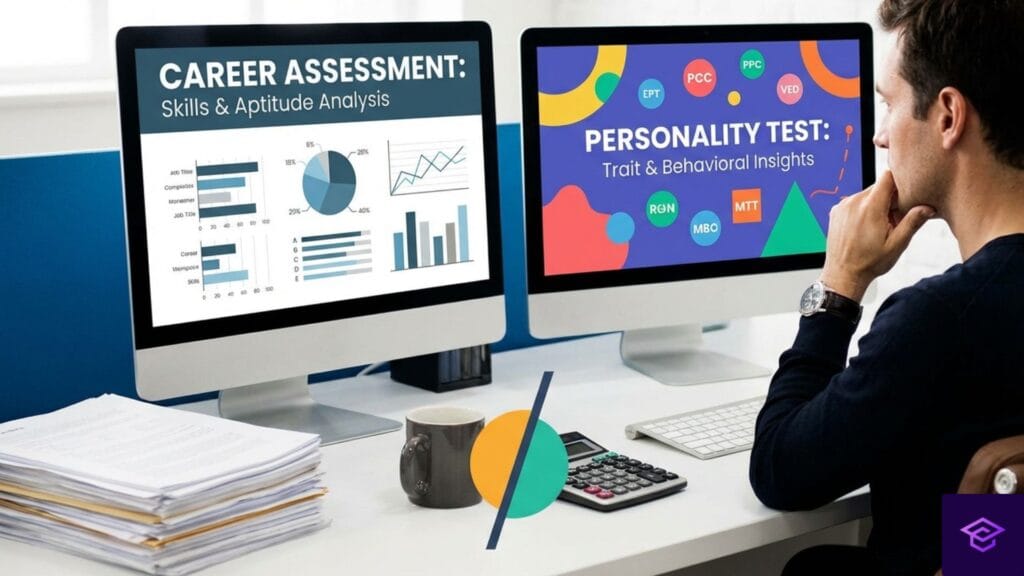
Here’s where it gets tricky for most people. Even though you may see the terms used interchangeably sometimes, taking a personality test and undergoing a career assessment are not synonymous.
A personality test, such as Myers-Briggs (MBTI) or Big Five, gauges how you process information, communicate with others and move through the world. It is telling you that you are an INTJ, or an extrovert. That’s helpful information, but it is incomplete for career planning.
Why Personality Alone Isn’t Enough
Let’s say you’re an introvert. Does that mean you cannot be in sales? No. Does it mean you shouldn’t be a teacher? Also no. Personality does play a role, but such an evaluation would consider the whole picture.
A full career assessment does include personality as a dimension, but not the only one — also part of it is what you’re good at (skills), where you’re naturally motivated (values), what interests you to read or talk about (topics and activities), things that have moved you in the past (background) and the way you’d like to work with people: remote vs office, autonomy vs structure.
The Problem with Personality-Only Career Tests
Personality-only assessments too often guide people toward careers that “fit” their personality type but have nothing to do with their abilities or value system. You may be a wonderful ENFP, but if you loathe conflict and value stability, that “perfect fit” crisis management job isn’t going to satisfy you.
And that’s why a multi-pronged approach is more successful. It captures the mismatches that personality tests overlook.
More than 70% of American workers do not work at something related to their college major, Bureau of Labor Statistics research finds – putting paid to the idea that interest and personality can predict career satisfaction.
Types of Career Assessments: Comparison
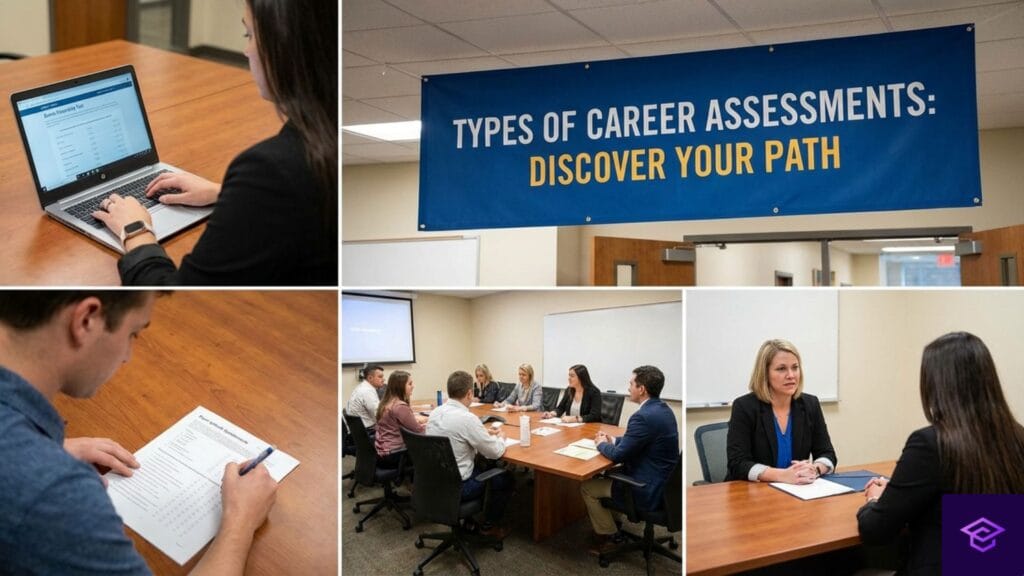
Not all career assessments are created equal. Here’s how the main types compare:
| Assessment Type | What It Measures | Best For | Typical Cost | Limitation |
| Personality-Only | How you think and interact (MBTI, Big Five) | Self-awareness | Free-$50 | Ignores skills, values, interests |
| Interest-Based | Topics and activities you enjoy (Holland Code/RIASEC) | Career exploration | $50-$100 | Doesn’t assess ability or values |
| Skills-Based | Hard and soft skills you possess | Job matching | $30-$80 | Being good ≠ enjoying it |
| Values-Based | What matters most to you at work | Alignment check | $40-$75 | Doesn’t assess capabilities |
| Multi-Dimensional | All 6 dimensions combined | Complete career clarity | $19/mo (CareerMIND) | Requires honest self-reporting |
Interest-Based Career Assessments
Interest-based assessments evaluate the types of topics, activities, and work settings that interest you. The most well-known one is the Holland Code (RIASEC) that classifies interests into six types: Realistic, Investigative, Artistic, Social, Enterprising and Conventional.
These are great tools for discovering new paths you’d never considered (but that might be a perfect fit), not so much when it comes to knowing what you’re actually good at, or if those so-called interests would be able to carry you through a shitty week at work.
Skills-Based Career Assessments
Skills assessments measure what you’re really good at, including hard skills (for example, coding or data analysis) and soft skills (such as communication or problem-solving). These assessments are pragmatic, because they focus on what you can do value while says something about your abilities.
The downside? If you are good at something, it doesn’t mean that you will enjoy doing it for 40 hours a week over the course of a decade.
Values-Based Career Assessments
Values assessments pinpoint what matters most to you in work: autonomy, impact, security, creativity, helping others, financial reward, work-life balance and so on.
The values-focused tool is so important because values misalignment is the number-one reason people feel stuck or unfulfilled in even their “successful” careers. You can be doing very well, status-and be completely miserable if your core values aren’t being fulfilled.
Comprehensive Multi-Dimensional Career Assessments
The best tools will offer all of the above. They consider your interests, skills, values, personality, background, and preferences to get a full picture of you.
CareerMIND does this. Our assessment doesn’t only tell you one thing about yourself — it tells you how the pieces of your personality fit together, and where that fits you in different career paths.
How to Choose the Right Career Assessment
There are hundreds of them, so how do you decide which one to use?
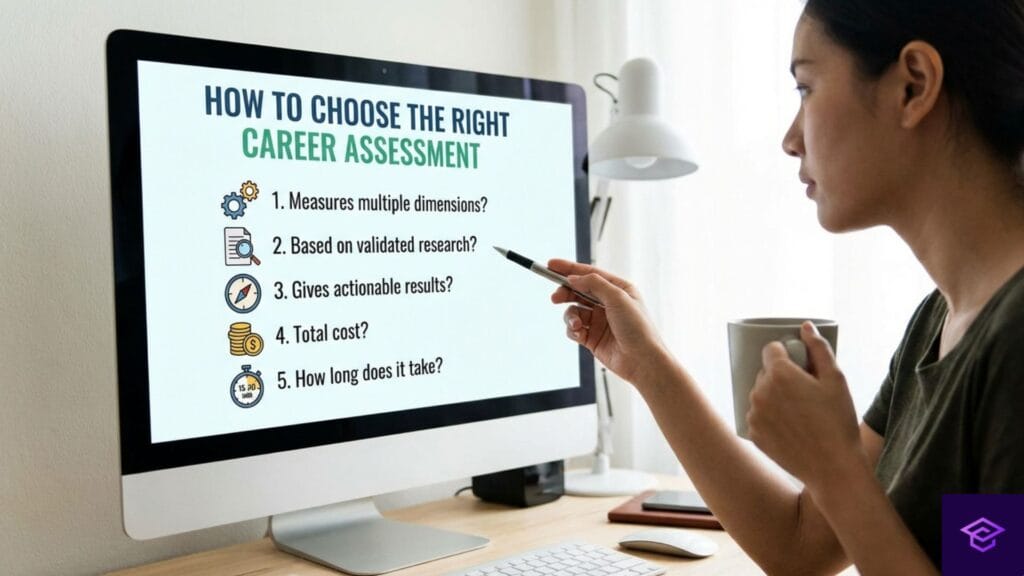
Ask These 5 Questions Before Taking Any Career Assessment
1. Does it measure multiple dimensions or just one? When it only measures personality or interests, it is incomplete.
2. Is it based on validated research? Search for instruments based on psychological models and evidence that have been validated in real populations. Gallup research shows that a thorough assessment is a better predictor of job satisfaction than single-dimension tests are.
3. Does it give you actionable results? It’s interesting to know you’re a four-letter personality type, but does it really tell you what kinds of careers are worth exploring?
4. What’s the total cost? Few are charging less than $300 a session. Others, like CareerMIND, include full assessments at a cost of $19/month (or cheaper than those Netflix and Spotify plans).
5. How long does it take? Quality checks usually take 15-30 minutes. Anything less is likely to fall short of being comprehensive.
Red Flags to Avoid in Career Assessments
Stay away from anything that says it will tell you “the one perfect career.” That’s not how careers work. You’re not a puzzle piece you put in just one place.
Skip also assessments that pose vague or poorly worded questions like, “Do you enjoy working with people?” We all like working with people in certain situations and loathe it in others. Great tools ask you to turn your attention away from everything else and answer a narrow, contextual question.
What a Good Career Assessment Should Measure
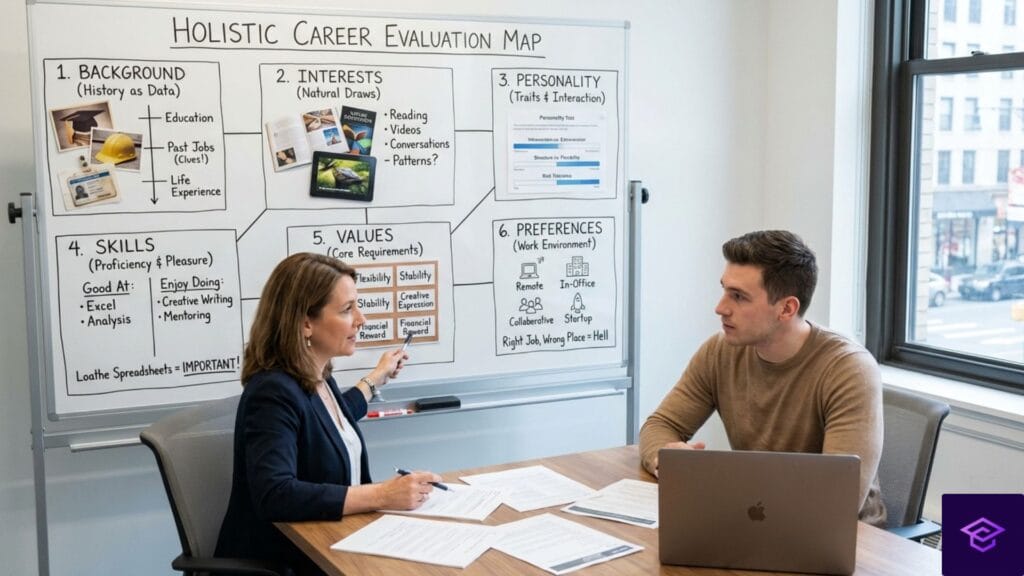
Here are six dimensions that should be covered in a thorough evaluation.
Dimension 1: Background
Your history is the sum of your education, employment , and life experience. There’s a good career assessment that doesn’t regard your past as a limitation but rather as data. Every job you’ve ever held, even the ones that sent you home wanting to curl up in a ball, holds clues about what does and doesn’t work for you.
Dimension 2: Interests
What are some subjects that you find yourself naturally drawn toward? What do you read about, watch videos on, or talk about when you aren’t getting paid? A good tool will recognize patterns in your interest data and guide you toward areas of study that you might not have thought of.
Dimension 3: Personality
How do you take in information and make decisions, recharge your energy, and deal with others? A decent assessment will take into account personality traits that influence job satisfaction: introversion vs extroversion, a preference for structure vs flexibility, conflict tolerance, risk aversion, and the list goes on.
Dimension 4: Skills
What do you actually do well? And equally as important, what skills do you find pleasure in exercising? A good assessment tells you what you are already very skilled in, as well as what skills you have that you would also like to use. You could be a whiz at Excel and loathe spreadsheets. That matters.
Dimension 5: Values
What do you require to experience fulfillment from work? A good assessment will also dig into your underlying values: Is it flexibility, a crusader ethos, stability and security, creative expression, or financial reward? When your work goes against your values, you’ll notice it every day.
Dimension 6: Preferences
How do you want to work? Remote or in-office? Independent or collaborative? Fast-paced or steady? Big company or startup? The right work environment is taken into account for a full evaluation, as the “dream job” with the wrong workplace can be hell.
Ready to Discover Your Career Dna?
Want to see how all six dimensions apply to your unique profile?
CareerMIND’s career test is quick (just 10 minutes) and gives you 3-5 personalized career matches based on a holistic view of who you are (not just one dimension).
Over 50,000 professionals have found career clarity with CareerMIND. For $19/month (less than two Starbucks runs), you get:
- 6-dimension evaluation
- Personalized career matches
- 24/7 AI career coach (Alex)
- 30-day action plan
What to Expect: Sample Career Assessment Questions
Wondering what you’ll actually be asked? Here are examples from each type:
Interest-Based Questions:
- “Rate your interest in analyzing financial data: Not interested / Somewhat interested / Very interested.”
- “How appealing is: Working with your hands to build or repair things?”
Skills-Based Questions:
- “How proficient are you at public speaking: Beginner / Intermediate / Advanced?”
- “Rate your ability to resolve conflicts between team members.”
Values-Based Questions:
- “Rank these in order of importance: High salary, Creative freedom, Job security, Helping others, Prestige.”
- “Would you trade $20K salary for full remote flexibility?”
Comprehensive Multi-Dimensional Questions:
- “Describe a time you felt energized at work. What were you doing, who were you with, and what made it satisfying?”
- “If money weren’t a factor, what problems would you want to solve?”
Quality tools use contextual, specific questions—not vague generalities.
How to Actually Use Your Career Assessment Results
Take a career assessment. Though calling the shots in your professional life is thrilling, it can be daunting to figure out where to start. Where most folks fail, however, is in how they use the results.
Don’t Treat Results as Final Verdicts
Your findings, those are insights, not instructions. If the test results show you would be a star in accounting , but thinking about it makes you want to nap, don’t force it. The tool tells you patterns and possibilities — you decide when to use it.
Look for Patterns, Not Single Matches
A good assessment should offer several possible careers, not just one. Identify themes among the suggestions. Are they all people-focused? Data-driven? Creative? Those patterns tell you more than any one recommendation.”
Test Your Results in the Real World
And after you do your due diligence, don’t just settle on a career and invest five years. Test it. Talk to people in that field. Do informational interviews. Tackle a side project on that front. Your test results point you — real-world experience verifies it

Create an Action Plan from Your Career Assessment
Here’s what to do after getting your results:
- Identify your top 3-5 career matches
- Research each one—day-to-day responsibilities, salary ranges, required skills, growth potential
- Connect with people actually doing those jobs (LinkedIn is perfect for this)
- Experiment with one aspect of the career before making a big leap
Common Career Assessment Mistakes to Avoid
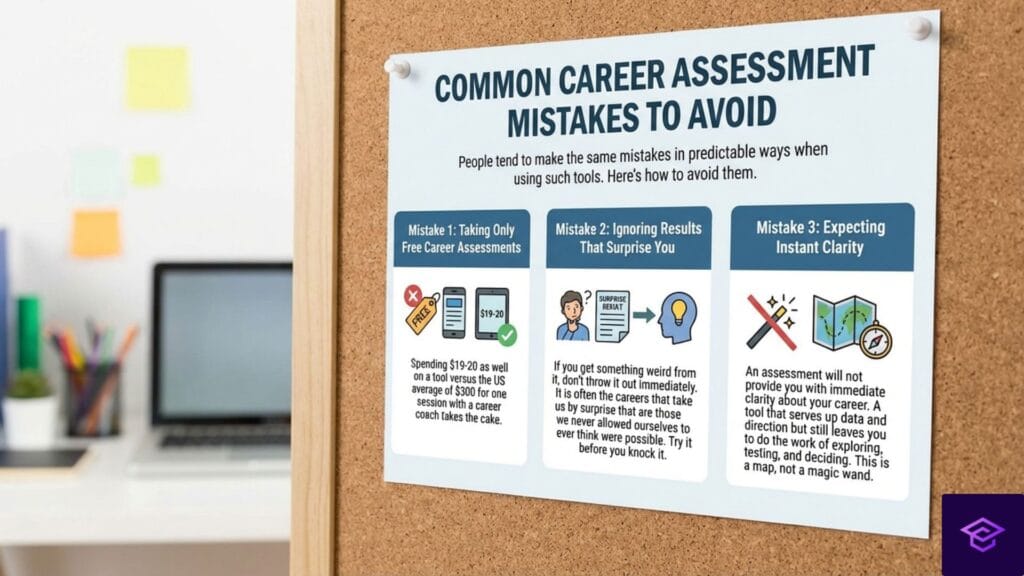
People tend to make the same mistakes in predictable ways when using such tools. Here’s how to avoid them.
Mistake 1: Taking Only Free Career Assessments
Free ones are free for a reason. They’re all either marketing tools for paid services or surface-level versions that don’t provide you with the depth necessary to use them well. Spending $19 as well on a tool versus the US average of $300 for one session with a career coach takes the cake.
Mistake 2: Ignoring Results That Surprise You
If you get something weird from it, don’t throw it out immediately. It is often the careers that take us by surprise that are those we never allowed ourselves to ever think were possible. Try it before you knock it.
Mistake 3: Expecting Instant Clarity
An assessment will not provide you with immediate clarity about your career. A tool that serves up data and direction but still leaves you to do the work of exploring, testing, and deciding. This is a map, not a magic wand.
Career Assessment Success Stories
Real people use these tools to make real changes.
Success Story: From Stuck Accountant to Thriving Consultant
Profile: Sarah, 32, CPA
Before: Successful accountant, creatively stifled, felt “successful but empty.”
Assessment Revealed: Values misalignment (creativity, autonomy, impact ranked highest)
Career Match Suggested: Project management & business consulting
After: Made the switch to consulting. “I’m happier than I’ve been in 10 years. I didn’t know work could feel this aligned.”
Success Story: From Lost Grad to Purposeful Freelancer
Profile: Maya, 24, Communications degree
Before: No idea what to do with degree, comparing self to peers who “had it figured out.”
Assessment Revealed: Values helping others + prefers independent work
Career Match Suggested: Freelance content strategy for nonprofits
After: Building a thriving business. “A career path I’d never considered became the perfect fit.”
Key Takeaways: Career Assessment Summary
These tools are powerful when used correctly. Here’s what to remember:
- A comprehensive career assessment evaluates multiple dimensions—not just personality or interests alone
- The best tools are research-backed, specific, and actionable
- Your results are insights, not orders—you make the final decisions
- Test your findings in the real world before making major changes
- Assessments work best when combined with research, conversations, and experimentation
- Expect to invest 15-30 minutes for a quality evaluation
- Multi-dimensional tools predict career satisfaction better than single-dimensional tests
Ready to Take Your Career Assessment?
Career clarity begins with self-awareness. A Summary Analysis provides you with the information necessary to stop guessing and make informed decisions.
Witha career assessment based on 6 dimensions, including your background, interests, personality, skills, values, and work preferences, you’ll receive personalized matches of 3-5 careers. For less than what you spend on coffee, you have access to the entire assessment, an AI career coach who is available 24/7, and a full career clarity toolkit.

Some 50,000-plus professionals have already found theirs. You’re next.
Stop wondering if you are in the right field. Find out.
FAQ: COMMON QUESTIONS ABOUT CAREER ASSESSMENTS
What is the best career assessment test?
The most useful kinds of career assessments assess multiple dimensions — not just personality. Select tools like CareerMIND that assess all six factors: background, interest, personality, skills, values and preference. Do not rely on one-dimensional tests (e.g., Myers-Briggs or Holland Code). Instead, seek out scientifically-supported assessments that give you real career matches for $15-30/month, not over-priced single evaluations.
How much does a career assessment cost?
Career assessment prices range from free to $500+. Free resources offer surface insights, though no depth. Professional assessments cost $50-150 one-time. Career coaches cost $300-500 per session. Tools that involve a subscription have evolved to include substantive ongoing AI coaching: CareerMIND, at $19/month, offers bang for its buck in terms of comprehensive guidance.
Can a career assessment tell me what job to get?
NO You review 3-5 matches of your career that are matched to you, and you decide to pursue them. Think of it like Netflix recommendations: It recommends options based on your preferences, but you decide what works. Use the assessment information together with informational interviewing and field testing to make a career change.
Do career assessments actually work?
Yes, when used correctly. Multi-measure assessments can predict job satisfaction well (65-70% accuracy). They do a good job if you: (1) respond honestly, (2) select tools of the trade, (3) view results as guidance, not bible truth and (4) take suggestions for a test drive in the real world. They do fail when people depend on personality-only tests or seek immediate fixes.
What’s the difference between a career test and a personality test?
Personality tests (e.g., MBTI, Big Five) measure your thinking patterns and how you interact with others—only one dimension. Personality assessments plus skills, interests, values, background and work preferences. But for most of us, being an introvert doesn’t chart our careers any more than nonintroversion does — although if you combine that with good writing abilities and a desire to work solo, it may suggest certain avenues like content strategy or research.