
Table of Contents
Introduction
85% of people hate their jobs. And the job market in 2026 isn’t fixing that automatically; it’s making career confusion worse for anyone who doesn’t know what actually changed. Not what the headlines say changed. What actually changed? Because there’s a real gap between those two things right now.
The job market 2026 has reshuffled industries, raised the bar for what “qualified” means, and completely killed the old resume-and-wait playbook. If you’re still operating on 2022 assumptions, you’re not just behind, you’re invisible to the employers who matter most in the current job market.
This is not a “here are some tips” article. It’s a true breakdown of what the job market looks like in 2026: who is hiring, what they’re looking for, which sectors are growing and which are contracting, and how exactly to position yourself to win. If you are a recent graduate, midcareer professional considering a pivot, or senior executive wondering whether your skills still translate, the 2026 job market will hit you differently. Let’s get specific.
What’s Actually Driving the Job Market in 2026
The job market 2026 is being shaped by three forces colliding at the same time: AI adoption, economic recalibration, and a massive generational shift in the workforce. None of these is slowing down. And together, they’ve created a job market that rewards adaptability above almost everything else.
A.I. did not “kill jobs” as people worried, but it definitely changed them. This job market requires more and more people who can actively engage AI tools, rather than just using them as passive crowds. Think prompt engineering and review of AI output, workflow automation, and human-in-the-loop decision-making. Companies aren’t swapping out their entire workforce. They’re automating the task-level work and then relying on their people to fill in any judgment gaps AI can’t.

At the same time, the economic recalibration of the last two years created a hiring market that’s selective but genuinely active. Employers in the 2026 job market are hiring for impact, not headcount. They want fewer people who do more, which sounds harsh but actually creates real opportunity for candidates who show up prepared with specific, quantifiable proof of what they can do.
The Generational Shift Reshaping the 2026 Job Market
Here’s something the headlines consistently underplay about the job market 2026: Baby Boomers are exiting the workforce faster than new workers are replacing them in skilled roles. According to the Bureau of Labor Statistics, retirements in management, healthcare, and skilled trades have accelerated significantly since 2023, creating real structural gaps not just in tech, but across almost every established industry.
The job market in 2026 isn’t just about landing a new role in a hot sector. It’s about every industry scrambling to fill mid-to-senior positions vacated by experienced professionals. If you have 5–15 years of experience in almost any field, the 2026 job market may have more legitimate opportunities for you than at any point in the last decade. The challenge is knowing where to look and how to frame what you bring.
Sectors Shrinking in the Job Market 2026
Let’s start here because this is what people actually worry about — and it’s the section that earns trust.
The job market in 2026 has real losers. Traditional media has shed jobs at a rate not seen since the 2008 recession, with print, broadcast, and legacy digital newsrooms continuing to contract as AI-generated content floods lower-margin content categories. Lower-level legal and accounting work — document review, basic bookkeeping, routine contract drafting — has been significantly automated. Entry-level customer service, data entry, and basic administrative roles have seen the steepest overall job market declines across nearly every sector in 2026.
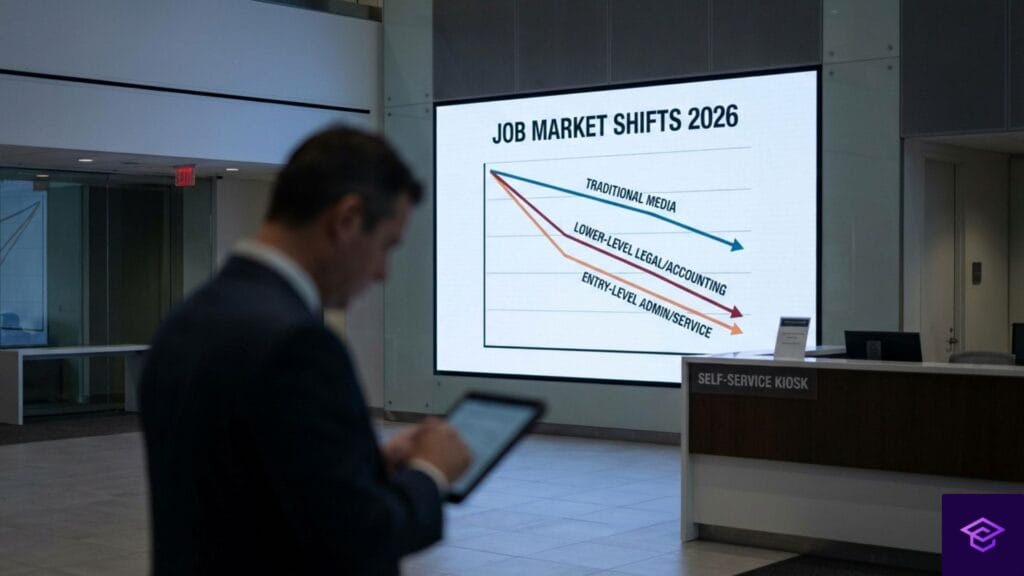
This doesn’t mean careers in these areas are dead. It means the floor-level positions that used to serve as entry points are largely gone. The job market in 2026 still needs senior journalists, litigation attorneys, CFOs, and customer experience strategists. It just doesn’t need as many people doing the low-complexity work beneath them anymore.
Understanding which parts of your industry are vulnerable is the first step to protecting yourself in the 2026 job market — and reframing your skills toward the work that can’t be automated.
Fastest-Growing Sectors in the Job Market 2026
Not all sectors of the job market in 2026 are growing equally. Here’s where the real momentum is.
Technology and AI Infrastructure
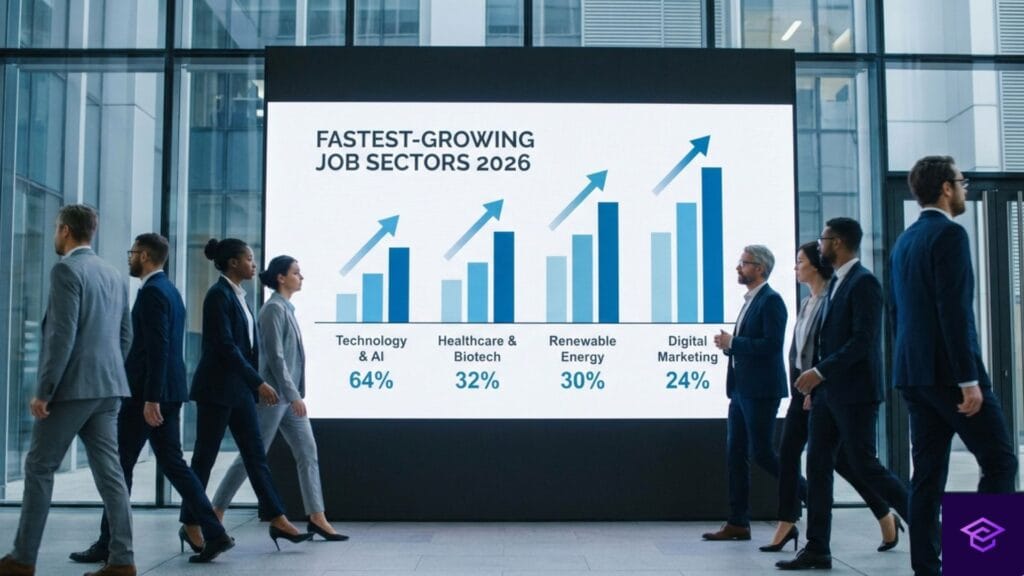
The job market 2026 tech boom isn’t about software engineering the way it was in 2020. Pure coding has become increasingly commoditized. The demand has shifted hard. The job market in 2026 needs AI trainers, data annotators, prompt engineers, machine learning ops specialists, and — critically — people who understand both the business problem and the AI solution. People who can bridge strategy and technology? The 2026 job market is wide open for them, and compensation reflects it.
Healthcare and Biotech
Healthcare represents one of the most structurally stable job market 2026 growth sectors in the country. The combination of an aging population, expanded behavioral health coverage, and post-pandemic infrastructure investment has created sustained demand. According to the Bureau of Labor Statistics, healthcare occupations are projected to add more jobs than almost any other sector through 2032. The job market in 2026 for nurses, medical technologists, healthcare administrators, and mental health professionals is genuinely strong — not just trending, structurally driven.
Biotech specifically has seen a surge in job market 2026 openings tied to personalized medicine, longevity research, and AI-assisted drug discovery. These roles barely existed five years ago.
Green Energy and Climate Tech
The Green Energy job market 2026 stopped being a “trend” category around two years ago. It’s infrastructure spending being directly turned into full-time jobs — solar installation, grid modernization, EV manufacturing, energy usage efficiency consulting, and carbon accounting, all watching as they become recognized career paths with compensation structures on a par with traditional finance/tech roles. This report notes that over the next ten years, job demand for climate-adjacent roles is anticipated to grow at 2–3x the rate of the entire economy (the larger job marketplace), and by 2026, ‘[LinkedIn’s] workforce insights indicate that professionals who work on climate-focused projects will comprise a significant portion of our jobs.
Not sure which of these job market 2026 growth sectors actually fits who you are? That’s the real question — and it’s the one most career articles skip entirely. CareerMIND’s 6 Dimensions assessment matches you to careers based on your Background, Interests, Personality, Skills, Values, and Preferences. Not just what’s trending. What’s right for you specifically. Try it at careermind dot app, that’s less than a single session with a career coach before you even finish introductions.
What Employers Actually Want in the Job Market 2026
The job market of 2026 has changed what a strong candidate looks like at every level. Hiring managers are screening differently. The skills that got you hired in 2021 are table stakes now — or irrelevant. Here’s what actually moves the needle in the current job market.
AI Literacy Is Non-Negotiable in the 2026 Job Market
You don’t need to be an AI developer to thrive in the job market in 2026. But you absolutely need to demonstrate that you use AI tools effectively, you understand their limitations, and you can improve the quality of AI output. Candidates who show up to job market 2026 interviews, unable to speak to how they’ve integrated AI into their daily workflow, are getting passed over — regardless of their other qualifications.
From a practical standpoint, get experience with at least two or three tools used in your field. For marketers: Claude, Jasper, Midjourney. For analysts: Copilot, Gemini, DataRobot. For ops: Zapier AI, Notion AI, Make. Then document the results. “Employed AI to cut content production time 60%” is a resume bullet that gets callbacks in the job market of 2026. “Familiar with AI tools” is not.

According to LinkedIn’s Skills on the Rise data, AI literacy is now the single fastest-growing skill requirement across job postings in the job market in 2026 — appearing in over 40% more listings year-over-year. That’s not a trend. That’s a new baseline.
Soft Skills Are Worth More Than Ever in the 2026 Job Market
Here’s the irony — as AI handles more tasks, the job market of 2026 has seen demand skyrocket for deeply human skills. Communication. Emotional intelligence. Conflict resolution. Creative problem-solving. Leading through ambiguity. These are the things AI cannot replicate, and employers in the job market in 2026 know it. Gallup research consistently shows that managers with high emotional intelligence outperform their peers across every measurable business outcome — and the 2026 job market is pricing that accordingly.
The candidates who stand out in the current job market combine technical competence with strong interpersonal ability. If you’ve always thought your people skills were a “soft” advantage, the job market of 2026 is finally giving them a hard dollar value.
Demonstrable Outcomes, Not Just Experience
The 2026 job market has fully shifted from credential-checking to proof-seeking. Employers want to know what you actually accomplished — not just where you worked and for how long. A resume that says “managed social media accounts” is dead in the job market of 2026. A resume that says “grew LinkedIn organic reach 340% in 6 months by implementing a data-driven content calendar that reduced production time by 4 hours per week” gets calls back.

Every single bullet point on your resume needs to answer: so what? The job market in 2026 rewards specificity. Go back through your last three roles and find the numbers — revenue generated, time saved, processes improved, team size managed, and cost reduced. If you don’t have exact figures, estimate conservatively and note “approximately.” In the 2026 job market, a rough number is infinitely more compelling than a vague description.
Job Market 2026 Tip: The “So What” Audit
Take 30 minutes. Open your resume. For every bullet point that doesn’t include a number or a named outcome, ask: “So what?” If you can’t answer it in one sentence with a specific result, rewrite it before you apply to another role in the job market in 2026. This single exercise has been called the highest-ROI resume activity by career coaches charging $300/session — and it costs you nothing but time.
How to Actually Get Hired in the Job Market 2026
Knowing the landscape is one thing. Winning in it is another. Here’s what actually works in the current job market, not what sounds good in theory.
Stop Spray-and-Praying in the Job Market 2026
Mass-applying is dead. With AI-powered applicant tracking systems screening resumes before a human ever opens them, generic applications get filtered out automatically in the job market of 2026, no matter how qualified you actually are. According to Jobscan research, over 75% of resumes are rejected by ATS software before reaching a recruiter. In the job market in 2026, quality beats volume every single time.

From a practical standpoint, get experience with at least two or three tools used in your field. For marketers: Claude, Jasper, Midjourney. For analysts: Copilot, Gemini, DataRobot. For ops: Zapier AI, Notion AI, Make. Then document the results. “Employed AI to cut content production time 60%” is a resume bullet that gets callbacks in the job market of 2026. “Familiar with AI tools” is not.
Build a LinkedIn Presence That Works for the Job Market 2026
In the job market of 2026, your LinkedIn profile is your actual first impression before your resume, before your cover letter, before the interview. If your profile is a dusty list of job titles with no recent activity, no recommendations, and no evidence of thinking, you are invisible in the 2026 job market. Recruiters actively sourcing candidates in the job market in 2026 filter by profile freshness, engagement signals, and content activity.
The minimum viable LinkedIn presence for the current job market: update your headline to reflect what you do and what value you create, not just your job title. Post once a week — even a short observation about your industry counts. Comment meaningfully on others’ content. Ask two former colleagues for recommendations. That’s it. The job market 2026 rewards people who show up as visible, engaged experts, not just passive applicants hoping to be found.
Know Your Career DNA Before You Search
This is the most underrated move in the entire job market 2026 playbook. Most people applying in the current job market choose roles based on salary and title without deeply understanding what they actually need to feel fulfilled long-term. That leads to taking the wrong job, burning out 18 months in, and repeating the cycle. The job market in 2026 has more options than ever. That’s a gift and a trap at the same time.
Take Marcus as an example. He was a successful marketing manager at a tech company, 33 years old, good salary, respectable title, absolutely miserable. He was being rejected all over the 2026 job market for “senior marketing roles,” because that’s what looked right on paper. In fact, what his results through CareerMIND’s 6 Dimensions assessment revealed was that my highest-rated Values were autonomy and mission alignment; my Interests heavily indexed toward education and social impact; and my Preferences required a strong collaborative team environment. In fact, the 2026 job market would have dozens of such roles that fell within that description perfectly, none of them included “senior marketing manager” in the title. He shifted to an education technology company in a content strategy position. Same skills. Completely different level of fulfillment.

Before you dive deeper into your job market 2026 search, get clear on your 6 Dimensions: Background (what you’ve built), Interests (what energizes you), Personality (how you work best), Skills (what you’re genuinely great at), Values (what must be true for you to thrive), and Preferences (what environment you need to perform). The job market in 2026 has no shortage of jobs. Finding the right one takes clarity first; everything else is faster and easier once you have it.
CareerMIND runs your 6 Dimensions and surfaces 3–5 career matches that actually fit your full profile, not just what’s hiring right now in the job market 2026, but what’s built for how you specifically work. No career coach hourly rate. No $15,000 bootcamp. Just clarity. Try it at careermind dot app.
Key Takeaways: Navigating the Job Market 2026
- The job market 2026 rewards AI literacy, demonstrable outcomes, and human skills — not credentials alone.
- Healthcare, climate tech, and AI infrastructure are the strongest structural growth sectors in the current job market.
- Traditional media, entry-level legal, and low-complexity admin roles face the steepest job market 2026 contractions.
- Soft skills have never commanded higher premiums in the job market in 2026 — because AI can’t replicate human judgment.
- ATS filters kill generic applications: quality, targeted outreach outperforms volume in the 2026 job market every time.
- Knowing your career DNA — your 6 Dimensions — is the most underrated advantage in the job market 2026.
Ready to Find Your Place in the Job Market 2026?
Stop guessing. Start matching.
67% of professionals feel stuck in the wrong career right now. Most of them are applying to jobs in the job market 2026 based on what looks right on paper — not what actually fits who they are. CareerMIND changes that.
Our 6 Dimensions assessment analyzes your Background, Interests, Personality, Skills, Values, and Preferences to surface 3–5 careers that genuinely match your full profile. Not what’s trending in the job market in 2026. What’s right for you specifically. With a 30-day action plan, AI career coach, resume prep, and job tracker included.
Career coaches charge $300–$500 per session. CareerMIND is $19/month. One month of clarity costs less than a single hour of coaching — and it’s available right now at careermind.app.
The job market 2026 has the roles. CareerMIND finds the ones that fit.
Frequently Asked Questions About the Job Market 2026
Is the job market in 2026 good or bad right now?
Selective, not dead. The job market in 2026 is strong for candidates with AI literacy, specific accomplishments, and clear differentiation. It’s harder for generalists. Preparation matters more in the current job market than at any point in the last five years.
What skills are most in demand in the job market in 2026?
The job market of 2026AIs fluency, data interpretation, cross-functional communication, and emotional intelligence rank at the top of employer demand lists. According to LinkedIn data, AI-related skill requirements increased more than 40% year-over-year in the current job-market postings. Depth by sector clinical expertise, energy systems, machine learning ops — also commands deep premiums.
How do I find my career path in the job market of 2026?
Start with self-knowledge, not job boards. The job market 2026 has more options than ever — which makes clarity more valuable than hustle. CareerMIND matches you to roles using your Background, Interests, Personality, Skills, Values, and Preferences. Not just what’s trending in the job market in 2026. What actually fits you?
Is it hard to change careers in the job market in 2026?
AI automated task-level work and raised demand for judgment, creativity, and human oversight. The job market in 2026 hasn’t produced mass unemployment — but it has produced massive role transformation. People who integrate AI into their workflow are more productive and more hirable in the current job market. Ignoring AI isn’t playing it safe in the 2026 job market. It’s the actual risk.